Hello Atlassian Community! 👋
We are excited to share that we are kicking off our Common Data Model (CDM) Open Opt-in Beta for Assets (request access here). As one of our most requested capabilities in the Assets roadmap, and one of the most impactful changes we're making to how teams get started with asset and service configuration management in Jira Service Management. We are excited for customers to dive in with real-world customer goals and problems they are trying to solve, so we can gather feedback and build from the experts who use our tools every day.
Modular with governance and flexibility
Asset and Service Configuration Management has become harder to run well when teams are forced into rigid, monolithic CMDB models that are difficult to adapt, govern, and keep accurate as environments change.
Customers need to manage hybrid infrastructure, cloud services, hardware, software, vendors, people, and locations as connected business data, but traditional CMDB approaches often require excessive upfront design, excessive manual maintenance, and too many custom workarounds. The result is inconsistent data quality, duplicated schemas, slower audits, and teams that struggle to trust or act on their configuration data.
We are shifting to support customers with a flexible, standardized, best-practice foundation for Assets that is easier to manage than a fully custom CMDB, while still nimble enough to extend for each team’s needs. Instead of forcing every organization into a rigid model or a blank canvas, our Common Data Model provides reusable structures, relationships, and governance patterns that support asset and service configuration management processes from day one.
This helps to improve consistency, reduce operational overhead, and make it easier for teams to understand, manage, and act on the assets and services they support.
What is Atlassian’s Common Data Model?
Our Common Data Model (CDM) is our opinionated, pre-built set of standardized asset schemas in Assets, designed to let you get started with best-practice data structures and serve as the CMDB backbone for managing your IT Asset and Service Configuration processes. No blank canvas, no guesswork.
Once activated, Atlassian’s CDM provides:
-
Standardized object types and attributes aligned to industry frameworks (ITIL 5, ISO 19770-1, NIST 1800-5, DMTF/CIM) so your data model follows proven patterns from day one
-
Cross-schema relationships baked in objects like People, Locations, and Organizations, are interconnected out of the box, giving you a single source of truth across domains
-
Immutable core structures you can extend the CDM defines the foundation; you add what's custom to your business on top, without conflicts
-
Automatic updates as Atlassian evolves the CDM, your schemas receive new attributes and relationships are layered in without touching your custom extensions
CDM is built on ITIL 5-aligned practices and a governance architecture that separates universal enterprise or business data from specialized team or solution data. While Assets already includes basic out-of-the-box templates today, the current templates are only a starting point. What comes with CDM is a more robust foundation that we can continuously improve through out-of-the-box workflows, automation, reporting, and standardized data structures.
Our goal is to make it easier, faster, and more efficient for customers to manage their Asset objects across their teams, service, and configuration management processes without forcing every team to build and maintain everything from scratch.
With our CDM Open Beta, here's what you get:
Foundation business CDM schema's
The following practice-agnostic domains that stay constant regardless of your use case, whether you're managing computers, software licenses, or facilities:
-
People: People, Departments, Cost Centers
-
Geographies: Regions, Countries, States, Sites, Buildings, Rooms
-
Organizations: Manufacturers, Vendors, Resellers
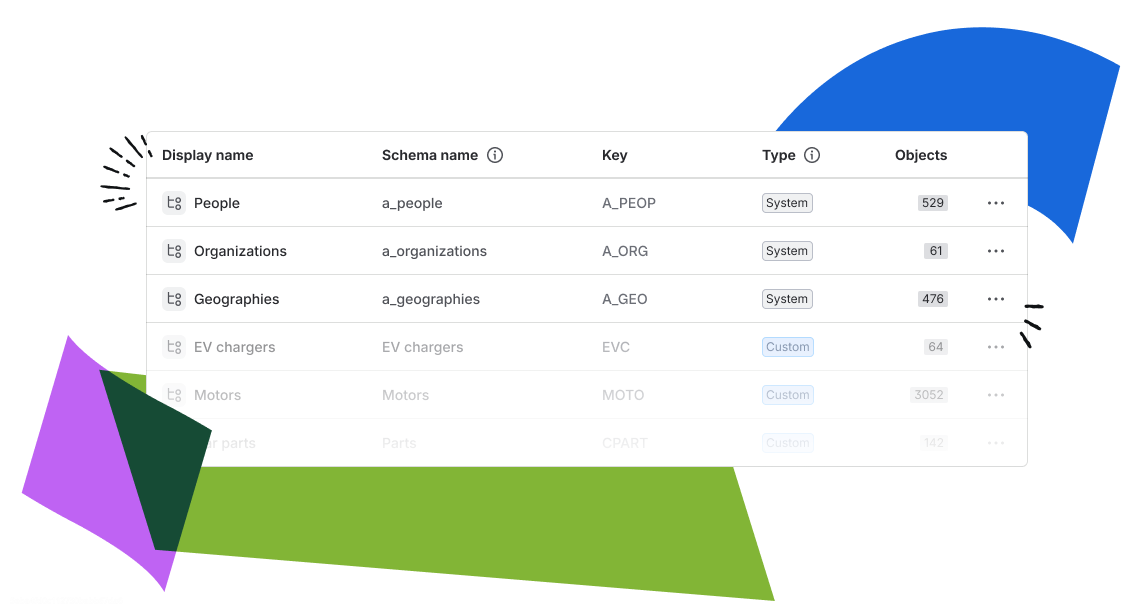
Each object type ships with rich, predefined attributes, including serial numbers and asset tags, warranty dates, depreciation fields, rack locations, OS versions, management platforms, and physical condition tracking. These are just examples of attributes to help you manage and track the asset and service configuration management process and support enterprise service management. Learn about other out of the box schemas.
Display name attribute
Display name attribute is the human-friendly label that determines how each object appears across Assets; in object lists, search results, references, and anywhere an object is linked from a Jira Service Management issue.
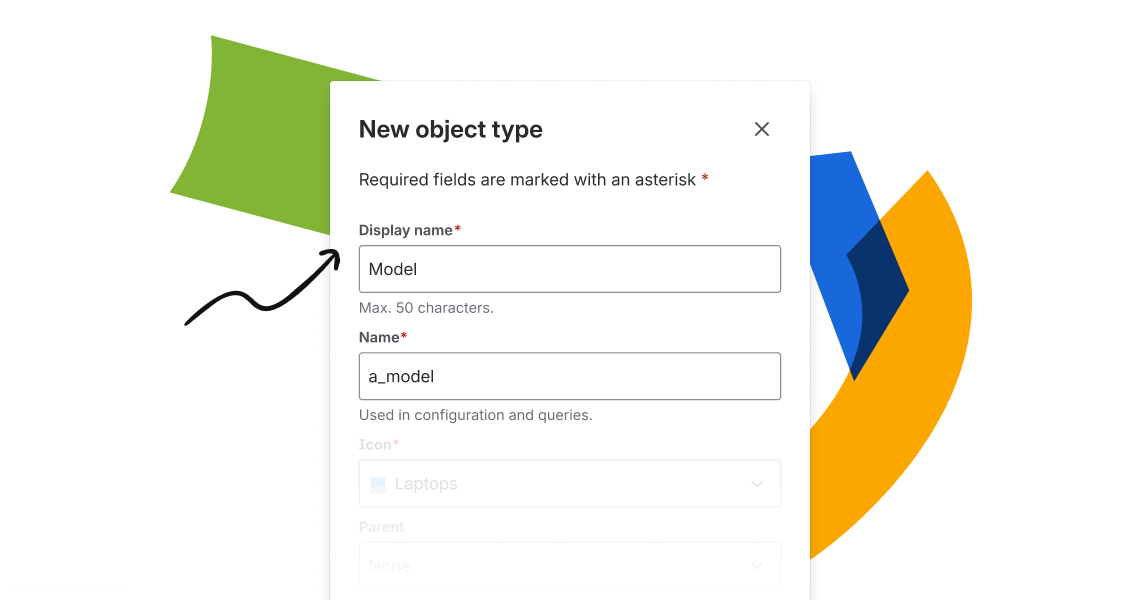
Instead of relying on a single field, you can configure Display Name as a combination of attributes (for example, Hostname + Serial Number, or Model + Owner), so every object surfaces the context that actually matters to your team at a glance. This makes objects far easier to identify, disambiguate, and reference, no more guessing which "Laptop-001" you're looking at.
As part of this EAP and in general, we'd love your feedback on how flexible the Display Name configuration feels for your real-world object types.
Who is eligible and how to sign up for the Common Data Model Open Beta?
To participate in the CDM Open Beta, your Atlassian site/environment must be on a Service Collection Standard+ plan. If you are on the required plan, submit the opt-in request to enable CDM through the portal here.
Once submitted, you will receive updates at the email address you provided. After enablement, your project or site admin can activate CDM through Assets settings.
What happens to existing schemas?
If your environment is currently on a custom schema structure, don't worry!! We have designed the CDM to coexist with your existing custom schemas. Activating CDM creates new system schemas alongside your current setup; it does not modify or overwrite your existing data.
Have questions or feedback?
If you have any questions about CDM, the Open Beta, or your eligibility, please comment below or submit a request here.
Want to see Assets in action? Check out an upcoming webinar with Atlassian Williams F1 Racing!


