I want the form to open already pre-filled with the data from the Jira issue.
That’s it. That’s the whole request.
And yet… it turns out to be weirdly complicated.
Here’s the situation most of us run into.
A work item gets created automatically — maybe from an intake form, maybe from an API, maybe from automation running in the background. The issue looks good. Summary is there. Description is filled out. Due date, budget, custom fields — all neatly populated.
So far, so good.
Then the workflow hits the human step.
The issue moves to Review or Waiting for Approval, and now you need someone to confirm something. A manager. A stakeholder. A customer.
You send them a form.
And that’s when the friction starts.
The Blank Form Problem
The form opens… completely empty.
Even though all the information already exists in the Jira issue.
So now:
-
The approver retypes the budget.
-
The customer retypes the description.
-
The manager copies the due date from the email.
It feels unnecessary because it is unnecessary.
And if you're the admin, it gets worse:
-
You sometimes have to manually open the issue just to prepare the form.
-
You save it as a draft so it becomes shareable.
-
Your automation can send an email — but it can’t carry the issue context into the form.
The workflow looks automated on paper, but in reality, it breaks right before the important part.
Why This Happens
Jira Service Management forms are solid inside the portal.
Jira Automation is powerful.
But when you try to connect them in a dynamic way, you hit a wall.
Forms don’t automatically “know” anything about the issue when opened externally.
They don’t inherit data.
They start from zero.
There’s no built-in way to say:
“Take what’s already in this work item and show it in the form.”
So admins start digging into community threads about URL prepopulation, smart values, draft workarounds, and all kinds of creative hacks.
Because what you actually want isn’t just a form link.
You want a form that already understands the issue.
How to Make the Form Arrive Already Knowing the Answers
If your goal is:
When someone clicks the form, it should already be filled with the data from the Jira work item.
You can build that flow using Smart Forms for Jira together with Jira Automation.
Here’s what that actually looks like in practice.
Phase 1: Prepping the "Dynamic Receivers"
Inside the Smart Forms builder, you don’t just build fields; you build placeholders. For any field you want pre-filled (Summary, Budget, Due Date), you simply insert a placeholder like: {summary} or {budget}.
These fields act as "receivers." You can even hide them from the user's view if you want to keep the UI clean while still capturing the data in the background.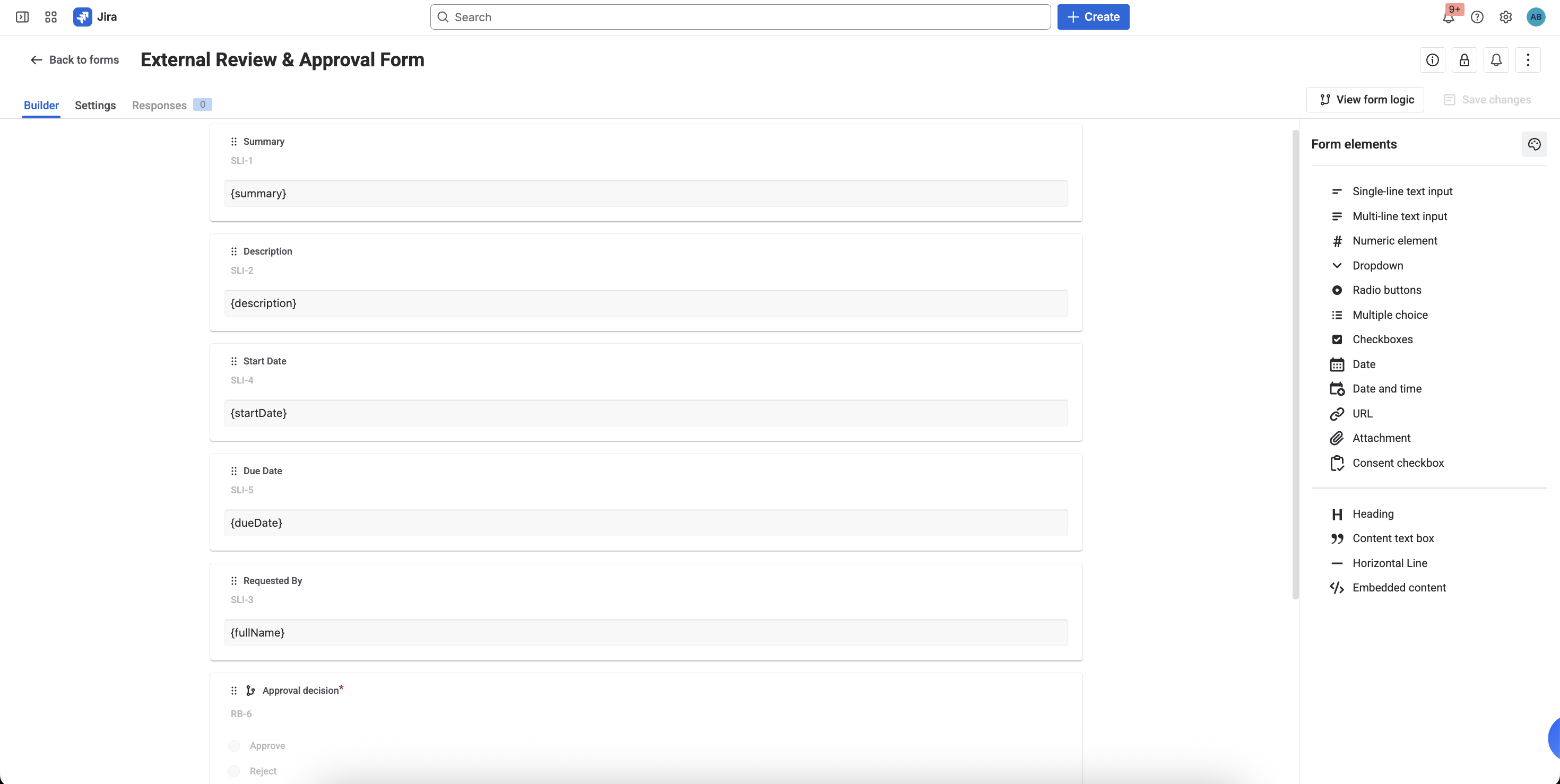
Phase 2: Zero-Touch Attachment
Forget saving drafts. Smart Forms allows you to:
-
Auto-attach forms based on issue type.
-
Generate secure URLs instantly. The moment the work item exists, the form is ready to go—no manual prep required.
Phase 3: The "Magic" Automation Rule
This is where the friction disappears. You set a trigger—like a status changing to "Waiting for Approval"—and use a standard Jira "Send Email" action.
By appending URL parameters to your form link, you’re essentially "injecting" Jira data into the form: ...&summary={{issue.summary.urlEncode}}&budget={{issue.budget}}<span class="lia-inline-image-display-wrapper lia-image-align-inline" image-alt="Screenshot 2026-02-11 at 19.12.32.png" style="width: 999px;"><img src="https://us.v-cdn.net/6038660/uploads/images/423710iC973F1C699DE403B/Screenshot%202026-02-11%20at%2019.12.32.png" role="button" title="Screenshot 2026-02-11 at 19.12.32.png" alt="Screenshot 2026-02-11 at 19.12.32.png"></span>
When the stakeholder clicks, they don’t see a blank page. They see a personalized, pre-populated form that requires 80% less effort to complete.
Phase 4: Update Work Item Fields After Submission
This is typically the step where teams expect the workflow to continue — but in many setups, it doesn’t.
With Smart Forms, you can configure the form so that after submission it:
In practice, this means:
-
An approval selection can update an Approval Status field
-
A confirmed date can update the Due Date
-
A revised budget can update a custom field
-
A CSAT rating can populate a Satisfaction Score field
-
An “Approved” response can move the issue to the next workflow step
This removes the need to manually copy values from the form into the issue, or to build an additional automation rule just to sync the response.
Instead of treating the form as a separate data collection step, it becomes part of the actual workflow. The submission directly affects the work item — which is usually what teams expect when they’re designing approval, confirmation, or survey processes inside Jira.
Where This Actually Changes Your Workday
| Use Case |
The "Smart" Difference |
| Finance Approvals |
Approvers see the Budget and Project Scope pre-filled. They just hit "Approve." |
| CSAT / NPS |
The survey already knows the Ticket ID and Customer Name. Higher completion rates, zero confusion. |
| Change Management |
Deployment Dates and Impact Scopes are pulled from the ticket. Stakeholders just validate. |
| HR Onboarding |
New hires confirm Start Dates and Equipment that are already listed on the form. |
The Bottom Line
This isn't just about saving a few keystrokes. It’s about process integrity. By moving from static forms to Context-Aware Forms, you eliminate manual draft preparation, stop duplicate data entry, and finally close the gap between Jira’s "brain" (automation) and its "hands" (collaboration).
That is the difference between sending a link and sending a solution.


