Forms for Jira makes data collection simple—but the real transformation begins when that data fuels automation.
Whether you're a Jira Software user managing sprint planning, or an HR lead using Jira Work Management to onboard new hires, mapped form fields (converted into Smart Values) unlock a new layer of efficiency.
Let’s break down practical automation use cases by department and show how to map form fields for maximum workflow value.
What Are Smart Values and Why Do They Matter?
Smart Values are dynamic references that pull live data from Jira issues into your automation rules. They allow you to make decisions, send custom notifications, and update fields—all automatically.
When paired with Smart Forms for Jira, form data submitted by users is seamlessly mapped into Jira issue fields and immediately available for use in automations via {{issue.fields.<fieldName>}}.
Getting Started with Smart Form Field Mapping
Step 1: Design your Smart Form
Step 2: Map fields to Jira issue fields
Step 3: Leverage Smart Values in Automations
Auto-Sharing Form Links in Automation
To include a direct link to a Smart Form in your Jira automation (e.g., in email notifications), the form must be attached to the issue. This can be done manually or automatically using auto-attach rules.
Enabling Auto-Share and Auto-Attach
-
Smart Forms generate a unique, shareable URL as soon as they are added to a Jira issue.
-
To auto-attach a form to an issue type (e.g., for customer requests), go to the Smart Forms settings and configure Auto-Attach based on Project and Issue Type.
Smart Value to Use in Automation
<span>{{#issue.properties."saasjet.forms.formsSharedUrls"}}
{{#if(equals(formName, "Your Form Name"))}}{{url}}{{/}}
{{/}}</span>
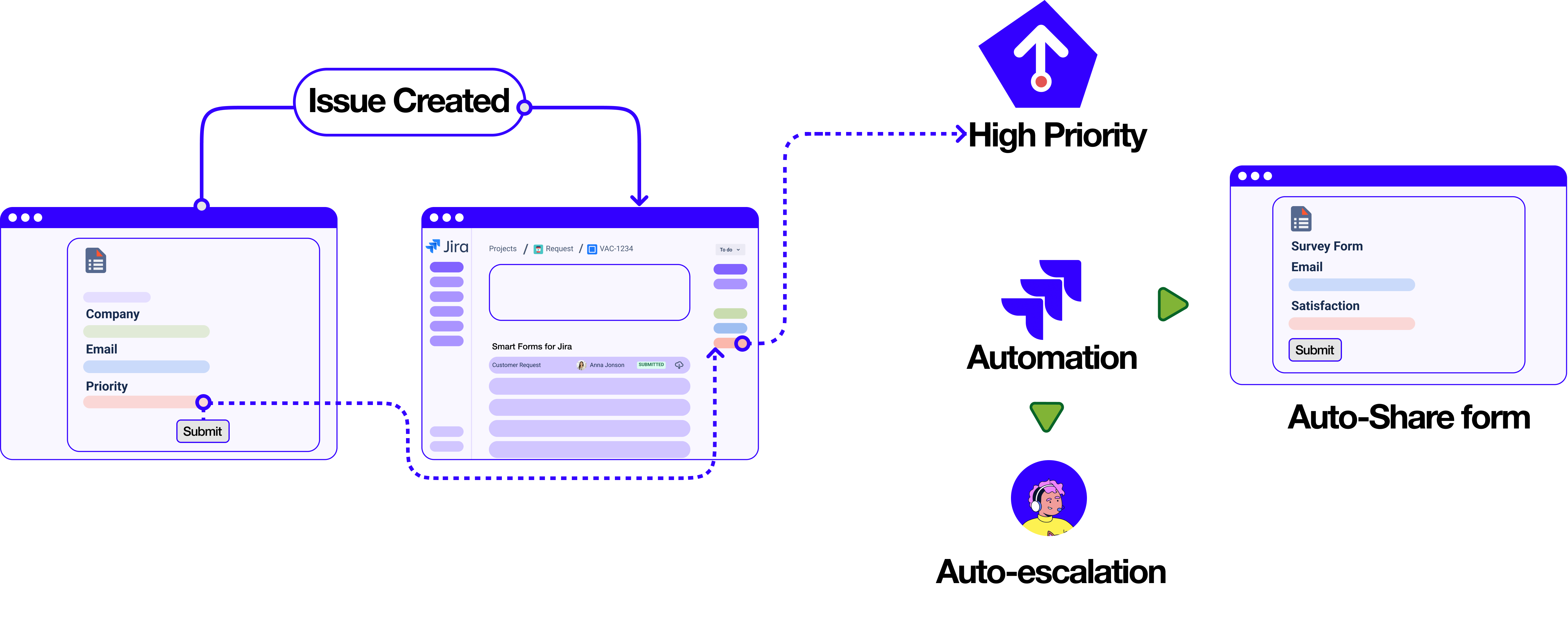
Use Case 1 – Product Teams: Auto-Assign and Notify Based on Feature Requests
Scenario: A product manager collects feedback via a feature request form. The form includes a field for product area (e.g., Mobile, Web, Backend).
Mapped Field: Product Area → Custom field Product Component
Automation Rule:
Use Case 2 – IT Helpdesk: Route Tickets by Department and Severity
Scenario: IT team uses a form to intake internal tech requests with fields like “Department” and “Urgency”.
Mapped Fields:
Automation Rule:
-
Trigger: Issue created
-
Condition:
-
Action:
Use Case 3 – HR Teams: Automate Employee Onboarding Tasks
Scenario: HR submits an onboarding form with fields like “Role Type”, “Start Date”, and “Manager Email”.
Mapped Fields:
Automation Rule:
-
Trigger: Issue created
-
Actions:
-
Create sub-tasks (e.g., "Create Laptop Account")
-
Send onboarding checklist to {{issue.Manager Email}} include the link of Smart Form with onboarding checklist
-
Set issue due date as {{issue.duedate.minusBusinessDays(3)}}
Use Case 4 – Customer Success: Feedback Collection Based on Status and Auto-share satisfaction survey
Scenario: A form captures customer feedback post-resolution. Data like “Satisfaction Level” and “Contact Email” are critical.
Mapped Fields:
Automation Rule:
Bonus Flow: To ensure forms are added and shared properly:
-
Configure feedback form to auto-attach to the "Customer Request" issue type.
-
When the issue is created, the feedback form is added automatically.
-
Use automation to send the survey form URL using the smart value as shown above.
Use Case 5 – Legal or Compliance Teams: Auto-Route Form-Based Approvals
Scenario: A compliance request form includes fields like “Region”, “Regulatory Type”, and “Due Date”.
Mapped Fields:
-
Region → Custom field
-
Regulatory Type → Labels
-
Due Date → Jira Due Date
Automation Rule:
Additional Smart Form Features to Enhance Automations
| Feature |
Benefit in Automation |
|---|
| Conditional Logic |
Show/hide fields dynamically to gather relevant info |
| External Sharing |
Intake from users outside Jira (vendors, partners) |
| Anonymous Submission |
Allow surveys or feedback without identity barriers |
| Pre-fill Fields |
Use existing issue fields to pre-populate form values |
| File Upload |
Automate file or screenshot intake attached to work item |
 Smart Tips for Building Automation-Ready Forms
-
Name fields logically so their mapped field names are recognizable in Smart Values
-
Keep form field types consistent with their destination Jira fields
-
Use help text and validation to avoid bad inputs that break automations
-
Use test issues to preview how values map and resolve in automation previews
Final Thoughts
Whether you're leading product strategy, running support, or managing cross-functional projects—your form data shouldn't live in isolation. With Smart Forms for Jira and field mapping, every response becomes a trigger for action.
By combining Smart Values with powerful automation and auto-shared form links, you're not just collecting data—you’re launching workflows.
Ready to start building smarter workflows from form submissions? → Try Smart Forms for Jira Cloud and Data center today.
Q&A
Question: What are Jira Smart Values and how do Smart Forms make them useful for automation?
Smart Values are dynamic references to live issue data that you can use in automation conditions and actions. When you map Smart Form fields to Jira issue fields, submitted form data is immediately available to rules via issue fields (for example: {{issue.priority.name}}, {{issue.duedate}}, or {{issue.customfield_XXXXX}}). This lets you auto-assign work, send tailored notifications, update fields, and drive decisions without manual updates.
Question: How do I map Smart Form fields to Jira fields and reference them in rules?
- In the form builder, use “Create New Work Item” to create an issue and map each form question to a Jira system or custom field (for example, map “Urgency” to Priority, “Start Date” to Due date, “Department” to a custom field).
- In automation, reference the mapped values with Smart Values such as {{issue.priority.name}}, {{issue.duedate}}, {{issue.Department}}, or {{issue.customfield_XXXXX}} (custom fields can be referenced by name or by their customfield ID).
- Design forms with structured fields (priority, dates, emails, labels) so values cleanly map and resolve in rules.
Question: How can I include a direct link to a Smart Form in an automated email or comment?
You can place the form link manually to your automation rule or automatically. For automatic form including in the rule the form must be attached to the issue first. Enable Auto-Attach in Smart Forms settings (by Project and Issue Type) so new issues get the form automatically. Then, use the shared-URL Smart Value in your automation content: {{#issue.properties."saasjet.forms.formsSharedUrls"}} {{#if(equals(formName, "Your Form Name"))}}{{url}}{{/}} {{/}} Smart Forms generates a unique, shareable URL as soon as it’s added to an issue, so your emails, comments, or Slack messages can include a live link to the correct form.
Question: What are some practical automation examples by team?
- Product: If Product Area (mapped to a custom “Product Component”) is “Mobile,” auto-assign to the Mobile lead and post to the #mobile-roadmap Slack channel.
- IT Helpdesk: Route Finance + High priority tickets to a senior agent and email the IT manager.
- HR: On issue creation, create onboarding subtasks, email the onboarding checklist to {{issue.Manager Email}}, and set due date to {{issue.duedate.minusBusinessDays(3)}}.
- Customer Success: When Status = Resolved and Satisfaction = Low, notify the CSM and send a follow-up survey to {{issue.Contact Email}}; auto-attach and auto-share the survey form.
- Legal/Compliance: If Region = EU, set Priority = High, notify the EU Compliance team, and schedule a reminder 3 days before {{issue.duedate}}.
Question: Any tips and features to make forms more automation-ready?
- Smart tips:
- Name fields clearly so their Smart Values are recognizable.
- Keep form field types aligned with target Jira fields (dates to dates, selects to labels, etc.).
- Use help text and validation to prevent bad inputs.
- Test with sample issues to confirm values resolve in rule previews.
- Helpful features:
- Conditional logic to show/hide fields and collect only relevant data.
- External sharing for intake from vendors/partners.
- Anonymous submission for surveys/feedback.
- Pre-fill to pull existing issue values into the form.
- File upload to capture attachments and process them in automations.


