Hello there!
I’m Elena from Communardo Products. With Atlassian moving apps from Connect to Forge, we’ve seen a lot of questions and uncertainty around what this actually means in practice. So I put together a short, straightforward guide to explain Forge, the upcoming timeline, and what vendors and customers should be aware of.
TL;DR
Atlassian Forge is the cloud app platform that replaces Connect, offering a secure, serverless environment with standardized security, performance, and governance. Starting in September 2025, all new Marketplace apps must be built on Forge, and Connect support will fully end by late 2026. For vendors, this means lower operational overhead, more predictable updates, and opportunities to innovate within a managed ecosystem. For customers worldwide, it translates to reliable apps, clear permissioning, and a consistent experience across regions. Forge isn’t just a technical change; it’s a strategic shift shaping the future of the Atlassian Marketplace globally.
A Strategic Foundation
Forge is Atlassian’s cloud app development platform: a serverless, security-first environment designed to simplify infrastructure, standardize integrations, and improve governance. Unlike Connect, which relied on vendor-managed hosting and varied deployment practices, Forge provides a centralized runtime and a standardized framework that benefits both developers and users.
Forge’s design reflects a broader trend in enterprise software: platforms are increasingly responsible not just for functionality, but for security, performance, and overall ecosystem health. By controlling runtime, Atlassian can proactively ensure apps remain performant, compliant, and safe, which is increasingly critical as organizations worldwide adopt cloud-first strategies.
The three principles highlighted in this infographic summarize Forge's core philosophy and explain why vendors and customers alike benefit from adopting it.
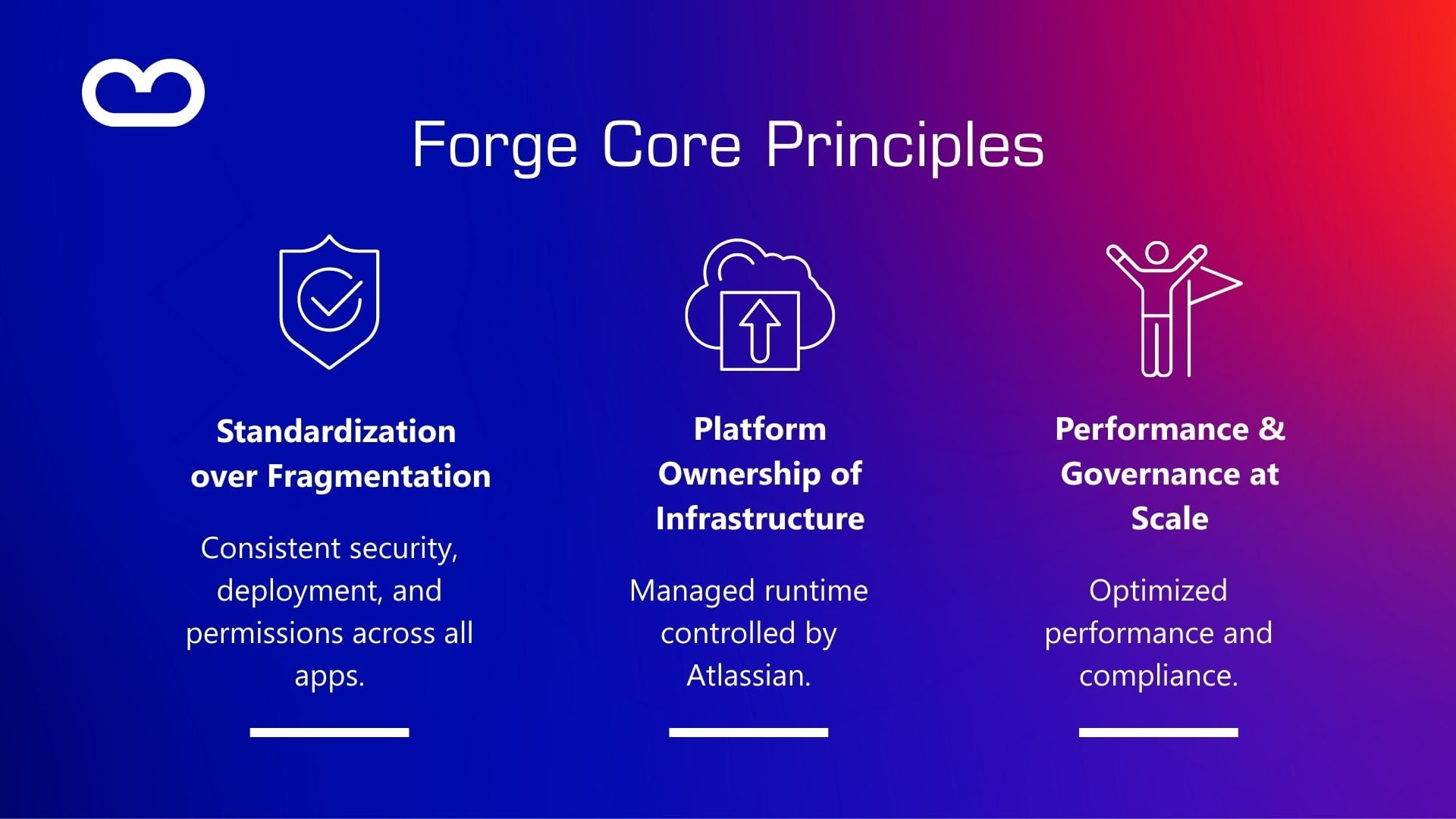
Step 1 – Standardization over Fragmentation
Forge enforces a unified framework for app development, meaning every app adheres to consistent security practices, deployment methods, and permission models. For vendors, this reduces the complexity of supporting multiple environments and ensures apps behave predictably across Jira, Confluence, and other Atlassian apps. For customers, it means a more reliable experience, fewer unexpected issues, and confidence in enterprise security compliance.
Step 2 – Platform Ownership of Infrastructure
Forge shifts the responsibility for hosting, runtime, and core infrastructure from vendors to Atlassian. By running apps in a managed, serverless environment, vendors no longer need to maintain complex cloud environments or worry about scaling and uptime. This not only saves time and operational costs but also ensures that apps benefit from Atlassian’s global infrastructure, providing consistent performance for customers regardless of location.
Step 3 – Performance & Governance at Scale
By operating inside its own controlled runtime, Forge allows Atlassian to optimize app performance and enforce governance consistently across the ecosystem. Vendors can focus on delivering meaningful features without worrying about cross-version compatibility or security drift, while customers experience faster, more reliable, and more compliant apps that integrate easily into their workflows.
Together, these three principles illustrate how Forge simplifies development, strengthens trust, and sets the stage for a higher-quality Atlassian Marketplace, ensuring a better experience for everyone involved.
The End of Connect and Migration Timeline
The Connect framework, previously used for many Jira and Confluence apps, is being phased out:
Starting September 17, 2025, all new cloud apps must be Forge-only.
Beginning March 2026, Connect-based Marketplace apps cannot be updated unless migrated to Forge.
By Q4 2026, Connect will no longer be officially supported.
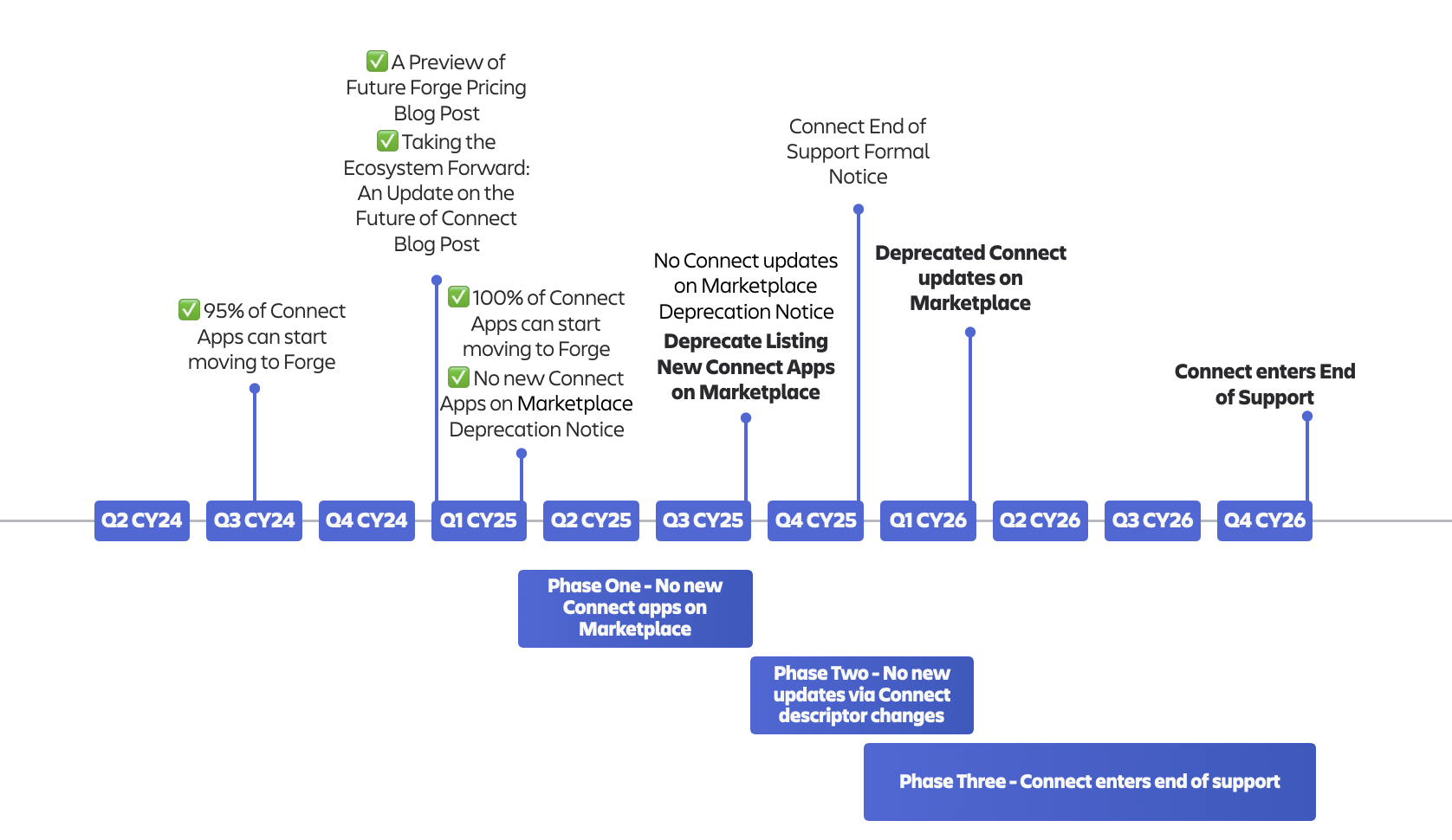
Image courtesy of Atlassian
Vendor & Customer Perspective: Opportunities in Forge
While Forge imposes some constraints compared to Connect, these limitations often drive innovation and quality.
Below is a summary of the benefits for both vendors and customers:
|
|
|
|
|---|
|
Operational Overhead
|
Reduced (no server management)
|
-
|
|
Security & Compliance
|
Scoped permissions & sandboxed runtime
|
Trusted, auditable apps
|
|
Release Predictability
|
Less breakage across Atlassian updates
|
Stable experience
|
|
Innovation Focus
|
Focus on value & UX
|
Better, native-feeling integrations
|
Beyond operational efficiency, Forge encourages vendors to focus on delivering real value to users instead of managing infrastructure or wrestling with fragmented deployment models. For customers, these benefits translate into a more consistent, reliable, and trusted Marketplace experience.
Conclusion: Why Forge Shapes the Future of 3rd Party Apps
Forge represents Atlassian’s strategy to unify the cloud app ecosystem. By controlling both runtime and experience, Atlassian ensures apps are secure, scalable, and performant.
For vendors, Forge is an opportunity to innovate within a standardized, secure, and globally scalable environment, giving early adopters a competitive advantage. For customers, Forge delivers predictability and confidence. Enterprise IT teams can adopt apps knowing they meet security and compliance requirements, while teams enjoy a consistent user experience across Jira, Confluence, and other Atlassian products.


