A practical ROI model for QA leaders evaluating agentic test execution on top of Jira Cloud and Xray.
TL;DR
-
Agentic test execution targets a specific QA cost pool: automatically running existing manual test cases or Gherkin scenarios with agentic AI. No scripting, no locators.
-
This article gives you: (1) a five-bucket cost map for QA, (2) a usage-based ROI model with a worked example, and (3) a four- to eight-week pilot plan to run inside Xray.
-
A free Excel ROI calculator implementing the model is available. DM me on LinkedIn.
Why ROI is the right first question
“What's the ROI?” It is usually the first question asked when AI tooling enters the QA budget conversation.
Agentic AI test execution changes the cost profile of one specific activity: executing existing manual and Gherkin test cases. The business case needs a model QA leaders can test in their own environment, rather than generic claims like “save 80% of your time.”
In earlier articles, I covered how agentic test execution works inside Xray, how it complements AI-assisted scripting, and how QA teams can build trust through reliability, clarification loops, and transparency.
This article focuses on the business side: which cost pools agentic execution targets, how to build a defensible ROI model, and which pilot metrics support the case.
Disclosure: I am co-founder of Smartesting, the company behind Lynqa.
AI in software development
Recent industry research, including DORA, GitHub Copilot studies, and the World Quality Report, converges on the same finding: AI improves productivity, but the gains vary widely across teams and depend on inputs, process maturity, and adoption discipline.
To determine the ROI of integrating AI into a phase of the software development lifecycle, we need to look at the details:
-
Which cost pool are we targeting?
-
What part of the test scope is actually addressable?
-
How much human review remains necessary?
-
What new costs appear?
-
What evidence will convince the team after a pilot?
What agentic test execution targets, and what the Xray integration unlocks
Agentic test execution runs existing manual or Gherkin test cases directly on the application interface. Instead of relying on scripts or locators, the agent reads the test steps, interacts with the GUI like a tester would, verifies expected results, and produces step-by-step evidence for human review.
Earlier article on how it works: Agentic Test Execution in Xray.
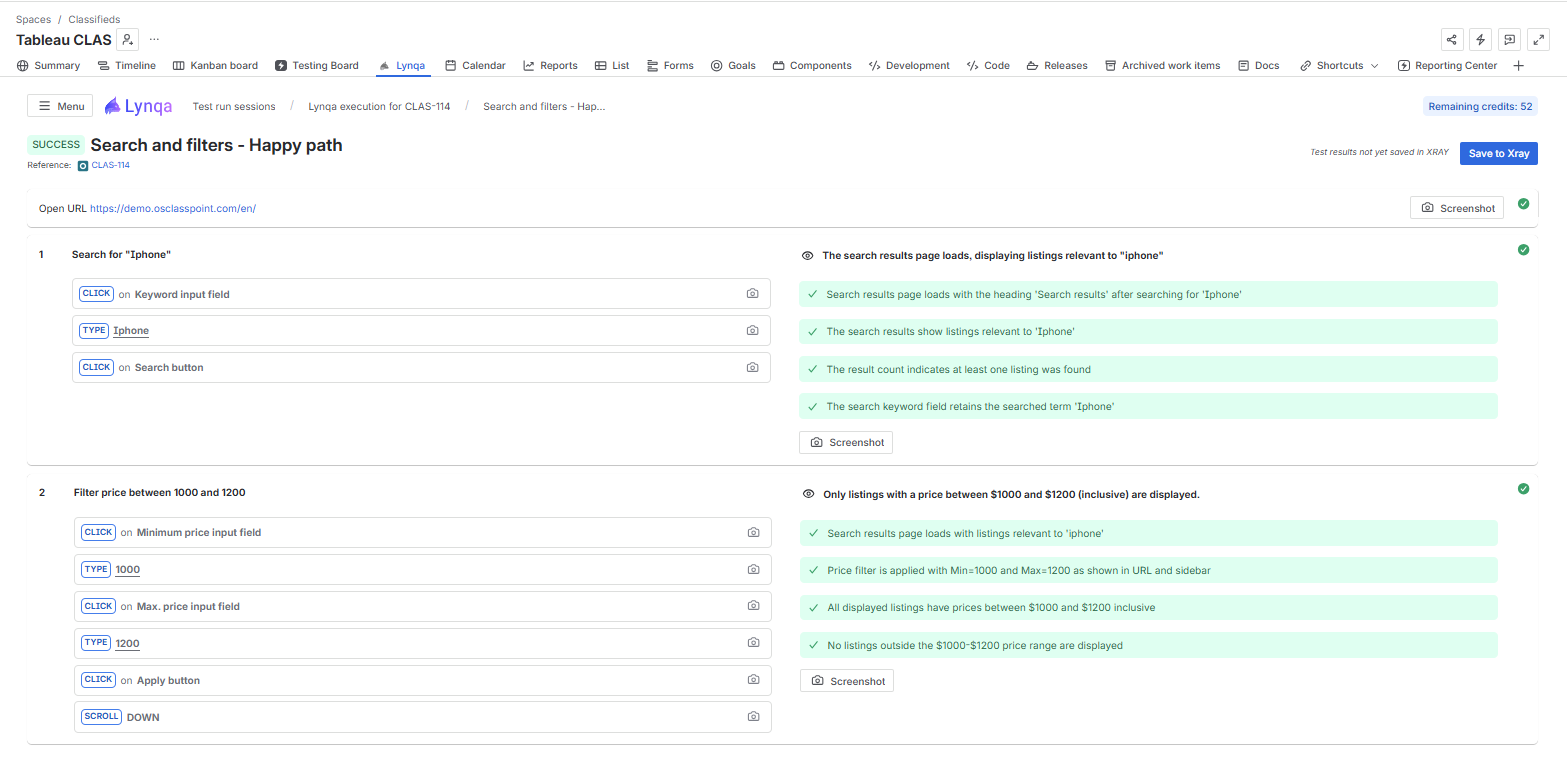
Figure: Lynqa agent executing a manual Xray test, with step-by-step evidence rendered.
Manual execution still dominates QA capacity
In tech-native companies, automation coverage can be high. In business-software environments and enterprise IT, manual execution often remains dominant, especially for end-to-end workflows, complex user journeys, and applications where scripted automation is expensive to maintain.
Manual test repositories are valuable but passive
Most QA teams sit on years of accumulated manual test cases. These tests are written in natural language, refined through product evolution, and enriched by incident learnings. They contain a great deal of business and product knowledge; yet in many teams, they remain passive assets: useful as documentation and expensive to run repeatedly.
Agentic test execution makes these assets executable as-is. No scripting. No locators. No rewriting into a framework before value can be captured. That is the business opportunity: changing the economics of repetitive execution while keeping QA ownership and judgment in place.
Why the Xray angle matters
For Xray teams, the value is sharpened by the fact that the test cases, executions, and evidence already live next to the development workflow. Lynqa for Xray runs those existing manual or Gherkin tests as-is and feeds the results back into the same Xray screens the QA team already uses. There is no second tool to integrate, no test export, no separate evidence store.
The five cost buckets QA actually pays for
A useful business case starts by mapping what QA actually pays for today. Most ROI conversations stop at the first bucket. The real value is often in the others.
| Cost bucket |
What it means |
How to measure it during a pilot |
|---|
| Direct execution cost |
FTE hours spent running manual test cases, release after release |
Manual execution hours avoided on the addressable subset |
| Automation maintenance debt |
Time spent fixing scripts, locators, test data, and fragile automation after product changes |
Maintenance hours or automation tickets avoided for tests no longer requiring scripts |
| Release pressure cost |
Coverage reductions, rushed testing, and incomplete evidence near the release deadline |
Test backlog remaining at release cutoff, delayed releases, skipped tests |
| Quality cost |
Escaped defects, support load, customer impact, and rework |
Defect detection parity, escaped defects, and severity of missed issues |
| Opportunity cost |
Skilled testers spending time on repetitive execution instead of higher-value work |
Tester hours reallocated to exploratory testing, design, risk analysis, or review |
Most QA budget conversations focus on direct execution cost. A complete business case includes all five. Agentic test execution creates value across several line items. The direct productivity gain is the easiest to calculate. The strategic gain often comes from better release confidence, more complete evidence, reduced maintenance burden, and more tester time spent on judgment-intensive work.
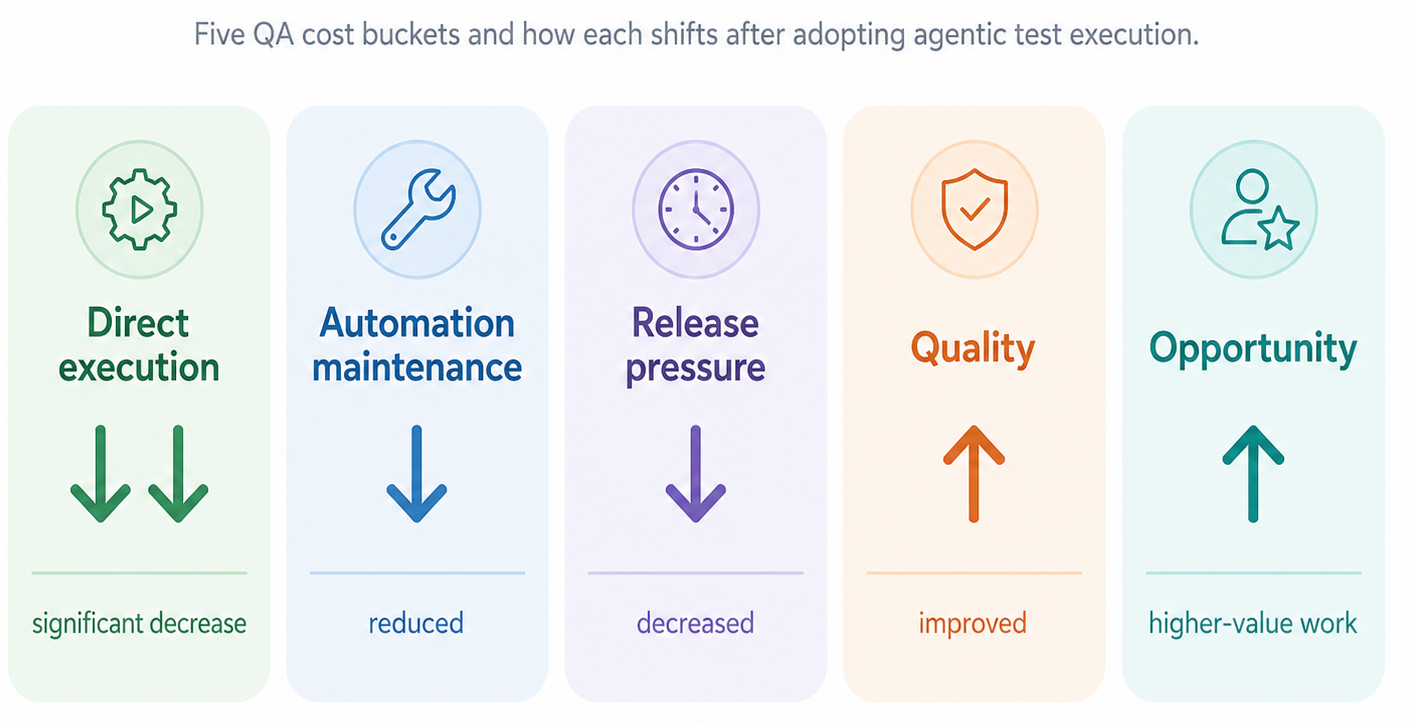
How agentic test execution shifts the cost profile
| Cost bucket |
Direction |
What changes |
| Direct execution |
↓↓ |
Significant decrease on the addressable scope |
| Automation maintenance |
↓ |
Eliminated or reduced for tests that no longer require scripting |
| Release pressure |
↓ |
Decreased through additional execution capacity and parallelization |
| Quality |
↑ |
Improved through clearer evidence, transparent execution reports, better clarification of ambiguous results, and more tester time spent on higher-value QA activities |
| Opportunity |
↑ |
Improved as testers move from execution to design, exploration, and critical review |
New cost lines also appear: usage-based credits for the agentic AI platform; human review time, since the QA tester validates results rather than executing every step manually; one-time enablement and change management; and test clarification where business intent or expected results are ambiguous.
The strongest gains typically appear where manual execution still consumes significant QA capacity, scripted automation is difficult to maintain, or release cycles create recurring peaks of testing effort. The more repetitive execution work a team carries out today, the larger the potential gain.
How this differs from other approaches
Agentic test execution is not the only option for cutting QA costs for the test execution phase. It addresses a specific failure mode of each alternative:
-
Mature scripted automation: strong on repeated execution but carries persistent build-and-maintenance debt for tests that change with the UI.
-
AI-assisted test scripting: accelerates writing the script, but you still own the test code, locators, and CI integration.
-
Offshore manual execution: reduces hourly cost but does not increase parallelization or evidence consistency, and adds coordination overhead. Agentic execution is immediately available from Xray, 24/7, without prior outsourcing setup or contract discussion.
Agentic execution complements rather than replaces these, but it is the most direct way to monetize a manual test repository without rewriting it.
A simple ROI model
A practical ROI model for agentic test execution starts with a few visible assumptions: current manual execution cost, addressable test scope, remaining human review effort, cost per agentic test execution, and enablement cost.
Recurring annual savings = baseline manual execution cost - residual human execution/review cost - annual agentic execution cost
Year-1 net savings = recurring annual savings - one-time enablement cost
The main variables are:
-
Number of manual test cases per release.
-
Average execution time per test or per step.
-
Number of releases or test cycles per year.
-
Fully loaded cost of a QA tester: salary or vendor rate, coordination, management, tooling, overhead.
-
Percentage of the manual scope addressable by the agent.
-
Percentage of agent execution time that still requires human review.
-
Non-conformance rate: share of AI-executed tests not accepted by the QA tester and requiring re-execution.
-
Cost per agentic test execution. At Lynqa product launch: $0.97 per completed test execution (≈ €0.89 vendor base price, excl. VAT, at FX €1 = $1.10). Pricing may evolve as the product and packaging evolve.
-
One-time enablement cost.
On the hourly cost assumption
The hourly cost assumption deserves particular attention. Many QA organizations in Europe and North America use a mix of internal testers, nearshore teams, offshore providers, and vendor-managed delivery. A single hourly rate can be misleading.
| Cost assumption |
Typical context |
Fully loaded hourly cost |
| Offshore manual execution |
Outsourced manual testing in lower-cost regions |
$20–35/hour |
| Blended QA delivery |
Mix of internal QA, nearshore delivery, vendor coordination, review |
$40–60/hour |
| Internal or onshore QA |
North America or Western Europe, fully loaded internal cost |
$60–90/hour |
A lower hourly rate reduces direct labor savings. In that case, the business case shifts toward release speed, execution parallelization, evidence quality, reduced coordination, and the ability to reallocate skilled testers to higher-value work. The point is to make assumptions explicit enough that the team can challenge them and replace them with real pilot data.
A worked ROI example you can reproduce
Note on currency: all figures in USD. Lynqa's vendor base price is €0.89 per execution; expressed at the indicative FX rate €1 = $1.10 used throughout this article, this equals $0.97 per execution. The Excel calculator lets you set your own FX rate.
Consider an illustrative QA team of eight testers. The team runs 26 releases per year. Each release includes 120 manual test cases. Each test has 8 steps, and the full execution including verification takes 10 minutes per test.
Baseline
| Calculation |
Formula |
Result |
| Manual hours per release |
120 × 10 / 60 |
= 20 h |
| Annual manual hours |
20 × 26 |
= 520 h |
| Annual manual labor cost |
520 × $50 |
= $26,000 |
The $50/hour figure represents a Blended QA delivery context, a mix of internal QA, nearshore delivery, and vendor coordination, typical of mid-market organizations. At an internal or onshore rate ($60–90/hour), direct-labor savings scale up proportionally. At an offshore rate ($25–35/hour), savings are smaller; speed, parallel execution, evidence quality, and reduced coordination carry more weight in the case.
Agentic execution scenario
-
Addressable share of the manual scope: 70%.
-
Time split on accepted runs: 80% performed by the agent, 20% reviewed by the QA tester.
-
Non-conformance rate: 5%, i.e. about one in twenty tests is not accepted by the tester and is re-executed. Conservative assumption: re-execution counts as 100% of the original manual time, even though Lynqa's evidence partly de-risks the second pass, so true effort is typically slightly lower.
-
Usage-based agentic execution cost: $0.97 per completed execution, excl. VAT.
-
One-time enablement cost: $2k: marketplace install, pilot scoping, baseline measurement, brief team walkthrough. Lynqa runs from a button inside Xray test executions, so no separate tool to learn or formal training to budget.
Effective time on addressable scope
Blended human time on addressable scope = 20% × 95% (review on accepted runs) + 100% × 5% (re-execution on non-conforming) = 24% of the original manual time.
Full reproducible computation
| Step |
Computation |
Result |
| Annual manual hours |
120 × 10/60 × 26 |
= 520 h |
| Addressable manual hours |
520 × 70% |
= 364 h |
| Non-addressable manual hours |
520 × 30% |
= 156 h |
| Human work on addressable (24%) |
364 × 24% |
≈ 87 h |
| Effective manual hours after AI |
156 + 87 |
≈ 243 h |
| Annual labor cost after AI |
243 × $50 |
≈ $12,168 |
| Annual agentic test executions |
120 × 26 × 70% |
= 2,184 executions |
| Annual Lynqa platform cost |
2,184 × $0.97 |
≈ $2,118 |
| Annual cost after AI total |
$12,168 + $2,118 |
≈ $14,286 |
| Annual savings (recurring) |
$26,000 - $14,286 |
≈ $11,714 |
| Year 1 net (after $2k enablement) |
$11,714 - $2,000 |
≈ $9,714 |
| Payback period |
$2,000 / $11,714 × 12 |
≈ 2.0 months |
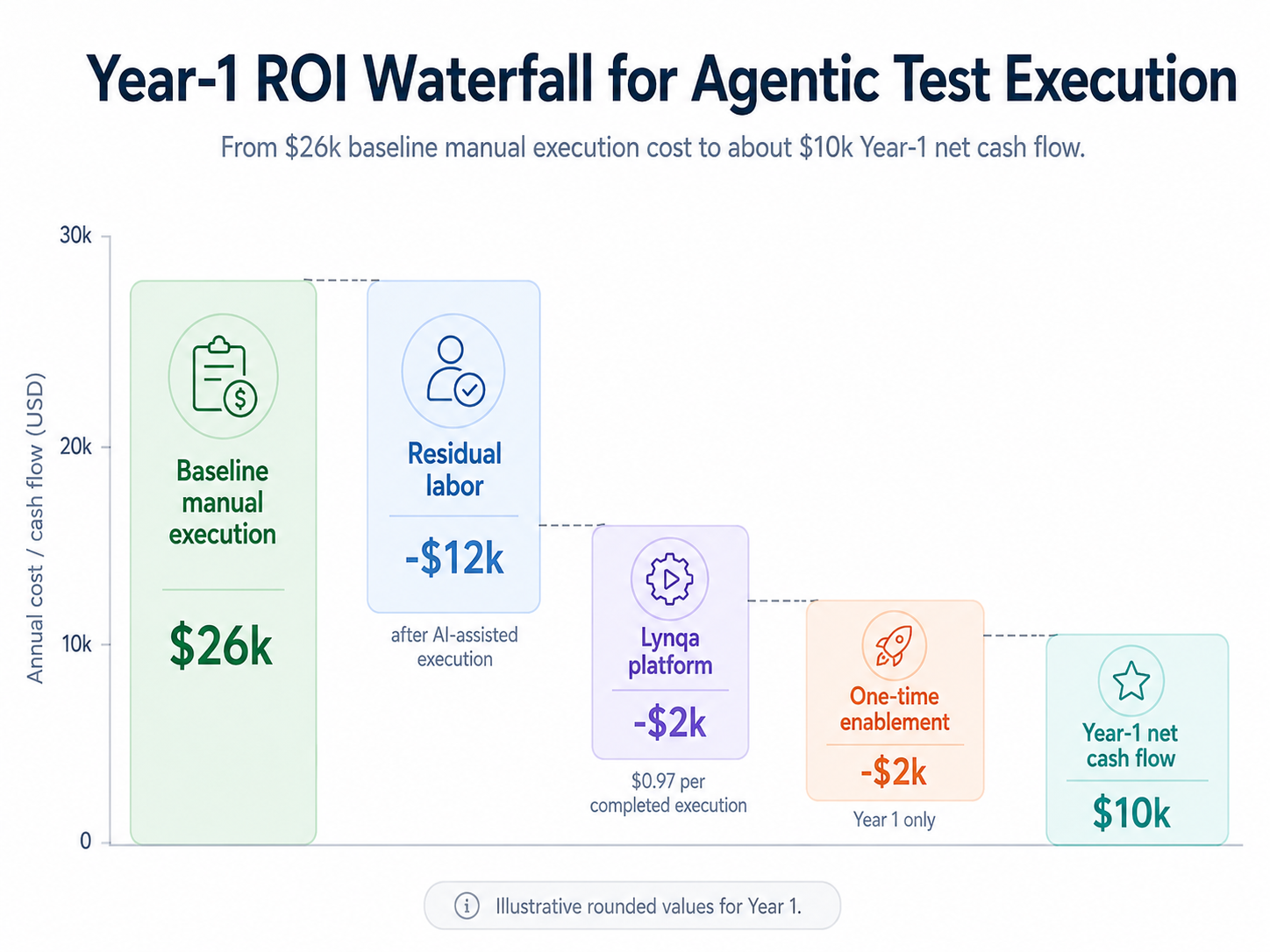
In this example, agentic test execution reduces annual QA execution cost from $26,000 to about $14,300, before one-time enablement. After the $2,000 setup cost, Year-1 net savings are about $9,700, with payback in roughly two months. The value comes from lower residual execution effort, usage-based platform cost, and QA time redirected toward review, analysis, and higher-value testing work.
Note on calculator scope: Our ROI calculator quantifies the first two cost buckets, direct execution and automation maintenance, where assumptions can be made explicit and reproducible. Buckets 3–5, release pressure, quality, opportunity, typically reinforce the case but resist standardization; track them qualitatively during the pilot rather than baking them into the headline number.
What it takes to capture the gains
Four conditions matter for turning model savings into actual savings.
1. A usable test repository
Lynqa does not require hyper-detailed test procedures. It can interpret relatively high-level manual tests, much like a competent nearshore or offshore testing partner would, and can create test data when useful for execution.
The test cases (or Gherkin scenarios) should express the business intent, the expected outcome, and the context a tester would normally need to execute them. Agentic test execution often surfaces places where the intent is ambiguous or where implicit business rules should be clarified. That feedback is useful in itself.
2. A lightweight but consistent review process
Agentic test execution should remain supervised. The QA tester no longer performs every action manually but still validates the result, reviews the evidence, and decides whether the execution can be accepted. Light enough to preserve the productivity gain, consistent enough to maintain trust.
3. A targeted pilot
Start with a representative subset before expanding to the full regression scope. Pick enough diversity to learn something meaningful: common workflows, some edge cases, a few longer end-to-end scenarios. The easiest happy paths overstate the result; the most critical or politically sensitive suite creates unnecessary risk for a first evaluation.
4. An evolving role for testers
The business case goes beyond doing the same work faster. As repetitive execution shrinks, testers can spend more time on test design, exploratory testing, risk analysis, and critical review, where their judgment creates the most value.
If the hours saved simply disappear into more meetings, the transformation has not landed.
If saved hours are reinvested into better testing, the opportunity-cost bucket inverts from a drag into a source of return.
Run a 4–8 week agentic test execution pilot in Xray
A real ROI conversation needs data from your own environment. Start with a representative subset of Xray manual or Gherkin tests, run them with Lynqa, and compare the results with a proper baseline.
Lynqa runs existing tests as-is from Xray, with no scripting and no rewriting. The test case stays in Xray, the execution is launched from Xray, the evidence is reviewed in Xray, and the results feed back into the same QA workflow.
How to set it up
-
Pick representative suites, not only happy paths.
-
Baseline hours, automation coverage, backlog, and escape rate.
-
Run the pilot for four to eight weeks.
-
Review failures carefully, they reveal agent limits and test-specification gaps.
-
Separate one-time and recurring costs, then rerun the ROI model with your own hourly rates and completed execution volume.
What to measure: three KPIs
-
Hours saved per release on the addressable subset. The numerator of the ROI model. Compare manual execution time before and after on the same scope. Include the human review time required for AI-executed tests; otherwise, savings will be overstated.
-
Defect detection parity. Run the agent and a human tester on a comparable scope and compare what each catches. The quality guardrail. A sustainable case preserves defect detection while improving execution capacity. The goal is supervised execution with evidence, not fewer defects found.
-
Tester time reallocated to higher-value work. Measure what the team actually does with the freed-up time. More exploratory testing, better test design, improved risk analysis, faster review of ambiguous failures. This KPI makes the opportunity-cost gain visible.
Together, these three measures capture both sides of the equation: the cost-side gain and the value-side shift.
Four questions a good pilot should answer
-
What share of our manual scope is addressable?
-
How much human review remains necessary?
-
Does defect detection remain at least equivalent?
-
What higher-value work did testers perform with the time saved?
If you can answer those four with evidence, the ROI discussion becomes much more concrete.
Conclusion
The business case for agentic test execution rests on more than one impressive number. It is built on a structured view of where QA spends time today, where agentic AI changes the cost profile, and how a team captures the gains under human supervision.
A serious business case looks beyond the headline savings. It identifies the QA cost buckets that are currently underestimated and uses a pilot to measure changes in the team's own environment.
If the answer is a payback period of a few months, stable defect detection, and a measurable shift in tester capacity toward higher-value work, you have a defensible case.
A pilot may also show that the scope is not yet addressable, review costs are too high, or the test cases need clarification first. That result is useful too. It identifies the real bottleneck.
Related reading
