Community resources
Community resources
Community resources
Rethinking BDD Automation with SpecBinder
a compile-time bridge between Gherkin and Java
Behavior-Driven Development (BDD) has always promised something powerful: readable specifications that double as executable tests.
At its core, BDD is a collaborative process — conversations, examples, shared understanding. Gherkin — a simple language for describing system behavior in Given/When/Then scenarios — plays a key role in that process by capturing those examples in a structured yet readable way.
The closing step of BDD process is automation — turning those same examples into executable tests. Tools like Cucumber, JBehave, and Reqnroll are commonly used for this.
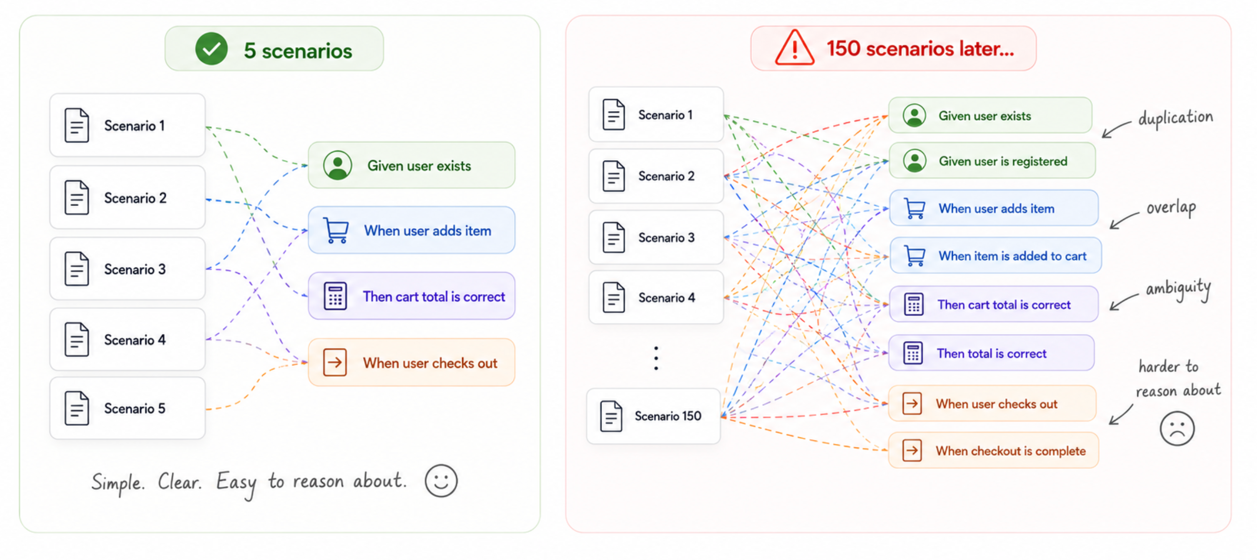
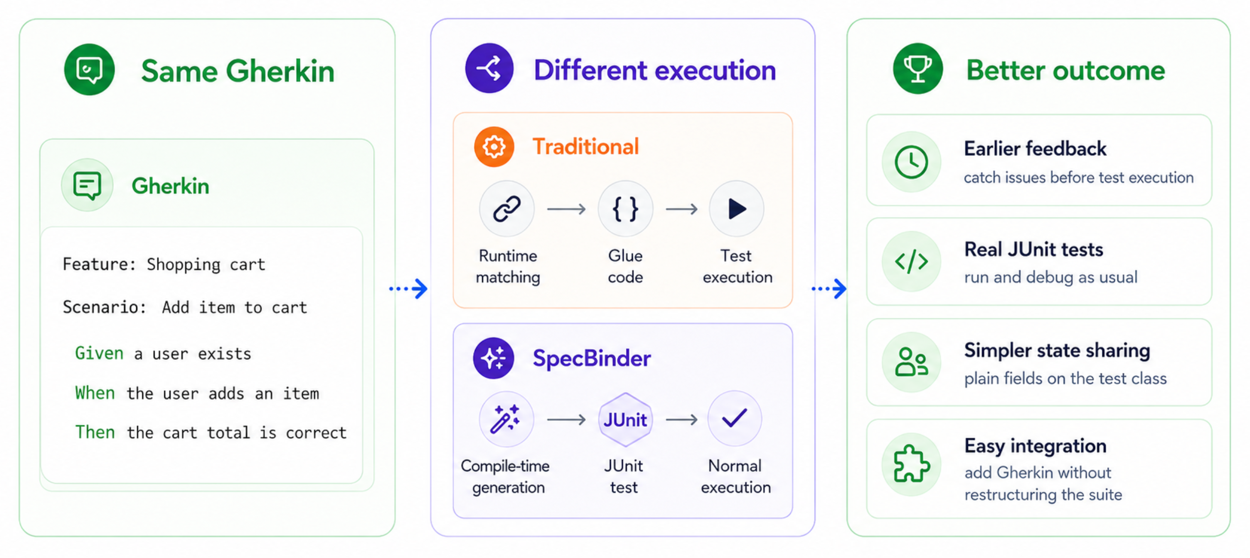
These tools parse the Gherkin text and use pattern (often regular expression) matching to bind each step to executable “glue” code. It’s simple to set up and works well at first—but as the solution grows, familiar challenges start to appear:
-
Step definitions accumulate and become harder to reason about
-
Similar steps appear in slightly different forms
-
Overlapping steps make behavior harder to predict
-
Changes can impact seemingly unrelated scenarios
-
It becomes harder to understand what actually executes
What starts as clarity at the specification level often becomes indirection, fragility, and delayed feedback at the automation layer.
What if Gherkin was processed at compile time?
SpecBinder takes a different approach.
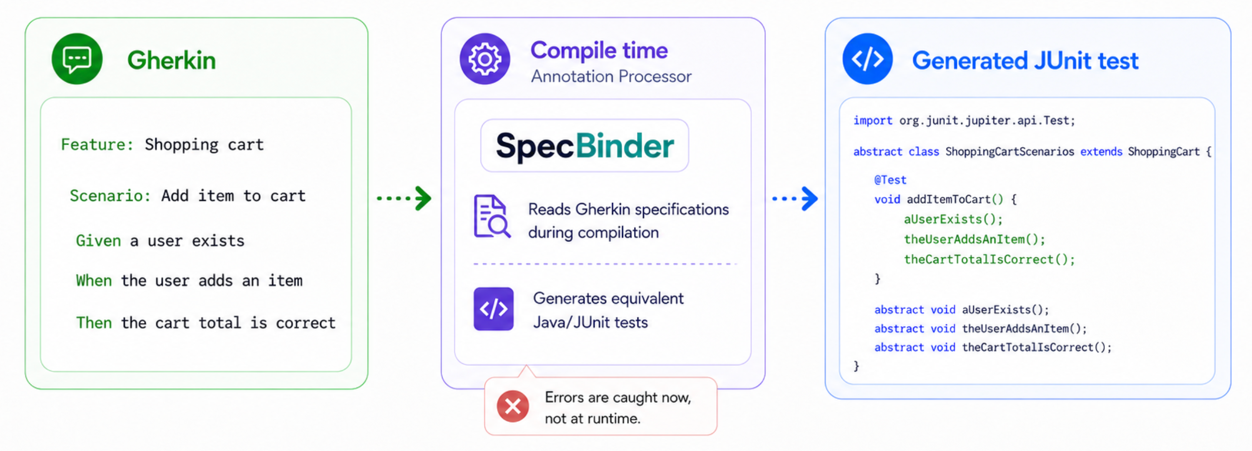
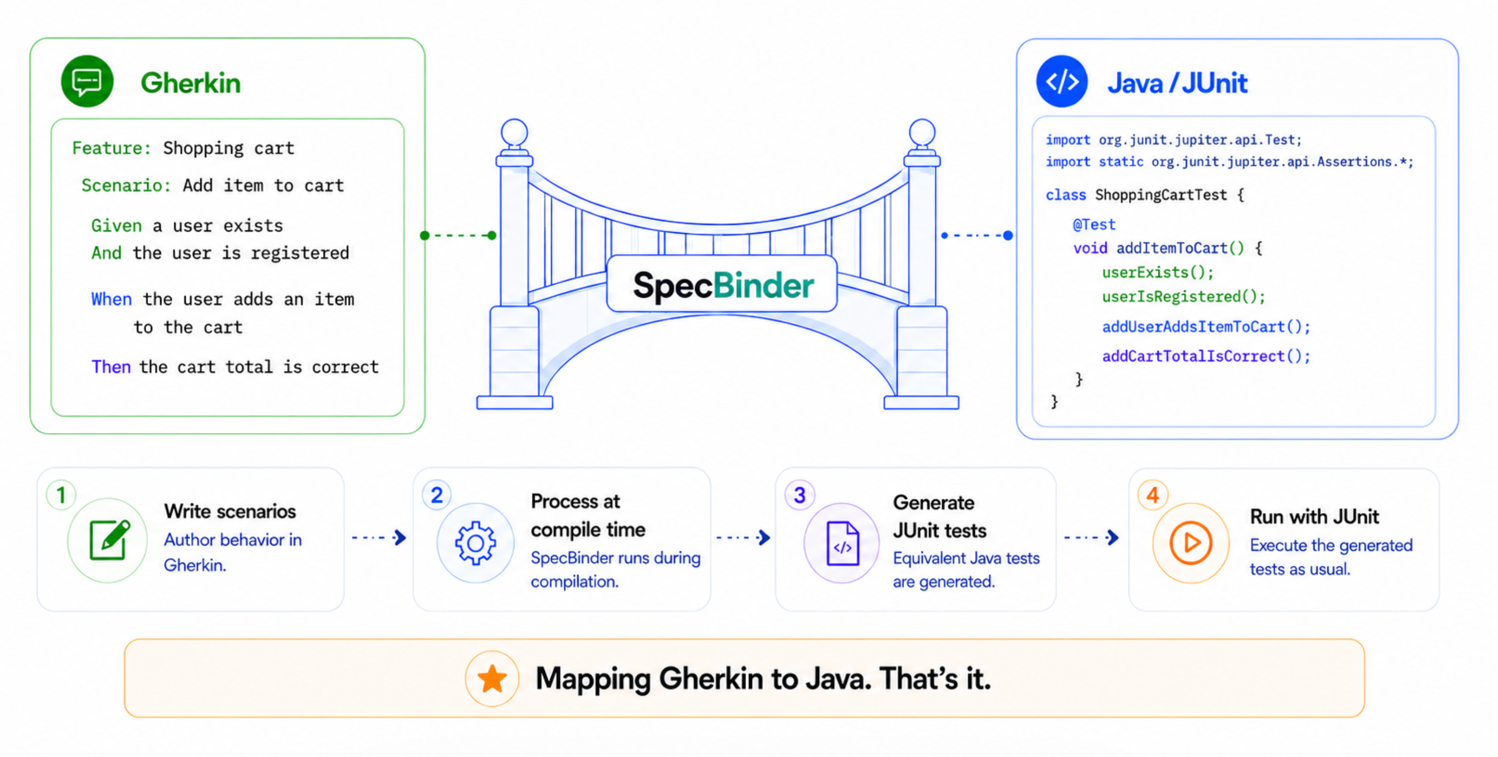
Instead of interpreting Gherkin at runtime, SpecBinder processes it during compilation — generating real JUnit tests from your scenarios.
Each scenario becomes a proper test. Each step becomes a strongly-typed method call.
No runtime binding. No surprises.
Why this changes things
1. Errors surface earlier
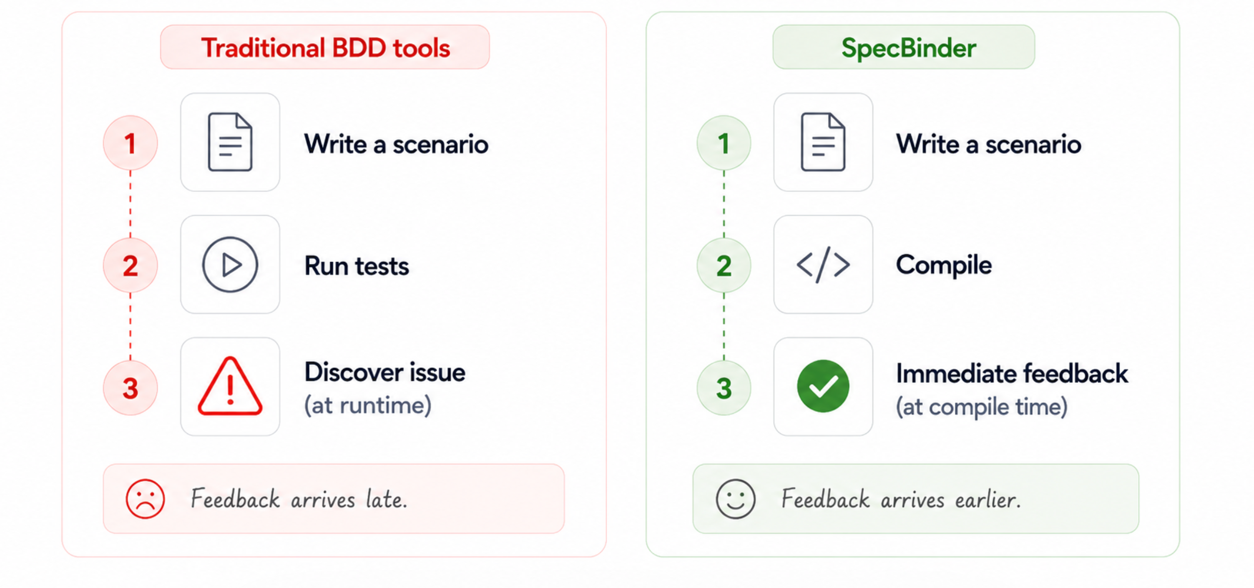
With traditional approaches, many issues only appear when tests are executed.
With SpecBinder, problems are caught during compilation:
- Mismatch in structure? ❌ Compile error
- Wrong parameter type? ❌ Compile error
- Missing step implementation? ❌ Compile error by default (optionally a failing stub)
You fix issues before you even run the tests.
2. Real tests, not indirect execution
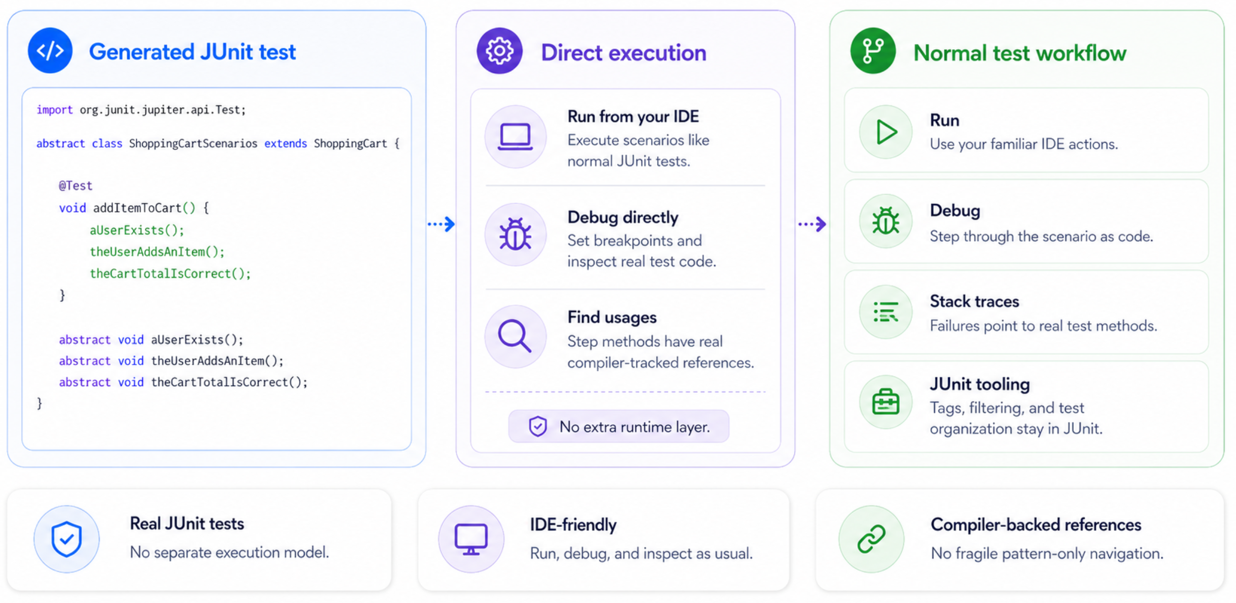
SpecBinder generates standard JUnit 5 tests.
That means:
- Run scenarios directly from your IDE
- Debug like any other test
- Use "Find Usages" on step methods with compiler-guaranteed references
- No additional runtime layer to reason about
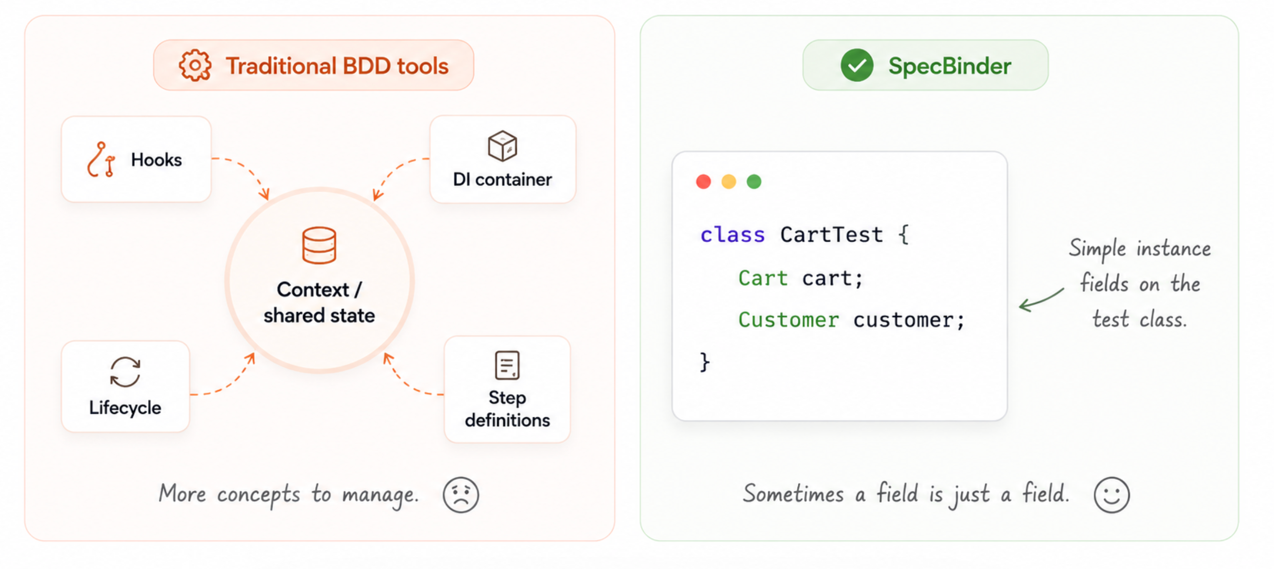
3. Simpler state management
Because scenarios are transformed into plain JUnit tests:
- Step implementations are regular instance methods on your test class, created and disposed along with the test instance by JUnit
- State can be shared using simple instance fields on the test class
- No need for additional dependency injection frameworks or context management to coordinate state between steps
4. Easy integration into existing tests
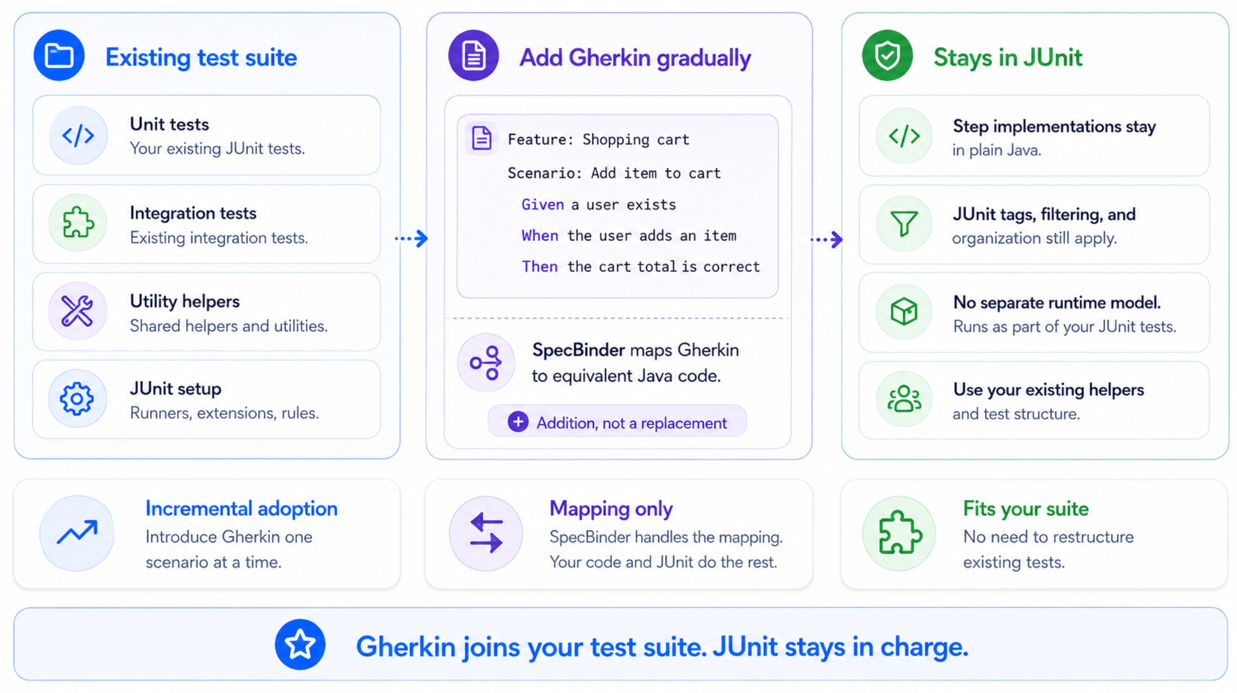
SpecBinder focuses only on mapping Gherkin to equivalent Java code — no more, no less.
- Your step implementations continue to provide the actual behaviour
- Core JUnit capabilities can be used to group, filter, parallelize, and organize your tests
- Gherkin can be introduced incrementally, without restructuring your existing test suite
Bridging specifications and code
BDD aims to connect business and engineering through shared understanding.
SpecBinder strengthens the automation side of that bridge:
- Gherkin remains readable and collaborative
- Tests become compile-time safe and IDE-friendly
- The gap between specification and execution becomes much smaller
Final thought
Gherkin doesn’t need to change.
But how it’s executed can.
Learn more
- Website: https://specbinder.dev
- GitHub repository: https://github.com/dmytro-stasyuk/SpecBinder
Other Gherkin tools from SpecBright
If you are already working with Gherkin in Jira, you may also find our existing apps useful:
If you have questions about these tools, or want to explore whether SpecBinder could help with the BDD automation part of your workflow, feel free to reach out to us at SpecBright.
Was this helpful?
Thanks!

Dmytro Stasyuk _ SpecBright
0 comments