Hi!
I want to send a reminder over Slack for assignees to add the missing Original Time Estimate to their tickets.
I currently found a temp solution which lets me send one Slack message to a public channel, tagging all the relevant assignees in that one message (so avoiding multiple messages to the same channel).
My questions -
- Is there a better way to do this than the one I detail below?
- When I try to put a smart value that should translate to a Slack ID in the "channel or user," it doesn't send the message to the specific user. Anything I'm missing? (see image for an example)
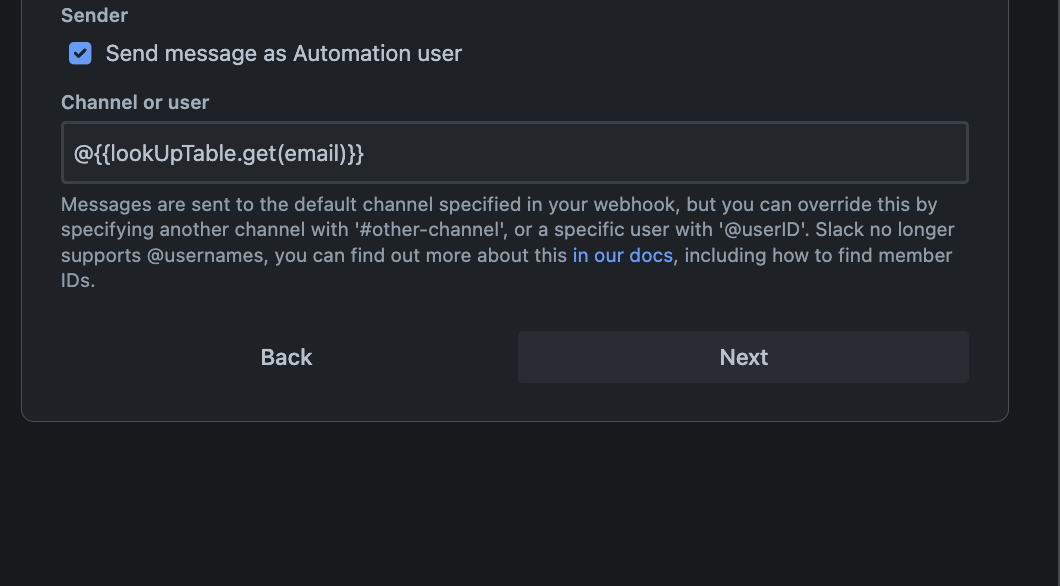
The solution I currently have: message a public Slack, tagging assignees in one message.
It requires making 3 different automation rules.
Rule 1
Step 1: Scheduled every 2 weeks
Step 2: Create a new issue with the summary:
{{now.jiraDate}} slack messageRule 2
Step 1: Scheduled every 2 weeks (later in the day than Rule 1) with a JQL searching for the issue created in Rule 1
summary~"{{now.jiraDate}} slack message"Step 2: Lookup issues
originalestimate=EMPTY AND assignee!=EMPTY
Step 3: Advanced branching using the smart value to find the email addresses of the assignees and removing dupes:
{{lookupIssues.assignee.emailAddress.distinct}}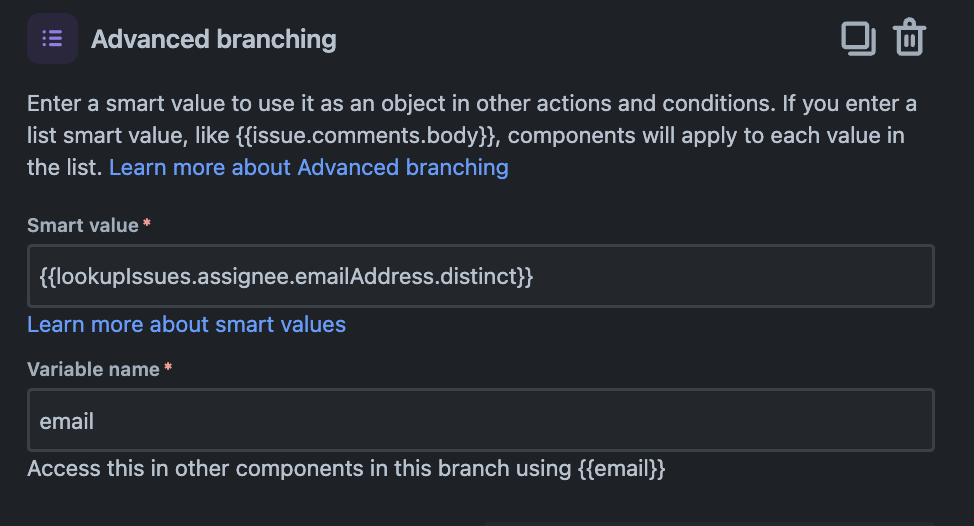
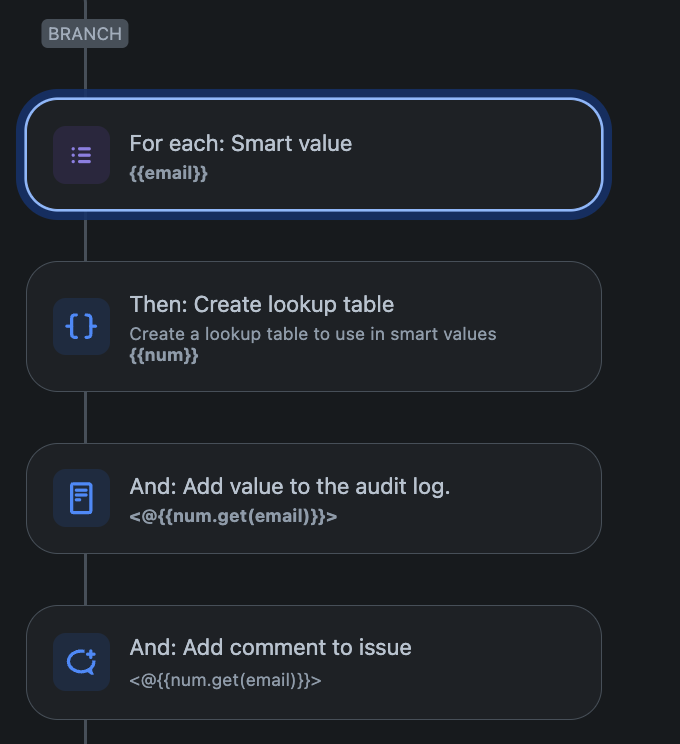
Step 4 (part of the advanced branch): create a lookup table with everyone's emails corresponding with their Slack IDs (which our Slack admins kindly provided. I exported the rule after creating the lookup table > copy-pasted the table from excel to the json file where the temp lookup table was > and imported the rule back to Jira)
Step 5 (part of the advanced branch): add a comment to the issue (the one created in Rule 1, and searched for in Rule 2) with the values from the lookup table corresponding to the assignees' emails. Break down of that part of the branch:
The lookup table was {{num}}
The variable for the branch's smart value: {{email}}
Getting the Slack ID for each email: {{num.get(email)}}
Note that it didn't need the {{ or }} before and after the "email" -- the log shows the expected values.
Adding the formatting so that in a Slack message it will turn to tagging the user: <@{{num.get(email)}}>
The end result is that the issue will have as many comments as users and they are all <@SLACK-USER-ID> (example: <@AJHFJJD123>
Rule 3
Step 1: Scheduled every 2 weeks (later in the day than Rule 2) with a JQL searching for the issue created in Rule 1
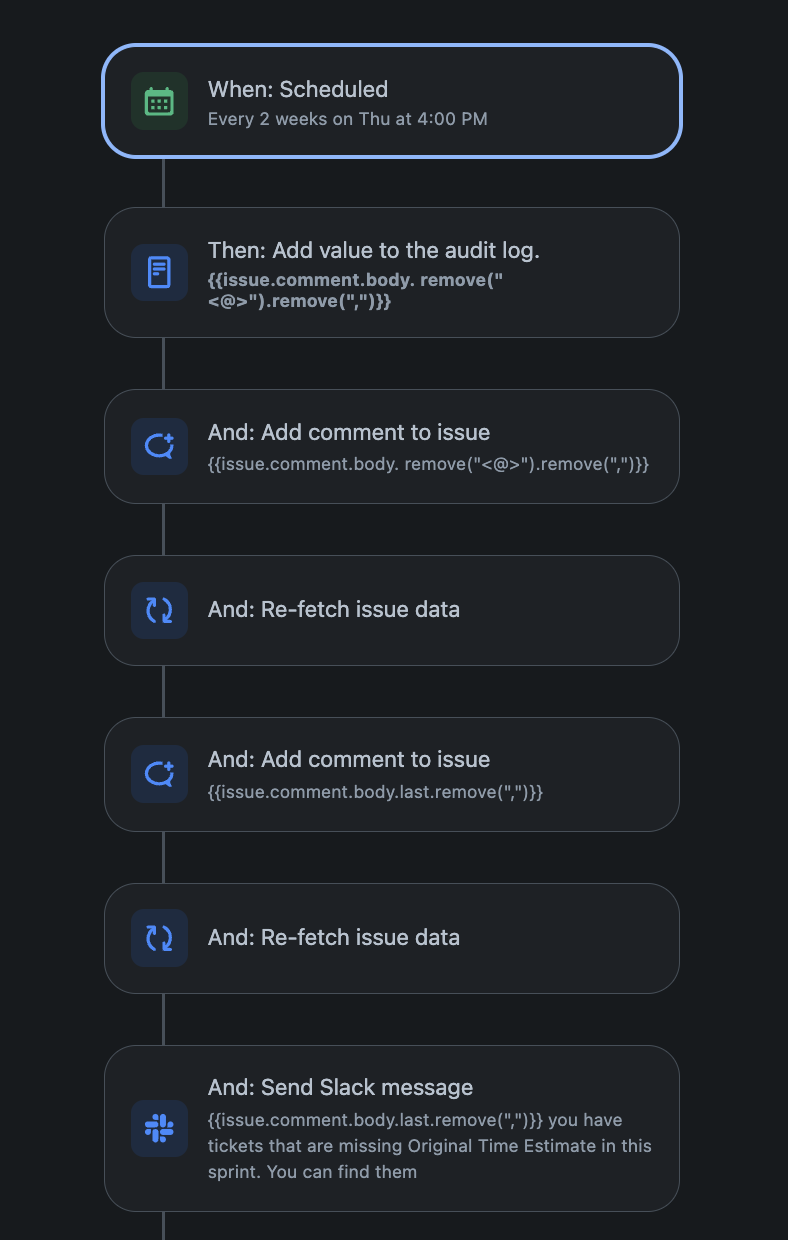
summary~"{{now.jiraDate}} slack message"Step 2: Get all the comments body and remove any extra "<@>" (I don't know why but some comments only had that. Maybe the assignee isn't in my lookup table) or ","
@{{issue.comment.body. remove("<@>").remove(",")}} Which results in a list of Slack IDs
Step 3: Message Slack and include in the body of the message: {{issue.comment.body. remove("<@>").remove(",")}}
(ignore the multiple "refetch data" that's nervous me)