From Server Rooms to Isolated Cloud
How Atlassian’s hosting models evolved and why it matters today
The Jira ecosystem has been evolving constantly, adapting to new realities in technology, security, and scale. This time, however, I don’t want to talk about apps or features. I want to talk about hosting models. The part that usually stays in the background, until it suddenly becomes one of the most important decisions an organization has to make.
Jira is used by thousands of organizations worldwide to manage work, projects, and collaboration, from small teams to large enterprises. How and where this software is hosted has changed significantly over the years, and those changes reflect how the entire software industry has evolved.
When everything lived in one room (2002)
To understand why today’s hosting landscape is so diverse, it helps to start at the very beginning, when “hosting” simply meant “where your company keeps its servers.”
When Atlassian introduced Jira Server (2002), there was essentially one hosting model:
servers running on physical machines in a company’s own server room.
That was standard 20+ years ago. Software lived close to us, sometimes literally on machines we could see every day in the office. Control felt absolute. Security, by today’s standards, was relatively simple. The main risk was physical access: someone unauthorized entering the office and accessing the machine.
In a world without shared infrastructure, global access, or massive data flows, data protection was simpler because systems themselves were simpler.
Everything à La Carte: Jira On-Demand (October 2011)
As companies wanted faster setup and less operational burden, Atlassian took its first real step toward SaaS. The idea was simple: don’t force every customer to become an infrastructure expert just to use Jira.
In October 2011, Atlassian introduced Jira On-Demand, its first Software-as-a-Service offering, promoted with the idea of “Everything à La Carte”: start small, avoid upfront infrastructure investment, and consume Jira as a service rather than installing and maintaining it locally.
Technologically, Jira On-Demand was still best understood as “hosted Jira”: Jira was operated by Atlassian for customers, rather than being something customers installed and managed themselves. Atlassian later described that earlier hosted approach as being hard to scale and slow to evolve, as cloud became a viable option at the enterprise scale.
As the industry matured, Atlassian moved Jira and Confluence cloud customers from its own infrastructure to Amazon Web Services (AWS) in a large migration effort that it described as completing in Q1 2018. This migration was not only “moving servers.” Atlassian also described rebuilding major parts of the products (including architectural work toward microservices) to remove scaling limits and increase delivery speed.
Scaling on-premises: Jira Data Center (July 2014)
At the same time, not everyone wanted SaaS, and the market’s expectations for performance and reliability were rising beyond what Jira Server could comfortably deliver at scale.
As Jira and similar tools became mission-critical, the key question shifted to: can we run it reliably for hundreds or thousands of users while keeping it on infrastructure we control?
Atlassian responded by strengthening the on-premises path.
In July 2014, Atlassian introduced Jira Data Center.
Data Center allowed Jira to run on multiple nodes working together as a cluster, delivering high availability and horizontal scalability. It was designed for enterprise environments with thousands of users and strict operational requirements.
With a Data Center, organizations could:
This model represented the peak of the on-premises approach: powerful, scalable, and flexible, but also complex and costly to operate and maintain.
The real technological shift: “new Jira Cloud” (October 2018)
As cloud hosting became more popular and expected, “hosted Jira” was no longer enough. Customers wanted faster innovation, smoother upgrades, and a platform built for cloud realities. Atlassian’s answer was a deeper shift: not just where Jira runs, but how Jira is built.
The fundamental technological transition happened later, around 2017–2018.
At this point, Atlassian made a strategic decision to stop treating cloud as “hosted Server” and instead build Jira Cloud as a separate, cloud-native platform. Atlassian referred to this transition as the “new Jira Cloud.”
In October 2018, Atlassian announced that the new Jira Software Cloud was available to all users, describing it as a redesign of both the user experience and the underlying stack.
This was not just a change in branding or hosting. It reflected a shift in how the product was built:
-
Cloud no longer shared the same development path as Server or Data Center,
-
the architecture evolved toward cloud-native services,
-
continuous delivery became the default,
-
scalability and resilience were handled at the platform level.
From that moment on, Cloud became Atlassian’s primary innovation platform, designed specifically for distributed, always-on environments.
The gradual sunset of Jira Server and Data Center
As Atlassian’s “cloud-first” direction became clear, the on-premises models moved into a sunset phase. First Jira Server, and now Jira Data Center. The key point is not only the end dates, but what this triggers next: the need for new options for organizations that cannot simply move to a standard multi-tenant cloud.
Jira Server: end of support
In October 2020, Atlassian announced the end of the Server era, including a defined end-of-support timeline.
Key milestones:
Jira Data Center: decommissioning and end of life
Jira Data Center continued as the remaining on-premises option, but not indefinitely.
In September 2025, Atlassian announced the Data Center decommissioning phases and the end-of-life plan.
The official end of life is planned for March 2029, when Data Center products transition permanently into read-only mode.
This marks the end of another era in Atlassian’s hosting history.
But the story doesn’t stop there.
Atlassian Government Cloud (October 2025)
Once it became clear that the Data Center was heading toward retirement, a gap appeared. Some organizations want cloud benefits, but cannot meet their regulatory requirements in standard SaaS environments. For the US public sector, Atlassian’s answer is Government Cloud.
To fill the space appearing as Data Center editions move toward retirement, and to address highly regulated environments, Atlassian introduced Atlassian Government Cloud, which became generally available in October 2025.
Government Cloud is a FedRAMP Moderate authorized environment designed specifically for US government agencies and their partners, hosted in US regions and aligned with US government security frameworks.
This hosting model exists because standard SaaS cloud environments do not meet certain public-sector security, sovereignty, and compliance requirements. Government Cloud enables cloud adoption in scenarios where the cloud was previously not permitted.
Isolated Cloud (announced for 2026)
Government Cloud is US-focused. But what about highly regulated organizations outside the US public sector, and enterprises that require stronger isolation than standard cloud can offer? With Data Center being phased out, Atlassian is clearly building another path.
Is it the end of the license story? Absolutely not. For companies with extremely demanding security and compliance requirements, Atlassian announced Isolated Cloud, planned for 2026.
This new hosting model is expected to offer:
-
full tenant isolation,
-
dedicated compute and storage,
-
stronger control over data egress,
-
advanced compliance support,
-
global applicability (not limited to the US public sector, like Government Cloud).
Summary
Over the last two decades, Atlassian has moved from self-managed server deployments to SaaS, and now to specialized cloud environments designed for regulated and high-security needs. This evolution reflects how our world has changed: technology has matured, expectations have grown, and software has become critical to how we work every day.
What do you think will come next?
Over to you
-
What types of hosting and compliance services will organizations need after Jira Data Center is retired?
-
Do you expect Isolated Cloud to fully replace Jira Data Center for enterprise customers, or will there still be gaps?
-
And what additional “in-between” options might be needed for industries that are regulated, but not regulated enough for full isolation?
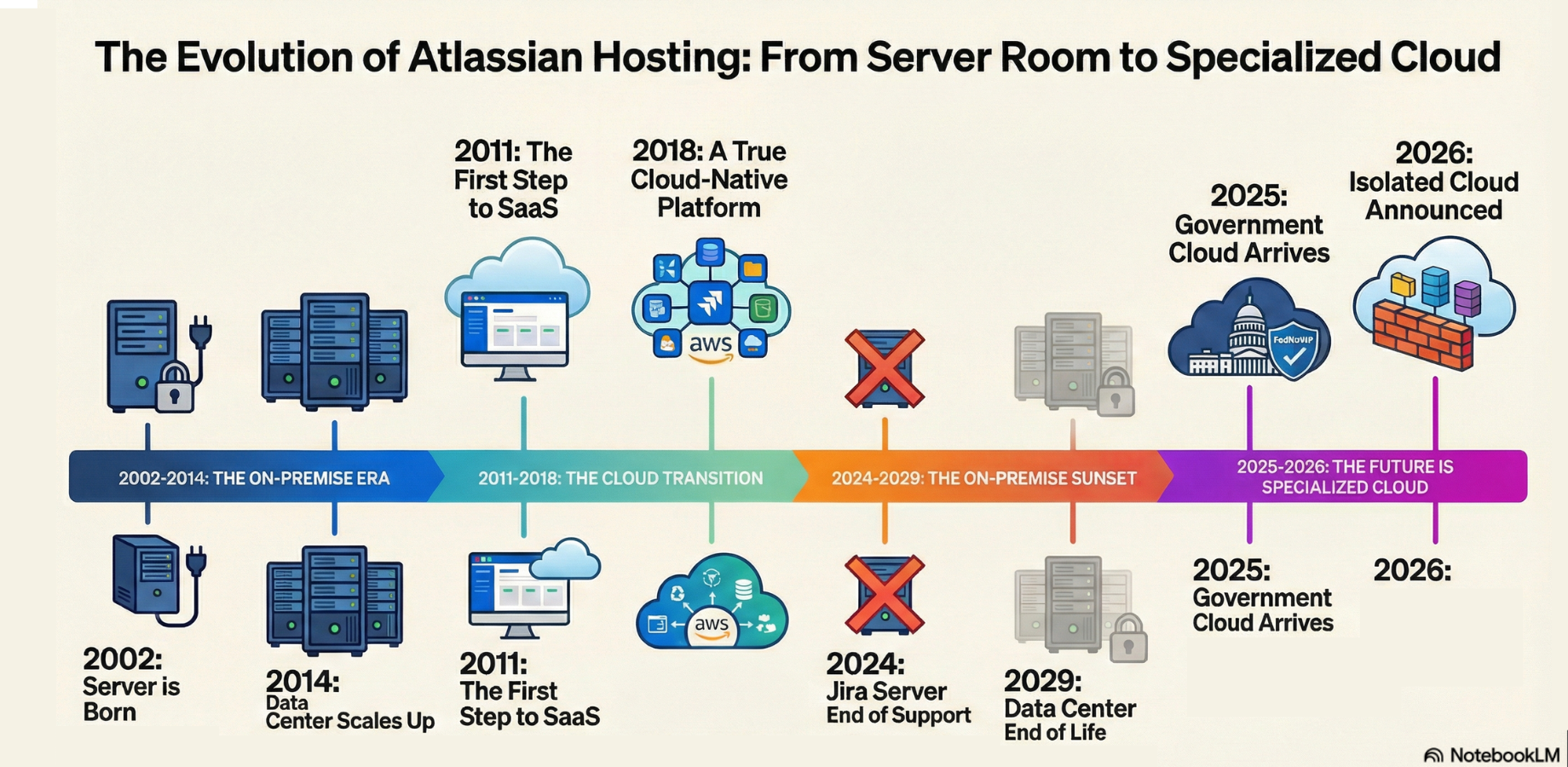
Timeline of key Jira hosting milestones
-
2002 – Jira Server introduced
-
October 2011 – Jira On-Demand (first SaaS)
-
July 2014 – Jira Data Center introduced
-
October 2018 – “new Jira Cloud” launched
-
October 2020 – Jira Server end-of-support announced
-
November 2023 – Last Jira Server release line (9.12 LTS)
-
February 2024 – Jira Server end of support
-
September 2025 – Data Center decommissioning announced
-
October 2025 – Government Cloud general availability
-
2026 – Isolated Cloud announced for availability
-
March 2029 – Jira Data Center end of life (read-only)

