
I first wrote the internal version of this on a Wednesday afternoon, at the end of a workday, because the feeling had been sitting in my head for a while and I needed to put it somewhere. I thought a few teammates might relate. Instead, it became the #1 internal post at Atlassian for about a week and a half, drew thousands of views, and sparked well over a hundred comments from engineers, designers, researchers, managers, and people far outside my immediate world saying some version of: “oh, thank goodness, it’s not just me.”
That response is why I’m sharing a version of it more broadly. The specific tools will differ from company to company, but the feeling is becoming very familiar.
By 5pm, after a full day of working with AI, my brain does not feel tired in the clean, satisfying way it does after a hard engineering problem. It feels like it has been put through a blender. I want to talk about that feeling, because it does not get enough airtime in engineering circles.
At any given moment, on any given workday, I might have several AI-assisted workstreams running at once. One is helping me with PR reviews. One is my main project work. One is handling “other” tasks such as improving team processes, working through bugs, or running investigations. Another might be helping automate issue resolution. On top of that, I’m chatting with other AI tools throughout the day, while also bouncing between Slack threads, DMs, meetings, and actual humans.
Each of these tabs and chats, with AI and humans, represents a context. Each context requires me to hold state in my head: what did I ask for, what did it produce, where was the gap, what do I need to correct, what’s the next prompt? That is easily a dozen live threads of thought I’m holding at once, all day, and by the end of it I’m not tired the way I used to get tired from hard engineering problems. I’m a different kind of depleted. Emptied out.
There’s a name for this now. Researchers are calling it AI brain fry.
The guilt phase is the precursor
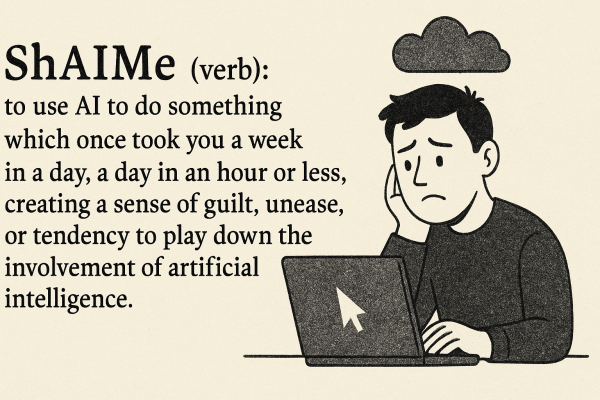
Here’s something I think matters and isn’t being discussed enough: we’re still in the guilt phase of AI adoption.
I’m writing about this from an engineering perspective because that’s my world, but this isn’t only an engineering problem. The research is looking at knowledge workers more broadly: anyone spending their day prompting, reviewing, correcting, and validating AI output can end up carrying the same oversight load.
A lot of engineers carry a quiet discomfort about using AI tools. Am I still a real engineer if Claude wrote that function? Should I feel weird about this PR I reviewed with AI assistance? Is my opinion on this architecture less valid because I explored it with a chatbot first?
Researchers have recently proposed “Artificial Intelligence Replacement Dysfunction” (AIRD) as a framework for the anxiety, identity loss, and feelings of worthlessness tied to AI-driven job insecurity. Over half of software engineers report experiencing frequent to intense imposter feelings, and AI tools are making that number climb.
I think this guilt is a transitional state. It’s the phase between “I shouldn’t be using this” and “this is how I work now.” And I think AI fry is what happens on the other side of that transition. Once you stop feeling guilty and fully lean in, once you have multiple AI-assisted workstreams running and you’re directing parallel threads of work all day, you discover the new cost. The guilt phase was protecting you from going all-in. Once you’re past it, there’s nothing between you and cognitive depletion.
This is not an argument against using AI. I’m more productive than I’ve ever been. The things I can accomplish in a single day would have taken a week three years ago. But the mental cost is real, and pretending it isn’t doesn’t make it go away.
What is AI fry?
In March 2026, BCG and Harvard Business Review published a study of 1,488 full-time US workers. They found that 14% of AI users are experiencing what they called “brain fry”: mental fatigue specifically caused by excessive use or oversight of AI tools. Not burnout. Not general tiredness. A distinct cognitive overload from the constant loop of prompting, reviewing, correcting, and deciding.
The numbers are stark. Workers with high AI oversight loads reported 14% more mental effort, 12% greater mental fatigue, and 19% more information overload. When workers used four or more AI tools, self-reported productivity dropped, even though it climbed with three or fewer. Among those experiencing brain fry, 34% were actively thinking about quitting, compared to 25% without it.
Key stat: Productivity climbed when workers used one to three AI tools, but dropped when they used four or more. The extra output did not outweigh the extra oversight load.
Separately, UC Berkeley researchers embedded themselves in a 200-person tech company for eight months and found that AI didn’t free up anyone’s time. Instead, employees worked at a faster pace, took on a broader scope of tasks, and extended work into more hours of the day, often without being explicitly asked to do so. By month six, reports of burnout, anxiety, and decision paralysis had spiked.
That “without being asked” part is important, but it can also understate the pressure people feel. Nobody has to explicitly say “do more with AI” for the floor to rise. When the tools make more output possible, it is very easy for “possible” to quietly become “expected.” Peer pressure, performance reviews, layoffs, promotion cycles, and the fear of being the person who cannot keep up all create a kind of invisible stick. That is not voluntary in any meaningful sense.
Other developer surveys point in the same direction. A HackerRank survey found 67% of developers reported increased stress specifically from AI code validation responsibilities. Stack Overflow’s 2025 survey showed 84% of developers using AI in their workflows, but 46% said they no longer trust the accuracy of AI outputs, up from 31% the year before. We’re using these tools more and trusting them less. That gap is where the cognitive load lives.
That tracks. The promise of AI is that it removes the bottleneck of implementation. The reality is that it replaces it with a different bottleneck: the cognitive cost of overseeing, validating, and directing everything it produces. You’re not coding less. You’re reviewing more, deciding more, and context-switching constantly. Your job shifts from creating to validating, and you become a full-time reviewer for a junior developer who never sleeps, never learns your project’s specific context, and never gets tired.
And the really sneaky part is that AI often removes the “easy” work first. The boring, mechanical tasks used to give your brain a bit of recovery time between the harder problems. Now the easy work gets automated away and what’s left for the human is the judgement-heavy, ambiguous, emotionally loaded, high-context work. It is faster, yes. But it can also mean running at full cognitive load all day.
You’re not alone
If you’re reading this and thinking “yeah, that’s me,” I want you to know: this is not a personal failing. It’s not a sign that you’re not cut out for the AI era. It’s a structural consequence of how these tools work right now.
The shape of it is weirdly specific: the buzzing feeling, the mental fog, the difficulty focusing, the slower decision-making, the headaches. It is the feeling of having too many partially-complete thought loops open at once, and no obvious way to close them.
If that sounds familiar, congratulations: you’re a normal human being whose brain wasn’t designed to supervise multiple tireless AI assistants simultaneously.

One thing I did not fully appreciate until people started responding is how lonely this can feel. When you get stuck, it is increasingly easy to ask the agent instead of asking a teammate. That can feel efficient in the moment, and sometimes it is. But over time it can quietly erode the small human moments where a lot of learning and connection used to happen: the side tangent, the “oh, that reminds me of when…”, the quick explanation that teaches you how another person thinks.
AI gives you an answer. It does not give you the lived experience of a colleague, the reassurance that your question was reasonable, or the relationship built by working through something together. If AI has made your work feel faster but lonelier, you are not imagining it.
What actually helps
I’m not going to pretend I’ve solved this. I haven’t. But here’s what I’ve noticed makes a difference, both from personal experience and from what the research supports.
Fewer tools, used deliberately. The BCG data is unambiguous: productivity peaks at one to three AI tools. Every additional tool adds oversight cost that exceeds its output value. I know “use fewer tools” is hard advice when your company is rolling out new AI integrations monthly. But being intentional about which AI interactions you take on versus which ones you skip is the single highest-leverage thing you can do.
Batch your AI work. Context switching between AI-assisted tasks is more expensive than switching between traditional tasks, because each AI context requires you to hold the model’s state in your head alongside your own. Grouping similar AI tasks together, like all the PR reviews in one block and all the investigative prompting in another, reduces the overhead of mental context rebuilding.
Ask the AI to return context to you. A colleague pointed out that this looks a lot like managing a large team with broad scope. One thing managers often do with humans is ask them to start with the context: where we left off, what changed, what decision is needed now. We can ask agents to do the same. Having the AI begin by summarising the task, the current state, the last decision, and the next ask can reduce the amount of state you have to keep warm in your own head.
Protect non-AI time. Some of my best thinking happens when I close all the tabs and just… think. With a notebook. Or a whiteboard. Or a walk.
The other day I literally printed off the documents for a new project I’d picked up, closed my laptop, and lay on the couch with a highlighter and pen. It felt almost absurdly analogue, but it worked. There was no prompt to refine, no output to validate, no extra thread to supervise. Just the shape of the problem, a pen, and enough quiet for my brain to reconnect the pieces.
The UC Berkeley study found that AI work seeped into pauses: lunch, before meetings, evenings. Protecting time where you’re not prompting, reviewing, or validating is not slacking off. It’s maintenance.
Preserve human collaboration. Before asking an agent, consider whether this is actually a moment to ask a person. Not because AI cannot help, but because collaboration is not just about getting the answer. It is how we learn, build trust, share context, and remember we are not doing this alone.
Name the feeling. Before I had the term “AI fry,” I just thought I was tired or getting old or not handling my workload well. Having language for it changes how you respond. You stop trying to push through with more coffee and start recognising it as a signal that your cognitive budget is spent. That’s useful information.
Talk about it. I’ve started being more open with my team about when my brain is cooked. “I’ve been reviewing AI output all afternoon and I’m fried, can we move this discussion to tomorrow?” is a legitimate thing to say. The more we normalise it, the less likely people are to quietly burn out pretending everything’s fine.
This is a design problem, not a willpower problem
The temptation is to frame AI fry as an individual discipline issue: just be better at managing your attention. But the BCG researchers were explicit that this is an organisational design problem. The way we structure work around AI, the expectations we set, the metrics we use, the number of tools we deploy - those are the levers that matter.
It is also a product design problem. The “just one more prompt” pull is baked into how many chat interfaces work. There are no natural stopping points, no end-of-shift signal, no satisfying sense of “I have finished my queue and can log off.” Even if your organisation tells you to stop at 5pm, the product is still right there, ready to keep going.
The UC Berkeley researchers put it well: the competitive advantage belongs not to the companies that use AI to run the fastest, but to those that use it to run the longest. If your team is shipping more but burning out faster, you’re not more productive. You’re borrowing from the future.
We’re in an extraordinary moment. The tools are genuinely powerful. The things we can build with AI assistance are remarkable. But we’re also running an experiment on our own cognition at a scale and speed that has no precedent, and the early results are telling us something we should listen to.
Your brain isn’t broken. The interface between human cognition and AI output just hasn’t been designed yet. We’re all figuring it out in real time, too many tabs at a time.
References & sources
BCG/HBR Brain Fry Study: Bedard, Kropp, Hsu, Karaman, Hawes & Kellerman. “When Using AI Leads to ‘Brain Fry.’” Harvard Business Review, March 2026. hbr.org
Fortune coverage: “AI brain fry is real - and it’s making workers more exhausted, not more productive.” March 2026. fortune.com
UC Berkeley/HBR Work Intensification Study: Ye & Ranganathan. “AI Doesn’t Reduce Work - It Intensifies It.” Harvard Business Review, February 2026. hbr.org
UC Berkeley Haas press release: “AI promised to free up workers’ time. Researchers found the opposite.” February 2026. newsroom.haas.berkeley.edu
Built In: “AI Brain Fry: Why Developers Feel Overloaded by AI Agents.” May 2026. builtin.com
Stack Overflow Developer Survey 2025: 84% AI adoption, 46% distrust rate. theaieconomy.substack.com
HackerRank 2026: 67% of developers report increased stress from AI code validation. sanjewa.com
AIRD Framework: McNamara & Thornton. “Artificial Intelligence Replacement Dysfunction.” Cureus, 2025. pubmed.ncbi.nlm.nih.gov
Entrepreneur: “Excessive AI Use Linked to ‘Brain Fry.’” March 2026. entrepreneur.com


