We're moving! The community forums are migrating to a new platform on September 22. Learn more
×Community resources
Community resources
Community resources
Jira Automation for Checklists and Issue Templates


If your team handles the same types of work week after week - QA cycles, onboarding requests, release steps, or service workflows - you already know the cost of setting them up manually each time. Steps get skipped. Jira checklist templates get copied incorrectly. New team members improvise.
Jira automation for checklists and issue templates solves this at the source. Instead of relying on people to remember the process, you embed it in the workflow itself.
This guide covers two complementary approaches: automating checklist templates with Smart Checklist for Jira and automating full issue structures with Smart Templates for Jira. It also explains where Jira Automation fits, how to enforce process completion with workflow validators, and which pattern works best for each use case.
Key takeaways
- Smart Checklist can auto-import checklist templates when a Jira issue is created, transitioned, or updated - using built-in automation with no Automation for Jira rules required.
- The Import Checklist Template action in Automation for Jira (Forge) gives teams more trigger flexibility and cross-project scope for advanced automation rules.
- Workflow validators in Smart Checklist block issue transitions until all checklist items (or mandatory items) are completed - making Definition of Done enforceable, not optional.
- Smart Templates automates full issue hierarchies. A webhook or Jira automation trigger can create a complete backlog from a single issue template.
- Choosing between subtasks and checklists depends on whether steps need separate assignees and workflow states. If they do, use subtasks. If you need a reliable execution record inside one issue, use a Jira checklist.
When subtasks create noise instead of structure
Subtasks are the right choice when each step needs its own assignee, estimate, or workflow state. But many recurring processes don't require that. They require a reliable list of steps and proof they were followed. If you're still deciding, the Jira subtasks vs. checklists guide covers the trade-offs in detail.
When teams use subtasks for simple recurring steps, the result is usually:
- 10-30 extra Jira issues per parent work item
- Time spent linking, updating, and moving subtasks across workflows
- Progress that's hard to read because the actual work is spread across multiple issues
Checklists keep the process inside one Jira issue. Steps become actionable checklist items that can be tracked, assigned, and validated - without creating more issues.
This is why teams replace subtasks with checklists for:
- Definition of Done and QA testing (development checklists, regression checklists)
- Onboarding and internal approvals (IT access, compliance steps, policy sign-off)
- Jira Service Management request workflows with consistent handling steps
- Any structured process where the goal is consistency and clear execution
|
Note: Once you treat the checklist as the execution layer, automation follows naturally. You're not automating 'creating more work items.' You're automating when the right checklist template appears in the workflow. |
Smart Checklist built-in automation: no Automation for Jira required

Smart Checklist can automate checklist template imports directly inside Jira - without building rules in the Automation for Jira rule builder. This is the fastest setup for teams that want the right Jira checklist to appear based on simple conditions like issue type, priority, component, or label.
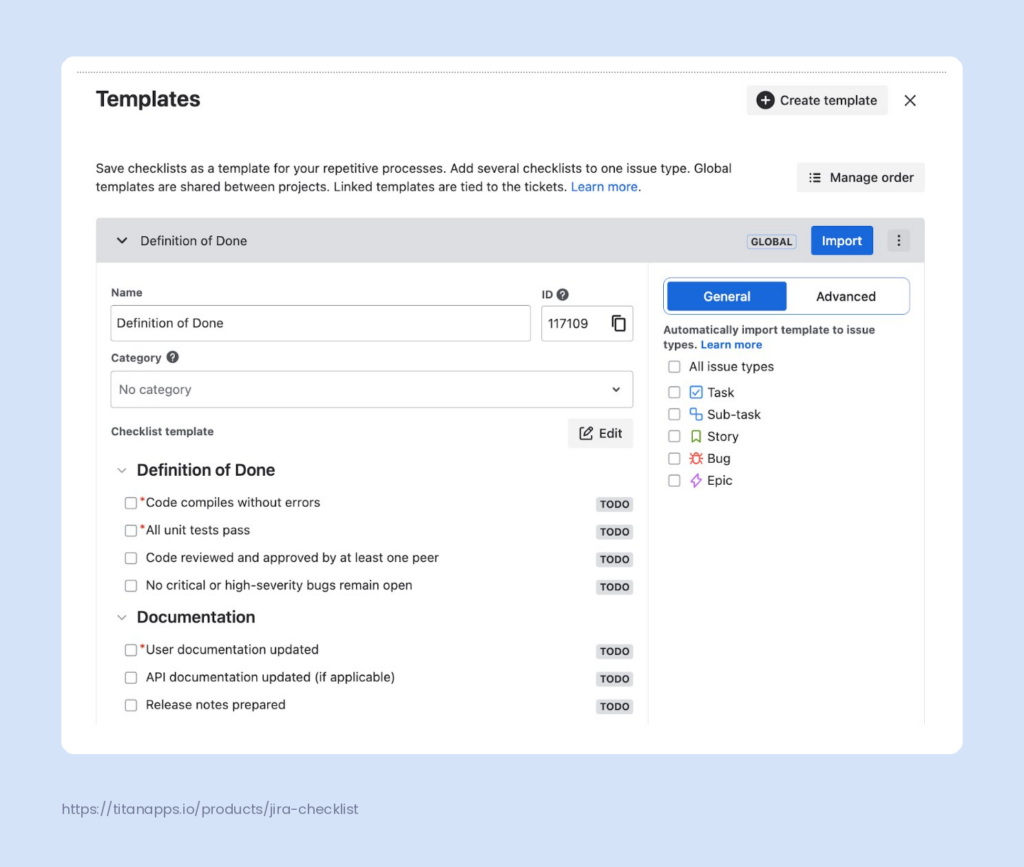
General conditions: auto-import on issue creation
General conditions cover the most common use case: import a checklist template when a Jira issue is created. Teams typically apply this to one or more issue types - Story, Bug, Task - so every new work item starts with a consistent Jira checklist template.
Advanced conditions: more triggers and field-based filters
Advanced conditions add two capabilities that general conditions don't cover.
More triggers. You can auto-import a checklist template when a Jira issue is created, transitioned, or updated. This maps closely to how many Jira automation rules work in practice: when something changes in the workflow, add the next steps.
Field-based filters. Advanced conditions let you filter by issue field values, so the checklist template is added only when it's relevant. Two examples that map well to real workflows:
- Label = Testing - adds a Testing checklist as soon as the issue is tagged, without requiring a status change first
- Issue transitioned to In Testing AND Label = Regression - auto-imports a regression checklist template at the QA stage
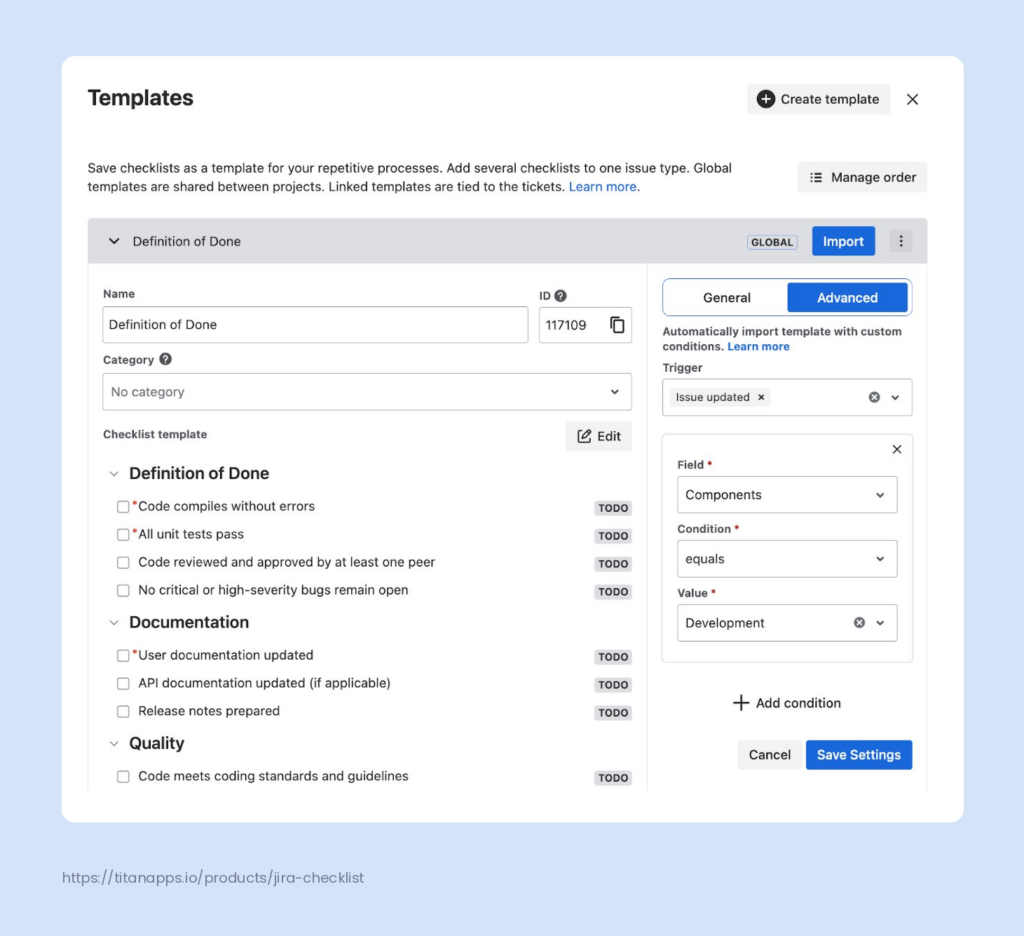
This approach works well in large Jira instances with many teams. Each project can manage its own checklist automation without admin overhead. Team members don't need admin permissions, and checklists appear at the right workflow stage without creating subtasks.
Automation for Jira: the Import Checklist Template action
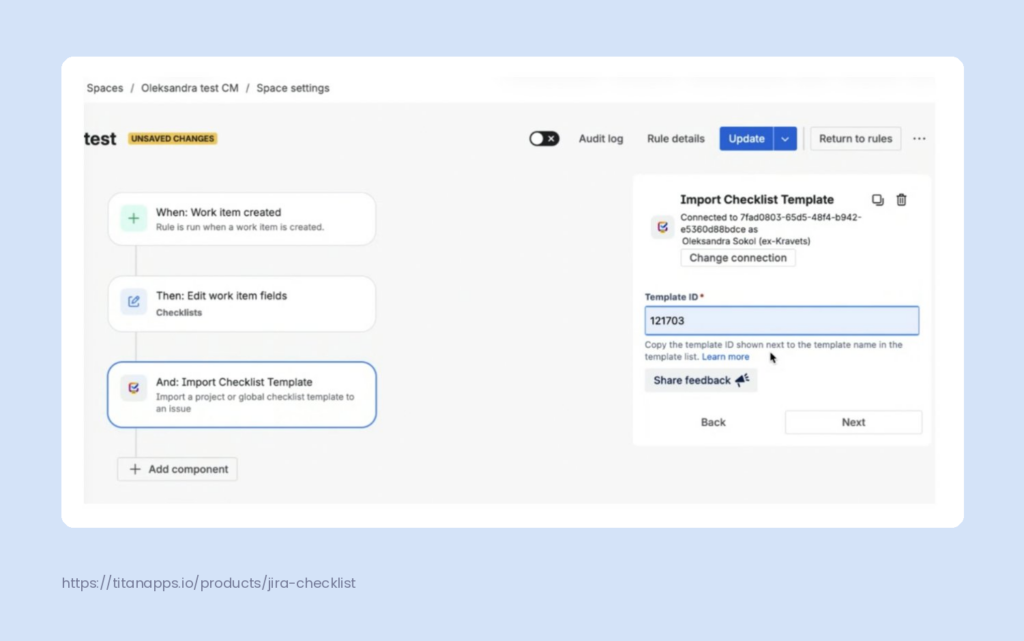
With the Forge migration, Smart Checklist added a native Import Checklist Template action to Automation for Jira. Instead of workarounds using entity properties or custom field updates, the rule builder now includes a purpose-built checklist automation action.
For a broader look at what Jira automation can do beyond checklists, the full automation guide covers rules, triggers, and scope options in detail.
Setup is straightforward:
- Open the template in Smart Checklist settings
- Copy the Template ID from the template header
- In Automation for Jira, add the Import Checklist Template action and paste the Template ID
When to use built-in automation vs. Automation for Jira
|
Use built-in automation when... |
Use Automation for Jira when... |
|
The trigger is issue creation or a simple transition |
You need cross-project scope (global or multi-project rules) |
|
Conditions are field-based (label, priority, component) |
You need more complex trigger chains or branching logic |
|
The rule stays inside one Jira project |
You want to combine checklist import with other actions (notifications, field updates, Slack messages) |
|
Project admins manage automation without global access |
You need consistent automation across departments or project types |
Example: When a Jira issue transitions to In Testing, import a Regression Testing checklist template, notify the QA assignee via Slack, and log the automation run. Built-in automation handles the first step. Automation for Jira handles all three together.
Automation scope: project rules vs. global rules
When you automate checklists in Jira Cloud, scope determines where the rule runs. This affects permissions, maintenance, and who can see and edit the rule.
Project automation
Project-level rules are created from Project settings and run only inside that project. This is the most common setup because:
- Each team controls their own process and checklists
- Component and label conditions mean different things across projects
- Permissions are simpler - project admins manage the rules
Project automation fits well when you want checklist templates to follow a team workflow - for example, importing a QA checklist when an issue transitions to In Testing.
Global automation
Global rules are created at the system level and can apply broadly. In Rule details, you can set scope to:
- Global (all projects)
- Multiple projects (select specific Jira projects)
- Project type (Software / Jira Service Management / Business / Discovery)
This is useful when one standard rule should work across departments - for example, a shared high-priority Jira checklist template or a consistent notification pattern for stakeholders.
Workflow validators: enforce checklist completion before transition
Automation adds checklists to issues. Workflow validators do something different - they enforce process rules inside the Jira workflow itself.
A common use case is transition control. If a team uses mandatory checklist items as part of their process, they may want to prevent a Jira issue from moving to the next status until those steps are done. For teams using Definition of Done in Jira , validators are the mechanism that makes it non-negotiable.
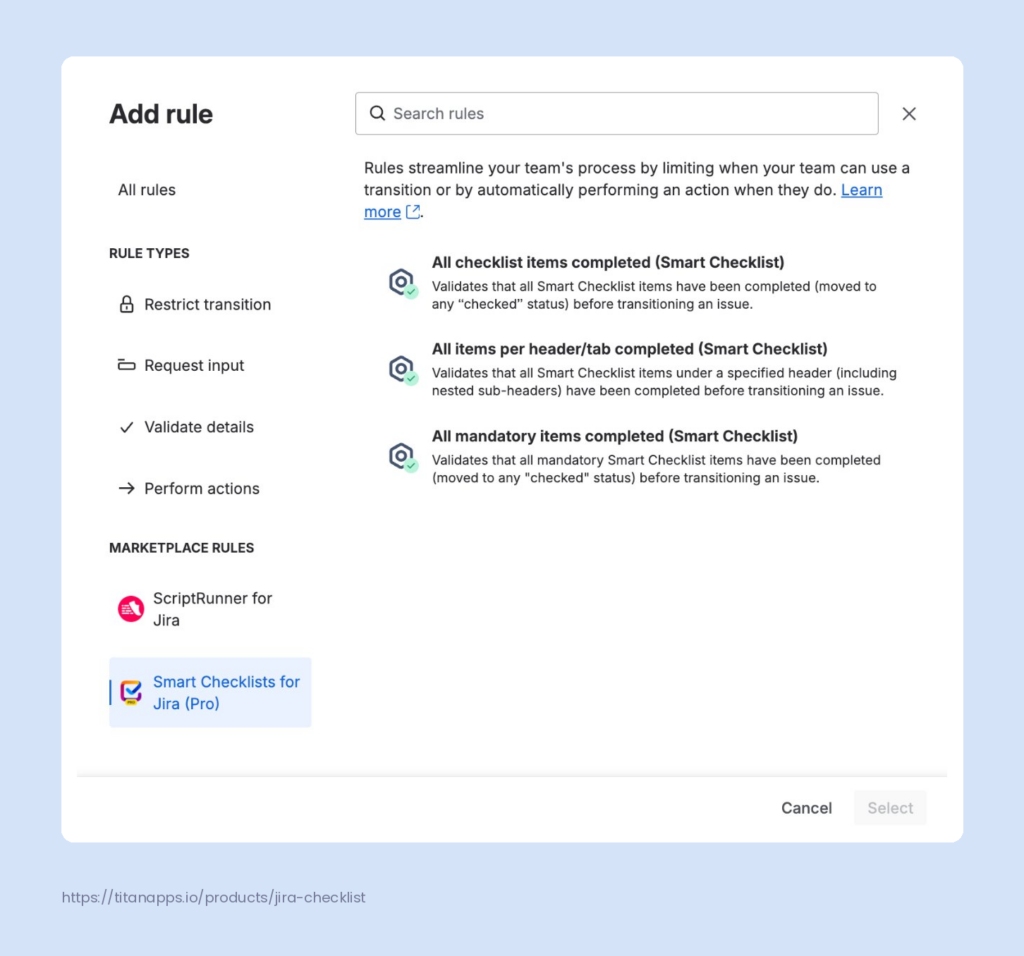
Smart Checklist provides two validator options in the workflow rule list:
- All checklist items completed - blocks the transition until every checklist item is in a checked status
- All mandatory items completed - blocks the transition until all mandatory items are done
This is useful for:
- Moving an issue from In Progress to Done
- Moving a task from In Testing to Ready for Release
- Any quality gate where incomplete required items should block progress - including release readiness checklists
|
Limitation: Workflow validators are available in company-managed Jira projects only. They are not available in team-managed projects on Jira Cloud. |
When you add a validator, you can also set a custom message shown to the user if they try to transition too early. Teams use this to explain what's missing, match internal terminology, or support localization for non-English users.
Four automation patterns that cover most use cases

The following patterns address the most common scenarios teams encounter when automating Jira checklists. For real-world examples across both Smart Checklist and Smart Templates, see the Jira process automation case studies .
1. The right checklist appears at the right workflow stage
Instead of adding the same checklist template when an issue is created, you can attach different templates as the issue moves through the workflow.
Example:
- Issue transitions to In Progress - import a Development checklist
- Issue transitions to In Review - import a Review checklist
- Issue transitions to In Testing - import a Regression / QA checklist
This removes subtask clutter and keeps each stage actionable without creating extra Jira issues.
2. Add extra checklist steps only when needed
Some teams keep their default Jira checklists simple and add extra steps only under certain conditions. This avoids turning every checklist into a long master list.
A business travel process is a clear example. The standard travel checklist covers booking transport, confirming dates, and arranging accommodation. If the employee needs a visa, the checklist expands automatically to include document collection, application submission, and approval tracking.
The same logic applies in development. A QA team may use a simple regression checklist by default, but add extra access and permissions checks only when a change touches user roles.
One issue. One checklist. One clear workflow - but flexible enough to cover complex cases.
3. Make Definition of Done enforceable
Automation adds checklists, but teams still need a way to prevent premature closure. That's where workflow validators come in. When mandatory checklist items are configured as required, the issue cannot transition to Done until they are complete. This makes Definition of Done, acceptance criteria, and compliance steps non-skippable.
This pattern is especially valuable for development and QA teams. For more on building a solid Definition of Done structure in Jira, see Definition of Done in Jira .
4. Sync checklist completion with issue status
For teams with mature workflows, Jira checklists can drive issue status changes rather than just sit alongside them. Two common patterns:
- When all checklist items are completed, automatically transition the issue to Done
- When an issue is transitioned to Done, automatically mark checklist items as completed or skipped
This improves status consistency across teams and reduces manual updates when closure happens from another system or process.
Smart Templates: automate full issue structures, not just checklists
Checklists work well when you want to keep process steps inside one Jira issue. Some workflows are larger than that. For teams that need repeatable project structures from day one, Smart Templates for Jira handles Jira ticket creation automation at the project level - not just the issue level.
Agencies, consultancies, and internal service teams often need a repeatable project start point. When a new Jira project appears, they want a ready backlog with the same core tickets every time - without manual setup.
Example: a marketing agency creates a new client project in Jira. Instead of manually creating the same Kick-off, Access, Research, Assets, Launch, and Reporting tasks, they trigger an automation that generates the full ticket set from an issue template.
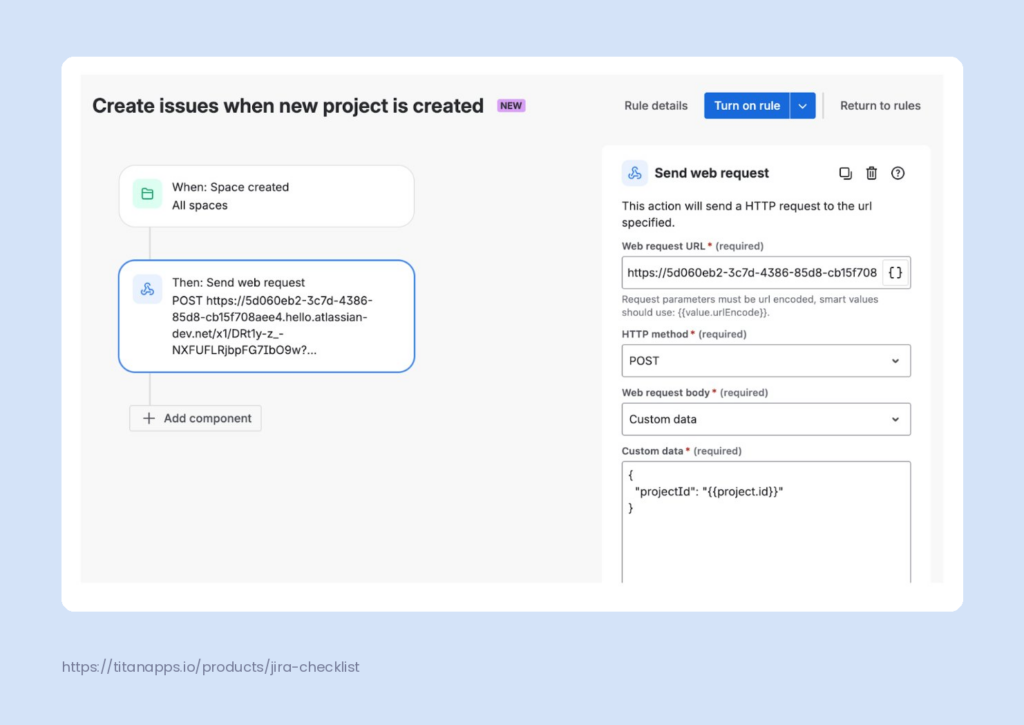
Smart Templates supports this pattern with two key capabilities:
Global templates. Create a Project Kick-off issue template once and share it across Jira projects. When a new project is created, the template is already available - no per-project duplication required. For an overview of how Jira project templates work natively and where Smart Templates extends them, that article is a useful starting point.
Automation webhook. Smart Templates generates a dedicated webhook link that connects to Automation for Jira. A Project created trigger can call the template to create issues in the new project, using smart values to pass the project identifier.
|
Important: Automation webhook URLs generated in the Connect version of Smart Templates stop working after migrating to Forge. Generate new Forge webhook URLs and update your rules. |
The result is immediate structure in the backlog, consistent workflows across projects, and clear ownership from day one.
When to use checklists vs. subtasks vs. issue templates
|
Approach |
Best for... |
|
Jira checklists (Smart Checklist) |
Steps that belong inside one issue - QA, Definition of Done, compliance checks, onboarding tasks |
|
Subtasks |
Steps that need separate assignees, independent status tracking, or their own estimates |
|
Issue templates (Smart Templates) |
Repeatable multi-issue structures - project kick-offs, delivery backlog setups, cross-functional workflows |
Summary
Jira automation for checklists and issue templates works best when it matches how teams actually execute work.
Smart Checklist for Jira gives you three automation layers: built-in auto-import using general or advanced conditions, the Import Checklist Template action in Automation for Jira for more complex rules, and workflow validators that enforce checklist completion at the right transition. Install Smart Checklist from the Atlassian Marketplace.
Smart Templates for Jira extends this to full issue structures. If recurring work is bigger than one issue, a global issue template with an automation webhook generates a complete backlog when a new project is created.
For a side-by-side look at which approach fits which scenario, the Jira subtasks vs. checklists guide covers the structural trade-offs in detail.
Frequently asked questions
Can I automatically add a checklist template in Jira?
Smart Checklist supports auto-import on issue creation, issue transition, or issue update using built-in advanced conditions. You can also use the Import Checklist Template action in Automation for Jira for more trigger flexibility and cross-project scope.
What is the difference between Smart Checklist built-in automation and Automation for Jira?
Built-in automation handles simple, project-scoped rules: import a checklist template when an issue is created or transitions, filtered by field values. Automation for Jira is broader: it supports more triggers, global scope, deeper workflows, and lets you combine checklist automation with other actions like notifications or field updates.
Can I add different checklists at different workflow stages?
Yes. A common pattern is: transition to In Progress imports a Development checklist, transition to In Review imports a Review checklist, and transition to In Testing imports a Regression / QA checklist. This keeps checklist items relevant to the stage without creating extra issues.
Can Jira automation trigger a checklist based on a field value?
Yes. Advanced conditions in Smart Checklist support field-based filters including priority, component, label, and issue type. This lets you add a specific Jira checklist only when the issue matches the right condition - without requiring a status change first.
Can I prevent closing a Jira issue until checklist items are completed?
Smart Checklist supports two workflow validators: one that requires all checklist items to be completed, and one that requires all mandatory items specifically. A third validator for specific checklist completion is planned for a future release.
Can I automatically close an issue when all checklist items are done?
Yes. You can configure Automation for Jira to transition an issue to Done when all checklist items are completed. The reverse also works: when an issue is transitioned to Done, mark checklist items as done or skipped.
Where do I find the checklist template ID?
Open Smart Checklist templates in Project settings, select the template you want, and copy the Template ID from the template header. This ID is used in the Import Checklist Template automation action.
Is this available in both Jira Cloud and Data Center?
Smart Checklist supports both Cloud and Data Center. Some automation capabilities - including the Import Checklist Template action and Forge-based features - are Cloud-specific. If you run both environments, verify which features are available in your deployment before standardizing your checklist automation rules.
Can I use this with Jira Service Management?
Yes. Many teams automate checklist templates for JSM request workflows, especially when request types require consistent handling steps like triage, approvals, and handoffs. Smart Templates webhook automation can also create work in another Jira project when a JSM request is approved.
Can Jira automation notify people in Slack or Teams when a checklist is added?
Yes. When using Automation for Jira, you can combine the Import Checklist Template action with notification actions for Slack or Microsoft Teams, auto-assign rules, and updates to related issues. Built-in Smart Checklist automation does not include external notifications on its own.
How do I debug when an automation rule doesn't trigger?
Start with the Automation for Jira rule history to confirm the trigger fired. Then check: rule scope (project vs. global), permissions for the rule actor, field value conditions (label, component, priority must match the issue exactly), and whether the correct Template ID was entered. Most failures resolve at one of these four points.
Related resources
Learn more about Smart Checklist on Atlassian Marketplace