The Atlassian Community Forums are currently in read-only mode. We will be relaunching on a new platform on September 22 (read more here). We apologize for the extended downtime. For concerns or questions, please email communitymanagers@atlassian.com. See you on the other side, on the new Atlassian Community Forums! :)
×Community resources
Community resources
Community resources
Turning Bitbucket Apps into Service Bundles: Our Approach for Atlassian Solution Partners
Most Marketplace vendors (including us at Izymes) have spent years talking about apps.
“Here’s a Bitbucket app that enforces pull request rules.”
“Here’s another that helps you find the right pull requests.”
But that’s not really how Atlassian Solution Partners sell.
Partners don’t go to customers with “a plugin”.
They go in with service offerings:
- “We’ll tighten up your release process.”
- “We’ll reduce your pull request bottlenecks.”
- “We’ll help you get your DevOps governance under control.”
That’s why we’ve started to reframe our Bitbucket-focused product line as service accelerators and package them into Solution Partner-ready service bundles.
This post is about why we’re doing that, and what’s in it for you as a Solution Partner.
The gap we kept seeing in Bitbucket projects
In conversations with partners and customers, the same pattern kept popping up:
- Customers want outcomes like safer releases, faster reviews, and better auditability,
not “yet another app to configure”. - Partners want repeatable, productised services they can sell again and again,
not a brand-new workshop and bitbucket-pipelines.yml for every engagement. - Everyone is under pressure to show value quickly, especially in Data Center and hybrid environments where tooling sprawl is already real.
Our apps already solve very specific problems in Bitbucket:
- Enforcing pull request workflows and merge rules
- Surfacing the right metadata across repositories
- Nudging people to review and approve work on time
But when we only presented them as individual apps, there was still a translation step:
“How do I turn these into a concrete service I can sell, price, and deliver as a partner?”
So we decided to meet partners where they already are: selling outcomes, not plugins.
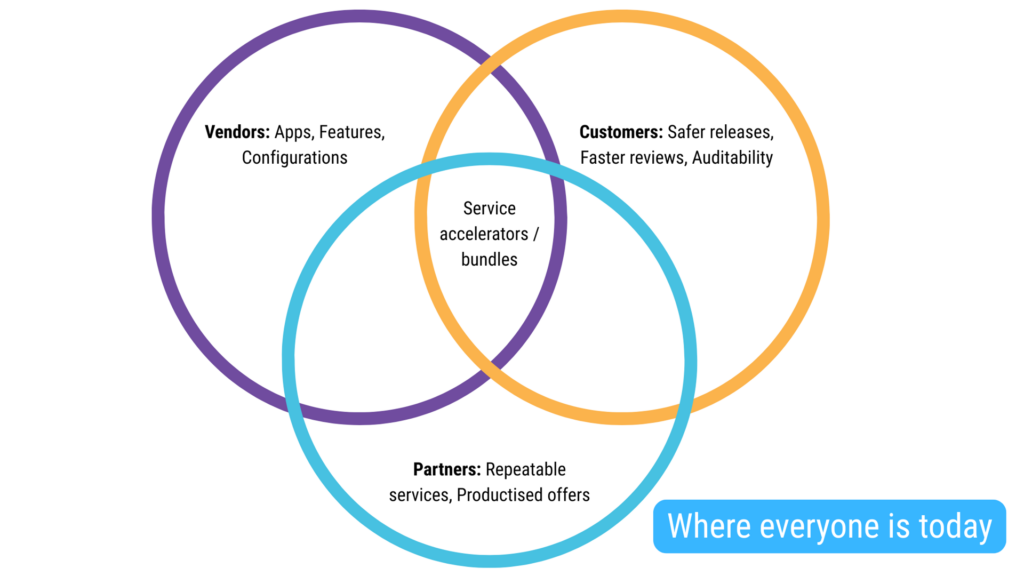
From “apps” to “accelerators”: how we now frame things
Instead of leading with products, we now think in terms of named service bundles a partner could actually put on a slide.
Examples:
- Release Readiness & Traceability
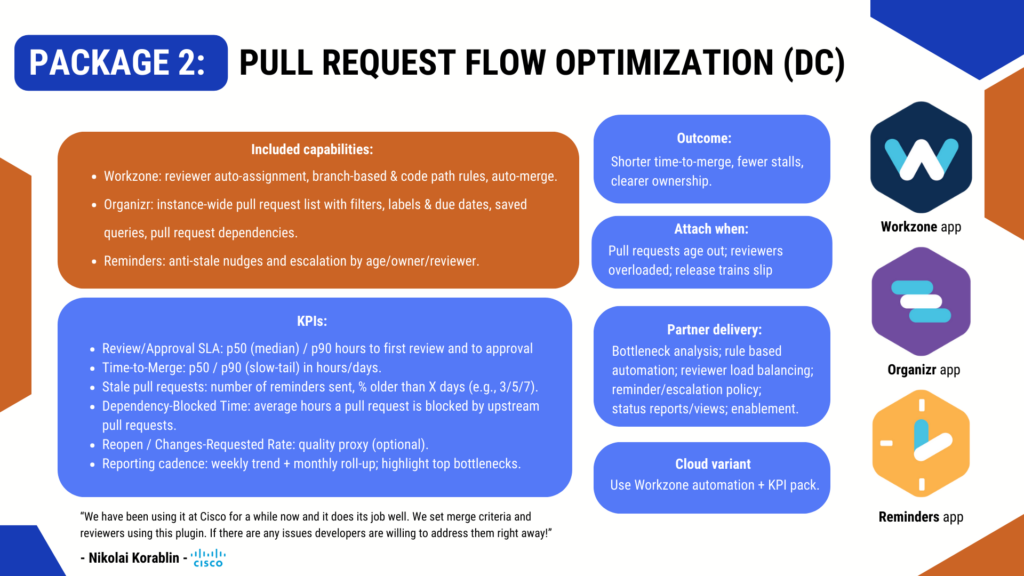
Help teams know exactly what’s going into a release, who approved it, and where it’s running. - Pull Request Flow Optimisation
Reduce cycle time and review fatigue by standardising how PRs move from “opened” to “merged”. - PR Governance & Compliance
Enforce review policies, approvals, and checks in Bitbucket — with the audit trail to prove it.
Each bundle has three layers:
- Outcome & story
- What problem it solves (“We keep getting surprised at release time”)
- Who cares (Dev, DevOps, Platform, Compliance, leadership)
- What “good” looks like (shorter lead time, fewer rollbacks, cleaner audit evidence)
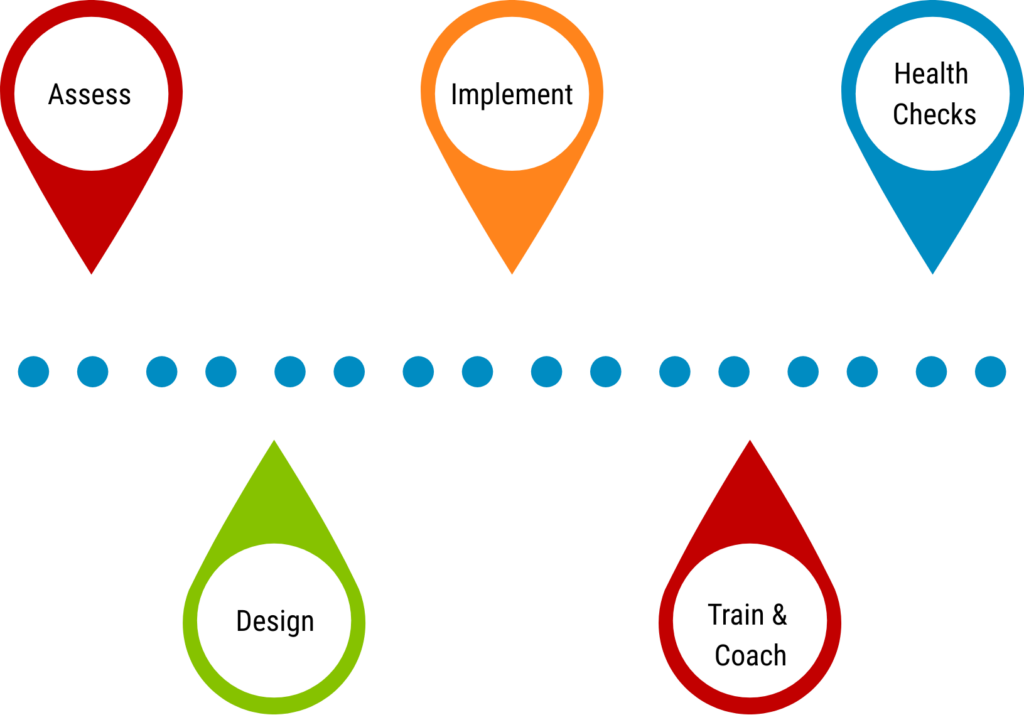
- Partner services
- Current-state assessment of Bitbucket and pull request practices
- Design of target workflows and governance policies
- Implementation in Bitbucket (and often Jira/Confluence around it)
- Training, coaching, and periodic health checks
- Our apps as accelerators
- Opinionated app configurations and templates
- Pre-built rules, guardrails, and dashboards that back up the service
- Documentation and examples tuned for delivery, not just admin toggles
So instead of saying:
“Here’s App X. It has features A, B, and C.”
…you can say:
“We offer a Release Readiness & Traceability package.
In 4–6 weeks, we’ll get you from ‘we hope this release is fine’ to
‘we know exactly what’s going out, and we can prove it’ — powered by Izymes’ Bitbucket accelerators.”
That’s easier to sell. And it’s much closer to how partners already position their services.
Why this approach makes sense for us as a vendor
Being candid: we’re not doing this just because it sounds nice on a slide. It also makes sense for us.
1. A value story that isn’t “yet another plugin”
When we talk to customers and partners in terms of:
- release safety,
- PR throughput,
- and governance,
it’s immediately clear why our apps matter.
It moves the conversation away from line-item features and towards business outcomes that budget owners actually care about.
2. Deeper, more deliberate adoption
When our apps are part of a structured engagement led by a Solution Partner:
- They get designed into real workflows, not just installed and left on defaults.
- There’s a clear rollout plan, training, and follow-up.
- People actually use the features we built.
That leads to more meaningful feedback, better renewals, and a product road map shaped by real use, not just wish lists.
3. Alignment with how partners make money
Partners make their money on:
- consulting and implementation,
- recurring managed services,
- and long-term client relationships.
If our apps are positioned as service accelerators, we’re not competing with that model — we’re supporting it.
We want you to be able to say:
“We have a packaged offer we can run over and over, and Izymes gives us the tooling and patterns to deliver it faster and more reliably.”
If partners win more work with our stack, and keep those customers happy, everyone wins.
What Solution Partners actually get out of this
Let’s look at it from your side.
1. Ready-to-productise service offers
You don’t have to start from a blank page.
We provide:
- named bundles (like Release Readiness & Traceability),
- a clear problem statement and outcome,
- suggested engagement structure (assessment → design → implementation → training → check-ups),
- and the recommended app combination and config patterns.
That’s the raw material for a repeatable, productised service you can price, quote, and reuse.
2. Faster time-to-value (with fewer “science projects”)
Because the patterns are already thought through:
- You spend less time rediscovering the same best practices.
- Delivery teams can lean on templates and reference configurations.
- Customers see tangible improvements sooner — which helps you make the case for phase two.
3. Higher margins with less delivery risk
Repeatability is where margins improve.
- You refine the same engagement pattern over time.
- You know which gotchas to avoid in Bitbucket and in team workflows.
- You can safely delegate more to your delivery team, because the playbook is already proven.
The apps simply act as the backbone that makes your process stick.
4. A differentiated story in the Atlassian ecosystem
Not every partner is walking in with an opinionated Bitbucket-centric DevOps offering. Or, for that matter, customers do not knock on your door with an exact Bitbucket-centric requirement spec.
Arriving with a named accelerator, clear outcomes, and tooling to back it up sends a different message:
“We’re not just here to turn things on.
We’re here with a tested way of working that we’ll adapt to your context.”
That’s powerful in competitive situations where customers are comparing several partners who all “do Atlassian”.
How we’re supporting partners behind the scenes
To make sure this isn’t just a PDF that gathers dust, we’re investing in enablement for partners:
- A Service Offering Deck you can adapt and rebrand for your own pitches
- Suggested implementation patterns, including typical phases and milestones
- Example configurations and rulesets you can use as a starting point
- Direct collaboration on real opportunities where our accelerators are a fit
We want it to feel less like “installing someone else’s app” and more like:
“We’ve teamed up with a vendor who understands how Bitbucket is actually used in the wild, and who has built tooling that supports the way we deliver services.”
If you’re a Solution Partner, here’s what you can do next
If any of this resonates and you’d like to see how it could fit into your Bitbucket / DevOps portfolio, we’re happy to share more.
You can:
- Download the Service Offering Deck
Get the current version of our partner-facing deck with example bundles, positioning, and talking points you can adapt. - Get in touch with us
Have a client or use case in mind already? Reach out and tell us a bit about your situation — we’ll happily suggest where our accelerators fit (and where they don’t). - Book a call to explore a joint offering
If you’d like to go deeper, we can walk you through the bundles, discuss how they map to your existing services, and look at co-selling options for specific accounts.
Drop us a line, grab the deck, or book some time — and let’s see if we can turn “a few Bitbucket apps” into a set of services that your customers will actually recognise, buy, and keep coming back for.
Was this helpful?
Thanks!

Sean Manwarring _Izymes_
0 comments