A sprint begins with a clear goal, committed stories, and aligned teams. Progress looks healthy in Jira: tickets are moving, standups are productive, and work appears on track.
Then something shifts.
A frontend story is waiting on an API change. QA cannot begin because an upstream issue is still unresolved. A release-critical feature quietly stalls because one dependency slipped, but the ripple effect was not immediately obvious.
Most Agile teams have experienced some version of this.
The challenge is rarely a lack of effort or ownership. More often, it is the complexity of connected work.
As organizations scale, work becomes increasingly interdependent. Teams rely on other teams, stories depend on upstream tasks, and delivery outcomes often depend on work happening in the right sequence. A single delayed issue can quietly trigger a chain reaction across sprint commitments, testing timelines, and release confidence - what many delivery leaders experience as a subtle but costly dependency domino effect.
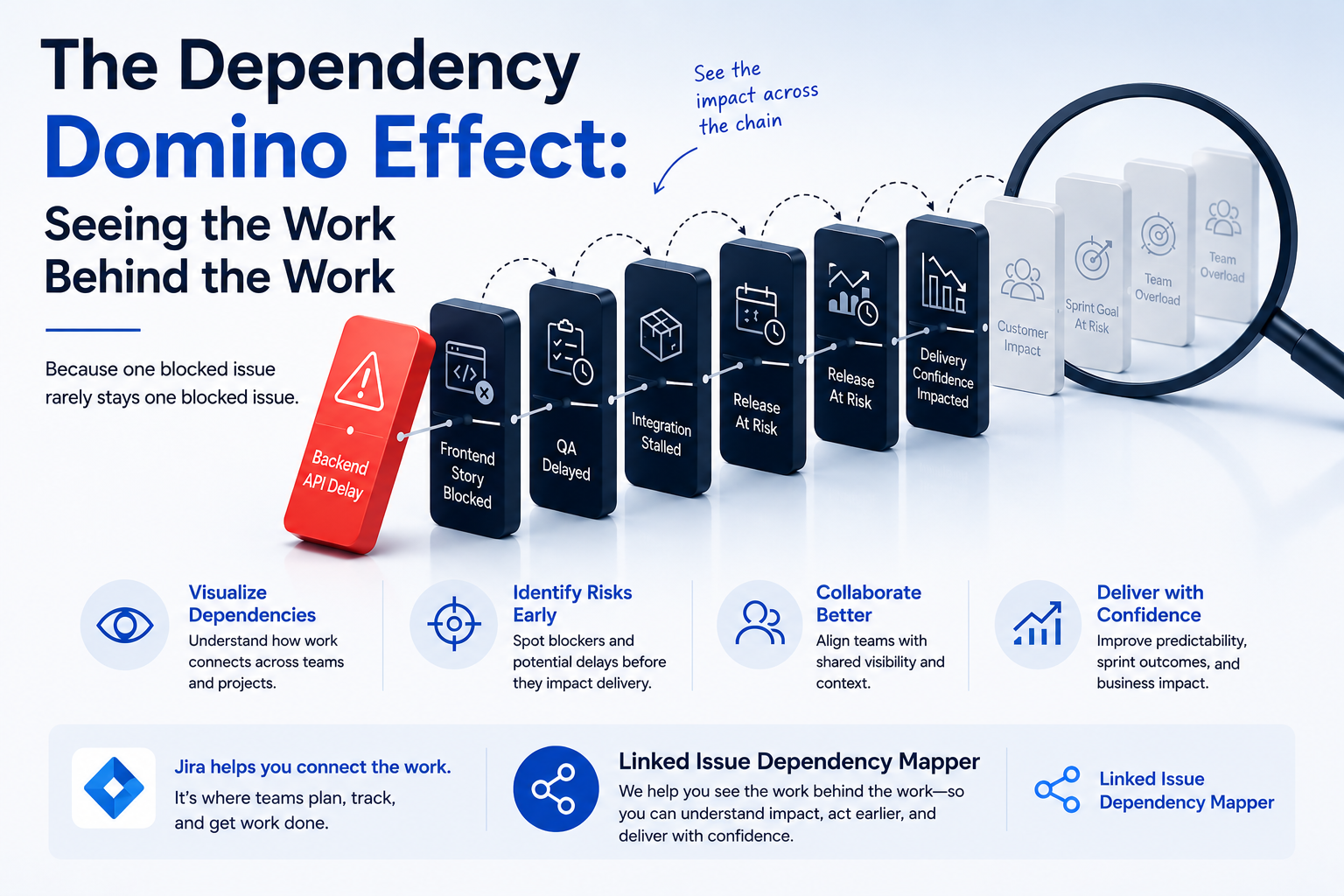
This is where teams benefit from seeing the work behind the work.
Jira already provides powerful capabilities to connect work through linked issues: blockers, dependencies, related work, and delivery relationships. These links create important context. They help teams understand not only what work is being done, but how work connects.
However, as delivery complexity grows, simply having linked issues is often not enough.
In environments with multiple teams, boards, and initiatives, it becomes harder to understand how one issue impacts another and where delivery risk is quietly building. Teams know work is connected, yet still struggle to answer practical questions quickly:
- Which work items are affected if this slips?
- What downstream stories or teams are now blocked?
- Which sprint commitments are becoming risky?
- Where should teams focus attention before delays compound?
Which is why we built Linked Issue Dependency Mapper.
The idea was straightforward: if work in Jira is already connected, teams should be able to better understand those relationships, surface blocked issues sooner, and understand how one delay impacts connected work.
Instead of navigating issue links one ticket at a time, teams can gain a clearer view of how work connects, understand impact sooner, and collaborate more effectively across interdependent teams. Scrum Masters can spot delivery risks earlier, Product Owners can make more informed decisions, and delivery teams can act before blockers begin affecting outcomes.
High-performing Agile teams are not simply good at delivering work. They are good at understanding how work connects.
Because in complex delivery environments, better outcomes often come from seeing the work behind the work.
How visible is the “work behind the work” in your team today?
