Community resources
Community resources
Community resources
Jira–SAP Integration: Structuring WBS Alignment for S/4HANA Enterprises
Many enterprises use Jira for delivery governance and SAP S/4HANA for financial controlling. This article describes a workflow-driven integration model that aligns Jira approval processes with SAP WBS structures through structured hierarchy design, controlled ETL synchronization, and financial validation guardrails. Based on a large-scale enterprise implementation, it demonstrates how to achieve stable year-end financial alignment and transparent cost reporting.

1. Motivation
Many enterprises use Jira Software as the governance layer for demand intake, prioritization, estimation, and delivery tracking, while SAP S/4HANA serves as the financial backbone for budgets, WBS structures, procurement, and accounting truth.
In an enterprise client engagement with several thousand end users, we encountered a scenario where Jira was already deeply embedded in technology and delivery processes, while a new SAP S/4HANA landscape required structured synchronization. The challenge was not a tool capability issue, but the need to align established governance workflows conceptually and technically with financial controlling structures.
This article outlines how we designed and implemented that synchronization in a scalable and enterprise-ready way.
2. The Enterprise Challenge: Delivery Intent vs Financial Enforcement
Jira is built for governance of delivery: capturing demand, running approvals, estimating effort, prioritizing the backlog, and controlling change. SAP S/4HANA is built for financial enforcement: WBS structures, budget availability checks, procurement constraints (POs), actual postings, and open commitments.
A scalable integration respects this boundary: Jira expresses decisions; SAP enforces what is financially real. Synchronization is therefore not “data copying”, but controlled lifecycle alignment.
In enterprise environments, this boundary must be explicit. Without a clear separation of governance responsibilities and financial enforcement, integration designs tend to create operational friction rather than stability.
The following sections outline practical principles and implementation patterns for designing an effective Jira–SAP integration model — from aligning business processes to ensuring clean data flows and long-term scalability.
3. Enterprise Model (Governance → Finance Alignment)
In one of our enterprise client engagements, we structured the Jira landscape around a governance model driven by financial accountability and SAP Controlling requirements rather than a generic portfolio hierarchy.
The structure was defined as follows:
- Demand Unit – representing the requesting cost center in SAP (budget owner).
- Project – serving as the stable financial and reporting anchor across fiscal periods.
- Project Work Package(s) – corresponding to the highest-level scope planning elements, representing major deliverables within the project.
- Delivery Request – In a matrix organization, execution capacity typically resides within line units rather than within projects themselves. A Delivery Request, therefore, serves as the formal mechanism for allocating resources from the line organization to a specific Project Work Package. It defines the scope, expected effort, financial treatment (e.g., CAPEX/OPEX), and the responsible Delivery Units for execution. From an integration perspective, the Delivery Request becomes the key planning and commitment object that links governance decisions in Jira to financial planning structures in SAP.
- Delivery Unit(s) – operational execution entities mapped to responsible cost centers for cost tracking, accountability, and reporting.
This structure ensured that financial ownership (who funds), delivery accountability (who executes), and project-level controlling (where costs are accumulated) remained clearly separated yet fully traceable across Jira and SAP.
Rather than defining a universal framework, the model emerged from the need to align an already established Jira governance landscape with SAP S/4HANA controlling requirements in a scalable and maintainable way.
4. Stable, Reportable WBS Mapping (Finance-Controlled)
| WBS Level | SAP Meaning (standardized) | Jira Data Model | Why this level exists |
|---|---|---|---|
| WBS-1 | Project (Root Planning Element) Requesting Cost Center = Demand Unit (Budget Owner) |
Project | Stable financial anchor across fiscal years; primary controlling object and budget container. |
| WBS-2 | Project Work Package (Planning Element) Represents major deliverables, including CAPEX/OPEX classification and the responsible supplier cost center. |
Project Work Package | Aligns major scope elements with financial segmentation and execution ownership; enables structured CAPEX/OPEX governance and reporting. |
| WBS-3 | Delivery Request (Planning Element) Commitment and resource allocation element within a matrix organization. |
Delivery Request | Formal mechanism to allocate execution capacity from the line organization to the project scope; planning and commitment bridge between Jira governance and SAP controlling. |
| WBS-4 | Delivery Unit (Accounting Element) Assigned to a specific responsible cost center. |
Delivery Unit | Procurement-ready level: enables cost tracking, posting, and controlled closure. Not always mandatory; some organizations manage differentiation at the Purchase Order level. |
| (PO) | Purchase Order (Accounting Document) | — | Procurement and financial postings remain SAP truth; Jira consumes status and results. |
5. Workflow-Driven Synchronization
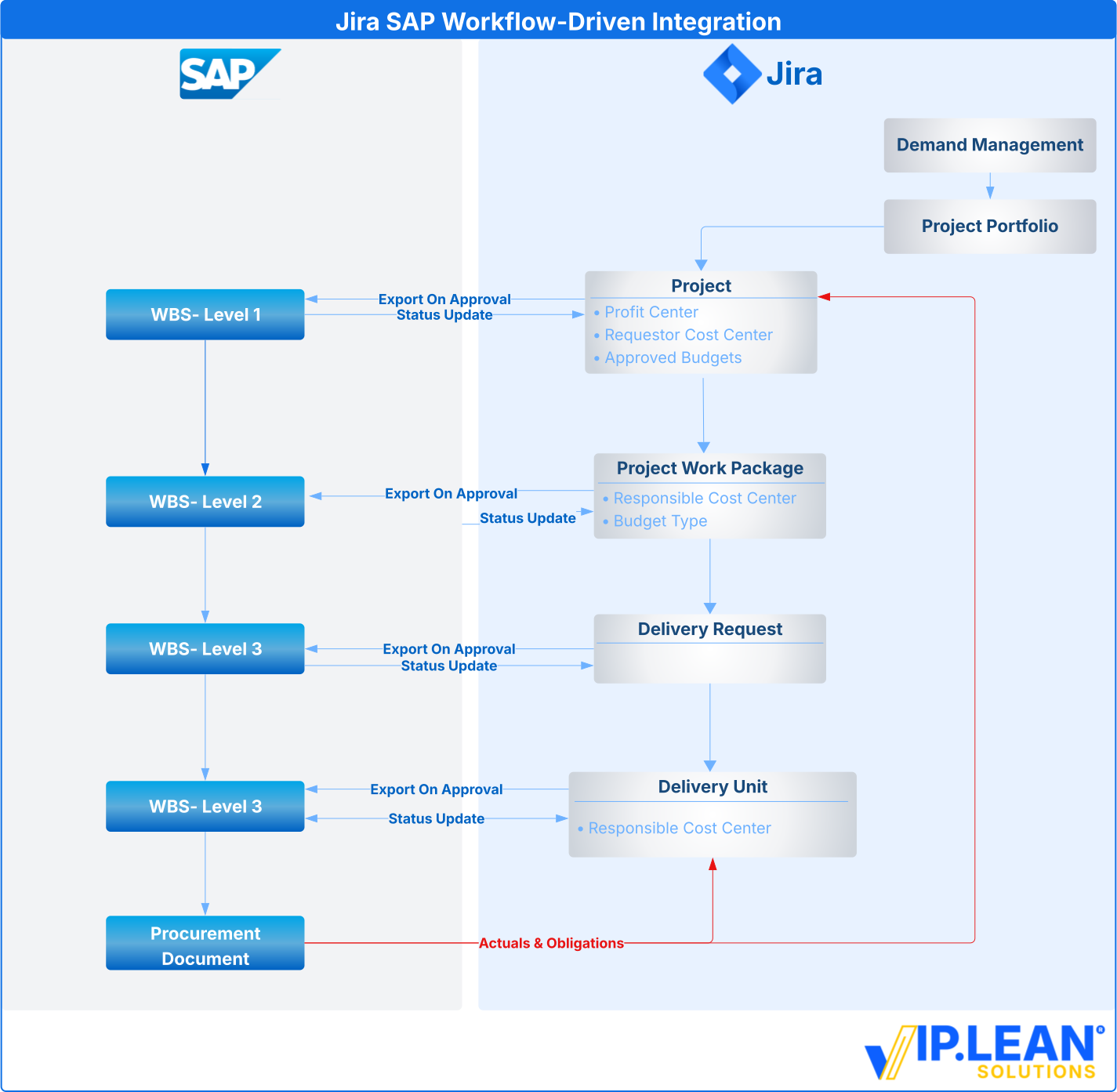
Avoid near-real-time “sync everything” designs that create conflicts and data drift. Instead, synchronize SAP only at clearly defined workflow gates that make information financially relevant (e.g., approval, commitment, closure).
The diagram below illustrates one possible workflow-driven synchronization pattern derived from an enterprise implementation. Such an approach requires a clean structural linkage within Jira itself. The relationships between Project, Work Package, Delivery Request, and Delivery Unit must be consistently modeled and easy to navigate. In our engagement, this was supported by structured issue linking and guided creation patterns to ensure traceability across all levels of the hierarchy.
The technical ETL implementation is described in a later section.
6. ETL Integration as Orchestration Layer
The ETL layer acts as an orchestration component rather than a simple data transport mechanism.
Based on structured Jira extracts and consolidated data in the integration database or data warehouse, the Python-based ETL processes determine when to trigger financially relevant updates in SAP. This includes, for example, creating WBS elements and controlled transfer of planned costs for financial tracking.
In the opposite direction, SAP provides structured financial reports — such as WBS overviews, Purchase Order reports, and Actuals and Commitments data. These datasets are synchronized back into Jira where relevant and, in parallel, fed into cost reporting pipelines.
Consolidated financial data is then made available to stakeholders through Power BI dashboards, ensuring transparency across governance, delivery, and controlling perspectives.
7. Closed-Loop Binding (Idempotence and Traceability)
A robust integration requires a persistent binding between governance and financial objects. For each relevant element, a binding record is maintained linking:
Jira item ↔ SAP WBS element ↔ correlation ID ↔ lifecycle state
This ensures that synchronization remains idempotent — meaning that reprocessing does not create duplicates — and that every SAP WBS element remains traceable to its originating governance object in Jira.
Such closed-loop binding is critical for auditability, operational stability, and long-term maintainability of the integration, especially in large-scale enterprise environments.
Rule-based linking mechanisms can further help maintain structural consistency as organizational models evolve over time.
8. Financial Guardrails (Reduce SAP Rejections)
To reduce downstream SAP rejections and financial inconsistencies, financial guardrails should be embedded directly into the governance workflow.
Examples include:
- Available Budget checks – preventing budget reallocations that would violate existing obligations or exceed approved financial limits.
- Available-to-Commit validation – blocking workflow progression if the requested commitment exceeds the currently available budget at the relevant WBS level.
By introducing these controls before financial updates are triggered, governance decisions in Jira remain aligned with SAP controlling constraints. This reduces late-stage procurement surprises, avoids rejected postings, and stabilizes financial reporting across systems.
9. Outcome and Operational Impact
In a large-scale enterprise environment with several thousand users, the Jira–SAP synchronization model delivered measurable improvements in financial alignment. Planned values defined during the delivery process in Jira were consistently reflected in SAP, resulting in a close alignment of Actuals and Commitments at year-end. Typical fiscal-year spillover effects were significantly reduced. In addition, integrated SAP data feeds enabled near-real-time cost visibility through Power BI dashboards. Project leads gained reliable Actual vs. Plan transparency with minimal latency, strengthening financial control throughout the delivery lifecycle.
10. Implementation Accelerators
To implement enterprise-grade delivery governance for Jira–SAP integration, Jira Software typically needs to be complemented by additional application capabilities. In practice, organizations often require structured hierarchy management, guided issue creation, dynamic field validation, and reliable reporting pipelines to keep delivery workflows aligned with finance-controlled SAP structures.
For customers building this governance model in Jira, VIP.LEAN Solutions typically supports the setup with the following Marketplace applications and components:
- VIP.LEAN Issue Pickers – structured and rule-based linking between Jira work items to maintain hierarchical consistency.
- VIP.LEAN Behaviours Builder – dynamic field control and validations to support process-compliant data entry. No code required.
- VIP.LEAN Create & Link – guided creation of linked work items with predefined field values.
Was this helpful?
Thanks!

Wajdi from VIP_LEAN Solutions
0 comments