In regulated industries (Automotive, MedTech, Embedded Systems), the V-Model is king. You need to prove that every user requirement links to a system requirement, which links to a test case, which links to a test execution.
The problem? Jira, out of the box, is built for flat lists and agile boards, not hierarchical V-Models.
One of the biggest fears we hear from clients (including our friends at HALready) is the "compliance tax." This belief is that being audit-ready requires slowing development to manually update traceability matrices.
This creates a dangerous dynamic where teams "code now" and "fix the paperwork later." That is exactly how projects fail certification or require massive rework right before launch.
Live traceability
The solution we advocate for (and build into RTM) is transforming the V-Model into a live, clickable structure within Jira.
Instead of a static matrix, imagine a tree structure where:
- Requirement (Issue Type A) is linked to...
- Test Case (Issue Type
 which generates...
- Defects (Issue Type C)
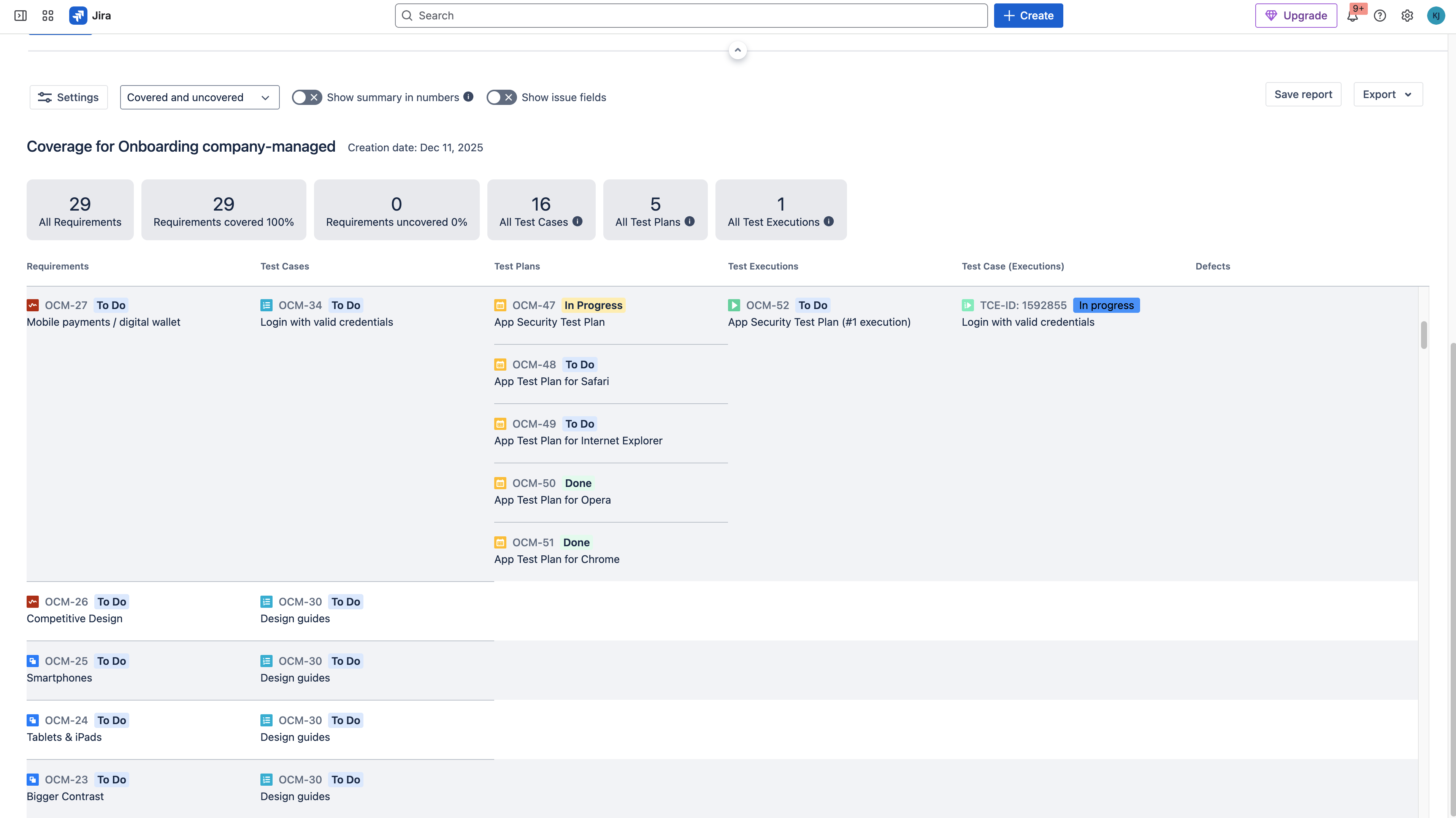
Coverage report in RTM for Jira
When this structure is native to Jira, reporting becomes instantaneous. You don't "create" a report; you just view the current state of the links. If a test fails, the requirement is automatically flagged as "Not covered" or "At risk."
Traceability shouldn't be a task you do at the end of the month. It should be a byproduct of your daily work.
Question for the Community: For those working in regulated environments, what is your biggest pain point when preparing for an audit? Is it the manual data entry or the disconnect between tools?
