How a recurring diagnostic routine — checking time in status, flow metrics, and issue history across every Jira work item — became an app.
Twenty years of leading delivery teams teach us a lot. We ride the waves — PMI and waterfall, then the Agile revolution, Scrum as the default starting point. The surprisingly powerful (and underappreciated) DSDM Atern Framework that opened doors to Scandinavian and British clients. And eventually, SAFe became the framework that finally gave large organizations a coherent language for scaling Agile at the enterprise level.
Then came Kanban and flow optimization — and honestly, this shift feels the most natural of all. When every engineer (and increasingly every non-engineer) gets a meaningful productivity boost from AI tools, reducing batch sizes and optimizing throughput matters more than ever. It's part of why we built Advanced Agile & Kanban Boards for Jira — to bridge the gap that native Jira boards leave open for teams serious about flow. But that's a story for another post.
This diagnostic problem is exactly what led us to build a Work Item Health Check for Jira — but first, let me describe the pattern itself.
The Problem That Never Goes Away
Here's something I've noticed across every methodology, every product, every company: the fundamental diagnostic work of a delivery manager never actually changes.
Regardless of the framework on the wall or the tools in the stack, you still find yourself scrolling through work item history, trying to reconstruct what happened — who did what, when, and in what sequence — to understand where the bottleneck is and how a piece of work arrived at its current state.
I caught myself doing this repeatedly. And when I started mapping out what I was actually looking for each time, the list looked like this:
Lean metrics
- Time in status — Where did the item slow down? What was the bottleneck?
- Cycle and lead time — How long since creation? How long was it actively in progress?
- Flow efficiency — Active time divided by total lead time, expressed as a percentage. Simple formula, surprisingly revealing.
- Flow returns — How many times did the item bounce back from Testing or Code Review to Development? Each return is a silent rework cycle and an efficiency killer.
Blockers recognition
- Impediment duration — How long was the item blocked, and what was the reason?
- Linked items - not many items are linked to this particular work item, and what to do with them
- Reassignments — Is this item being treated as focused work, or passed around like a hot potato?
Sprints and time constraints
- Due date risk — For teams using Gantt-style planning, is the remaining work aligned with the time left before the deadline?
- Logged work risk — Are we on track with hours, or quietly burning toward an overrun?
- Sprint integrity — Was the item moved between sprints? Added or removed after the sprint started? These sprint scope changes rarely surface in standard Scrum reports.
Individually, each check takes a minute or two if you know where to look. But multiply that across a backlog, multiply it by the number of people on your team who don't know where to look, and the cost becomes real — both in time and in dysfunctions that go undetected simply because no one ran the diagnostic.
The Idea
What if an app could run all of these checks automatically — from blocked time to flow efficiency — and instead of drowning you in raw numbers, translate the findings into a simple, intuitive score? Something like a school grading system: A through D, where A is healthy and D signals that action is needed.
And what if AI could then look at the pattern of scores across all dimensions and help you understand not just what is wrong, but why it matters — and point you toward the right resources to address the root cause?
That's the idea behind the Work Item Health Check for Jira.
What It Does
Work Item Health Check consolidates all diagnostic dimensions into a single Jira work item panel. Each dimension receives a score, and the scores combine to form an overall health grade. Instead of manually checking all potential disfunctions for each Jira work item — or building yet another report in a spreadsheet — the app automatically scores every dimension.
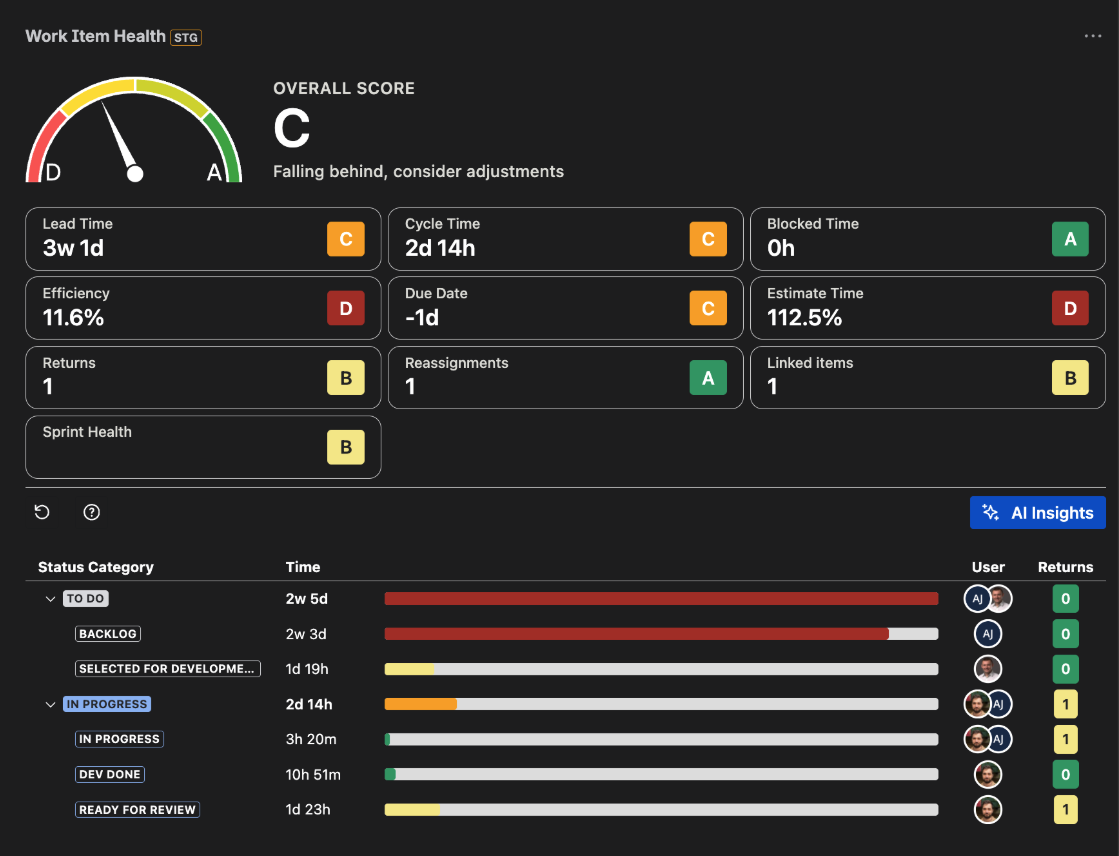
And an AI layer synthesizes the picture — surfacing insights you might miss when you're looking at one metric at a time.
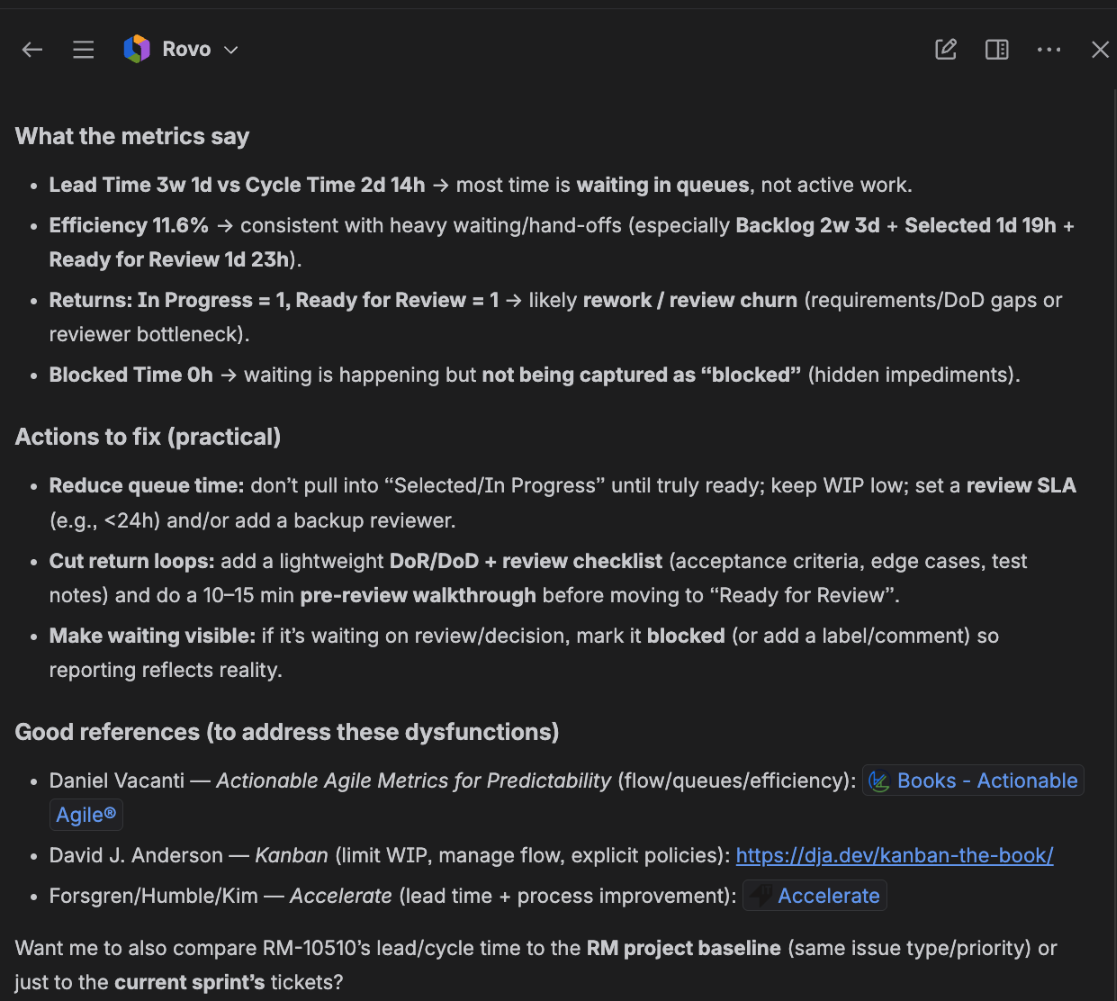
It takes seconds instead of minutes. And critically, it gives every team member — not just experienced delivery leads — a clear signal about whether a work item is on track or drifting toward a problem: excessive cycle time, repeated rework, or a quietly aging issue that everyone assumed was handled.
A few things worth highlighting for teams with security and compliance requirements:
- The app runs fully on Atlassian infrastructure (Runs on Atlassian / Forge-native), meaning no data leaves your instance
- We, as a developer of the app, are SOC 2 certified, so enterprise procurement conversations are straightforward
You might ask: doesn't Jira already have flow metrics? It does — at the board level. But when you need to understand why this particular work item has been in Code Review for four days, native insights won't tell you. That's the gap.
This Is an MVP — And That's Intentional
We're launching Work Item Health Check as a deliberate Minimum Viable Product (MVP). The diagnostic framework is solid, but the roadmap is long — and we want real feedback from real teams before we build the next layer of features.
If you recognize the scroll-through-history routine described above, we'd genuinely love your input. A free trial is available on the Atlassian Marketplace, and every piece of feedback directly shapes what we prioritize next.
Enable it as a work item panel in Jira and take it for a spin. We think the score will tell you something useful within the first five minutes. If you like it, turn it on for all work items by default. (There's a new menu item for each panel.)
Install Work Item Health Check from the Atlassian Marketplace, right now to score your first Jira work item
to see what the history tab has been hiding in plain sight. You'll know within five minutes whether this replaces your manual diagnostic routine.
