Introduction
In the early stages of building software products, engineering is mostly about speed—shipping features, iterating rapidly, and finding product-market fit. Engineering management at this stage focuses on optimizing delivery time, team efficiency, and technical execution.
But as the customer base grows, so does the volume of inquiries, incidents, production issues, and change requests. What once felt manageable begins to challenge team stability, delivery predictability, and engineer motivation. A common first instinct is to funnel everything into engineering backlogs like any other development task but this quickly reveals deeper systemic problems.
This article explores why that happens, what patterns leaders adopt to cope, and how an integrated “one flow” approach can help maintain both product momentum and customer satisfaction.
The Challenge: Balancing Product Development and Production Support
As customer-facing responsibilities increase, engineering organizations face a set of recurring tensions:
- Balancing new product development and customer support workload
- Maintaining predictable delivery velocity while reducing MTTI and MTTR
- Providing reliable delivery forecasts for internal and external stakeholders
- Keeping engineers motivated across both feature work and operational tasks
Left unaddressed, these competing demands might erode team morale, stretch timelines, and can ultimately slow both innovation and customer responsiveness.
Common Approaches: From Shared Responsibility to Dedicated Support
Many engineering leaders start by handling support within the same team. This is a workable approach for small teams with limited volume. As complexity grows, organizations often transition through recognizable stages:
Ring-Fencing Engineers Through Rotations
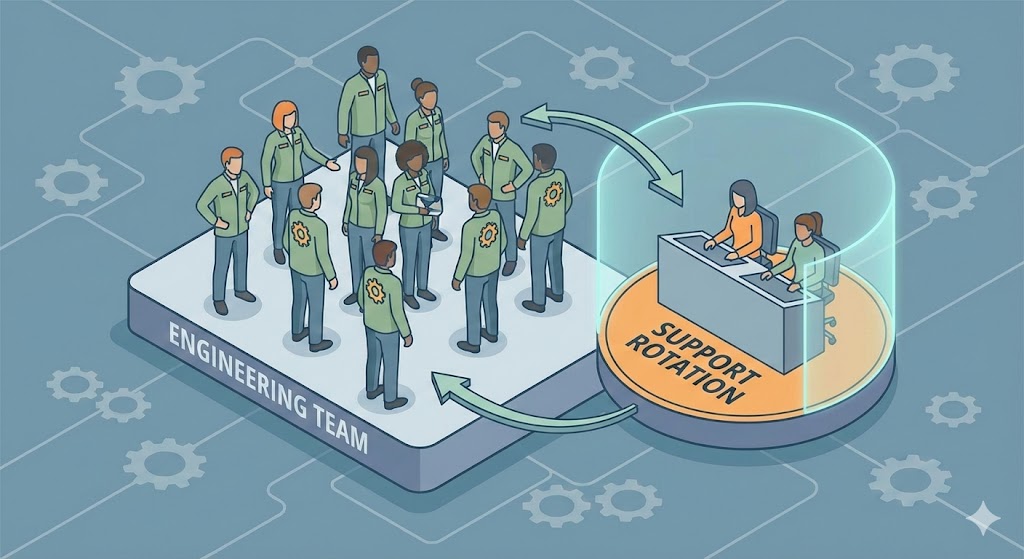
Engineers rotate into a support role for a sprint for Scrum teams or a week or two for Kanban teams.
| Pros | Cons |
- Maintains empathy for customers
- Ensures engineers stay close to production realities
| - Disrupts flow
- Creates unpredictable team velocity
|
Dedicated Support Teams
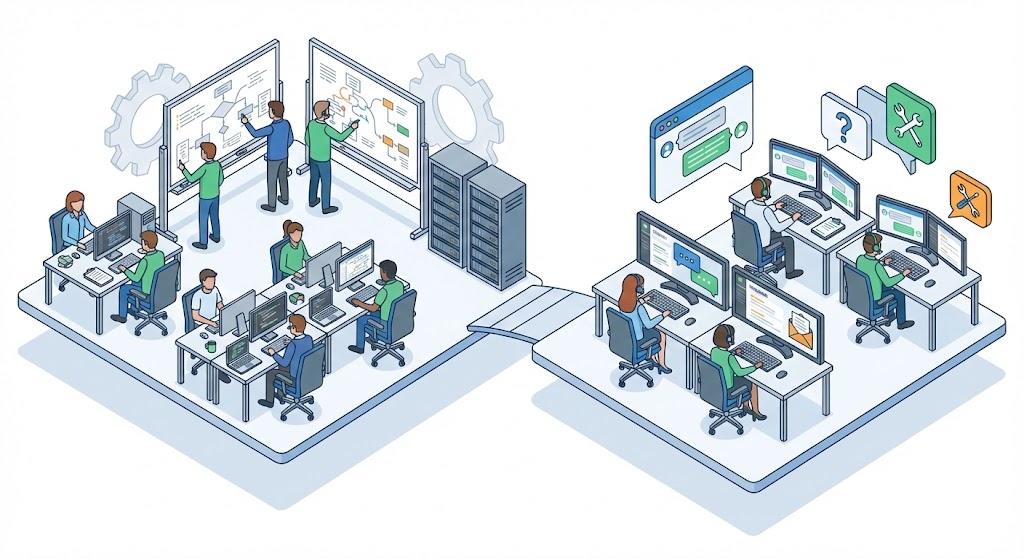
A team fully focused on customer cases and incidents.
| Pros | Cons |
- Faster response times
- Shield product development teams from operational noise
| - Risks of creating silos
- Can weaken shared ownership of quality and stability
- Product teams do not always get enough feedback from production issues and, therefore, are not motivated to eliminate production issues.
|
The question becomes: How can we maintain the benefits of specialization without losing the “one flow” culture?
The Hidden Culprit: Tools That Separate Instead of Connect
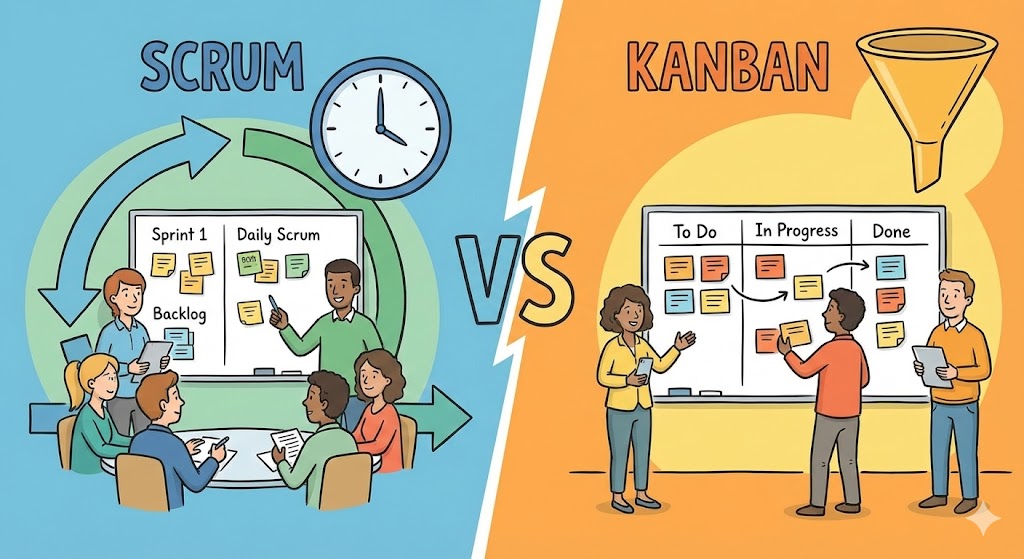
In many organizations, tooling unintentionally reinforces silos. Each team maintains its own board, workflow, and methodology:
- Engineering teams often select to operate in SCRUM, optimizing iteration planning and commitment.
- Support teams prefer to operate in KANBAN, optimizing flow and throughput.
This divergence is natural but it makes cross-team visibility difficult.
Ask yourself:
- How often do you view another team’s board?
- How easily can you visualize cross-team dependencies?
Jira offers strong capabilities for each team individually, but integrating multiple teams into a shared operational view remains challenging. This is where Marketplace Apps help bridge the gap.
One Unified Board: Integrating Teams Without Sacrificing Autonomy
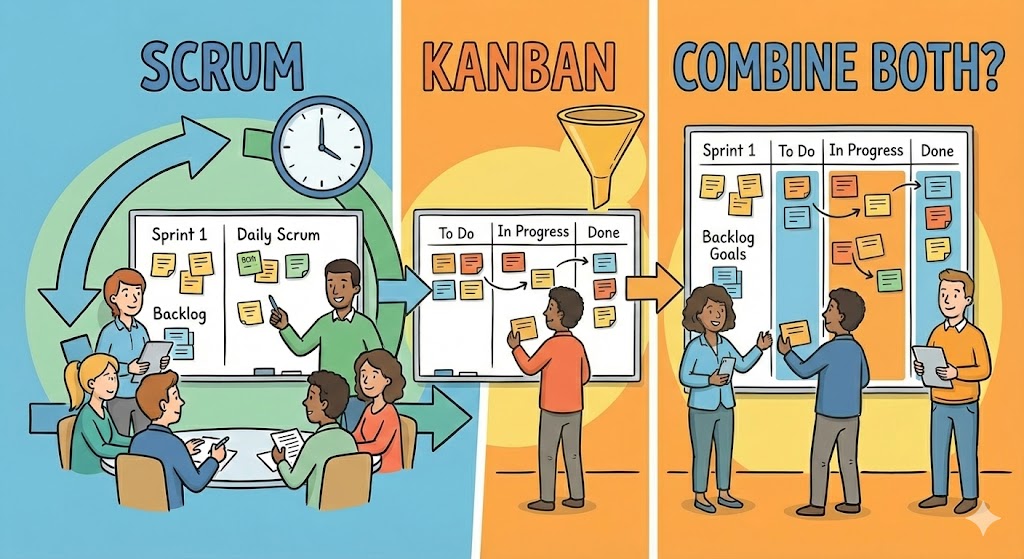
To promote true “one flow” collaboration, we need a shared place where engineering and support can see each other’s work while still maintaining their individual policies.
Combine Scrum and Kanban on the same board
Bring multiple SCRUM sprints and KANBAN lanes into one board as dedicated swimlanes. This instantly unlocks:
- Shared visibility
- Dependency mapping
- Real-time understanding of workload distribution
![[AAB.1] One Flow - Scrum and Kanban Conbined.png](https://us.v-cdn.net/6038660/uploads/images/419112i52BF4658A543B5B8/%5BAAB.1%5D%20One%20Flow%20-%20Scrum%20and%20Kanban%20Conbined.png "[AAB.1] One Flow - Scrum and Kanban Conbined.png")
Custom Views for Zoom-In / Zoom-Out Collaboration
Teams should be able to toggle between:
- Their own focused view
- A broader organizational view
This maintains independence while fostering collaboration.
![[AAB.1] One Flow - Board Views.png](https://us.v-cdn.net/6038660/uploads/images/419114i86EE752E2E418E15/%5BAAB.1%5D%20One%20Flow%20-%20Board%20Views.png "[AAB.1] One Flow - Board Views.png")
Empowering Scrum Teams: Manage Sprints Directly From Swimlanes
Scrum teams should be able to:
- Create and start new sprints
- Move remaining scope
- Estimate work
- Plan upcoming cycles
—all within their dedicated swimlane.
![[AAB.1] One Flow - Sprint Management.png](https://us.v-cdn.net/6038660/uploads/images/419115i6B2680C12E5E2CCE/%5BAAB.1%5D%20One%20Flow%20-%20Sprint%20Management.png "[AAB.1] One Flow - Sprint Management.png")
Supercharge Scrum with Kanban techniques
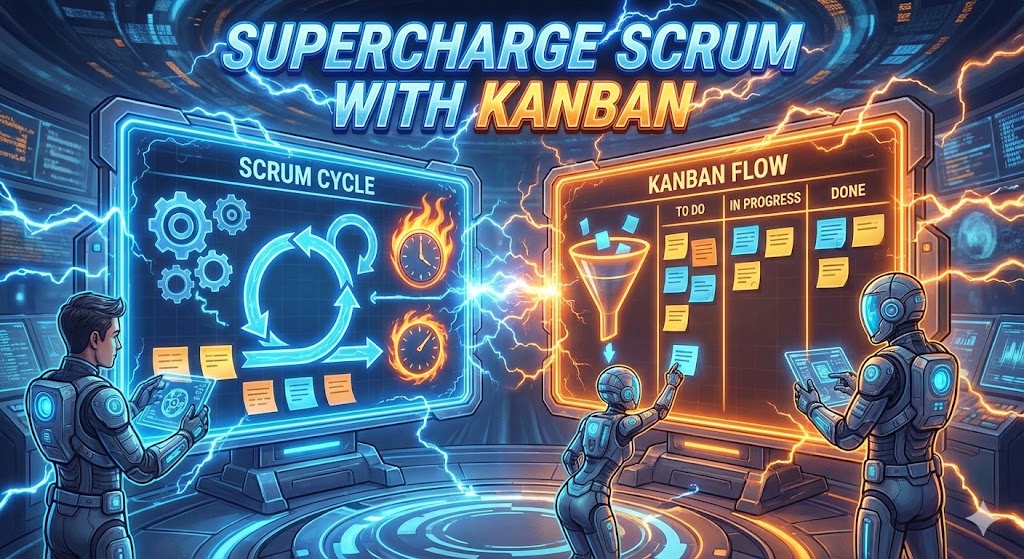
Mature Scrum teams can extract additional value by adopting selected Kanban techniques, including:
- A “doing–done” model to optimize queues and improve flow
- Personal WIP limits to reduce context switching
- Explicit exit criteria and policies to increase predictability and quality
These practices not only enhance Scrum performance, but also smooth the transition toward a Kanban-style flow when that becomes a more effective approach for engineering teams focused on delivering outcomes.
Empowering Kanban Teams: Optimize Flow Without Interference
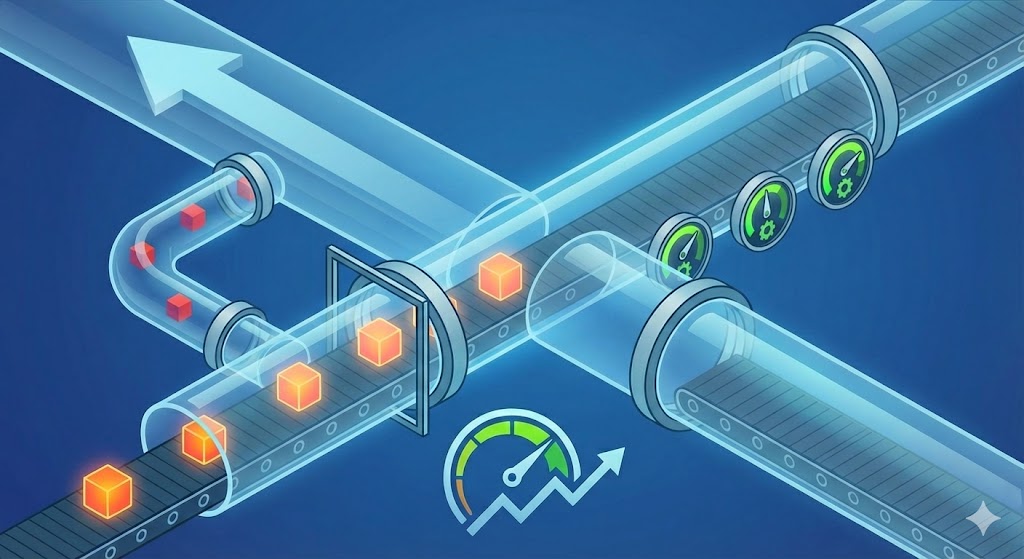
Kanban teams usually require:
- A combined set of WIP limits
- Cycle time insights
- Throughput analytics
- Return limits and efficiency metrics
—and they should manage it from their own swimlane without affecting Scrum processes.
![[AAB.1] One Flow - Kanban Flow.png](https://us.v-cdn.net/6038660/uploads/images/419121i8F48C7C8360F1928/%5BAAB.1%5D%20One%20Flow%20-%20Kanban%20Flow.png "[AAB.1] One Flow - Kanban Flow.png")
This integrated structure enables teams to learn from one another and adopt best practices across methodologies.
About Us
At Release Management Apps, we build elegant solutions that enhance cross-team collaboration and unlock true end-to-end visibility.
The screenshots above showcase features from our app Advanced Kanban & Agile Boards, which among other capabilities enables organizations to create a unified board for multiple teams—supporting autonomy while reinforcing a strong “one flow” culture.
