
Atlassian Team'25 Europe reinforced a fundamental shift: AI capabilities are becoming embedded across the entire development workflow. Specifically, Rovo Agents are emerging as intelligent assistants at every stage of the Software Development Lifecycle (SDLC), from initial requirements through to deployment. The impact is already visible - user stories are being decomposed into structured tasks, and those tasks are being converted into working code with unprecedented speed.
Yet for every Tester, QA Engineer and QA Manager, a critical question emerges: if AI is generating both requirements and implementation, what happens to quality assurance? As development velocity accelerates, the testing phase risks becoming the bottleneck. Test management tools integrated within Jira provide the structured environment where test cases and quality metrics live alongside development work, but the manual effort required to design comprehensive test cases remains significant.
This is where Rovo Agents transform the QA workflow. By bringing AI assistance directly into the test design phase, they can analyze requirements, understand acceptance criteria, and generate comprehensive test cases within Jira. In doing so, they establish a continuous 'Chain of Trust' from initial requirements through to quality-assured releases. To see this complete process in action, our webinar "AI-Powered Software Lifecycle in Jira with Rovo" demonstrates the end-to-end workflow, while this article explores how Rovo Agents complete the AI-powered SDLC for QA teams.
The QA Challenge: Where Velocity Meets Verification Bottlenecks
The pursuit of competitive velocity is the daily reality for every QA team. Yet, for all the progress made in development automation, the process of designing comprehensive test cases - the very blueprint for quality - remains a significant bottleneck. Consequently, this is a crucial point for QA Team Leaders navigating 2025's tight deadlines and complex compliance needs.
For Testers and QA Team Leaders, a familiar scenario plays out daily:
The Product team passes a complex User Story or Requirement. Translating this high-level concept into detailed, step-by-step test cases is time-consuming and prone to human error or misinterpretation, especially with rapidly changing requirements.
When timelines are tight, teams often compromise test coverage. They struggle to ensure that every new feature, potential edge case, and negative path is covered. Consequently, relying too heavily on "happy path" scenarios directly increases the risk of critical defects slipping into production, impacting product quality.
Test cases are living documents. When requirements or features change, every affected test case must be manually adjusted. This maintenance load often siphons valuable time away from actual test execution and high-value exploratory work, particularly when teams must design new test cases.
The slow, manual process of test case design can create a noticeable delay (or a communication breakdown) between the Dev and QA teams, reducing the speed of feedback and slowing down the entire agile cycle. This lack of alignment impacts the overall Software Collection velocity.
These challenges don't just affect the individual tester, they affect the entire SDLC. Specifically, a lag in test case design means a delay in test execution, which inevitably slows down the release cycle. Therefore, to keep pace with AI-accelerated development, AI must accelerate QA as well. Crucially, the solution lies in integrating intelligent automation directly into the tools testers already use every day.
Embracing the AI Wave: Appsvio Test Management as a Jira-Native Solution
Modern software testing no longer confines itself to the end of the development phase. Instead, Agile and DevOps methodologies demand continuous verification at every sprint, making test management tools that operate natively within Jira essential for maintaining seamless integration and traceability. When testing lives in the same ecosystem as planning and development, teams can respond faster to changes, track quality metrics in real-time, and ensure that nothing falls through the cracks. This integration becomes even more powerful when combined with AI capabilities that can accelerate the most time-consuming aspects of the QA process.
Where is AI used in Software Testing?
AI is already impacting several key stages of the software testing process, moving beyond simple automation:
-
Test Generation: Creating initial test scripts or logical test cases from high-level requirements.
-
Test Prioritization: Predicting which tests are most valuable to run based on code changes or risk analysis.
-
Defect Triage: Automatically analyzing defect descriptions to route them to the correct teams or suggest fixes.
The most transformative application, however, lies in Test Generation and Design, as it directly tackles the initial bottleneck of the QA cycle.
Taking a Look at Appsvio Test Management (ATM)
Appsvio Test Management (ATM) is an example of a native Jira test management tool. It is a solution designed from the ground up to be a seamless extension of the Jira ecosystem. It offers a true 'single source of truth' for all QA activities.
Key features that make ATM a future-proof choice for testers:
ATM is built entirely on Atlassian's Forge platform. This guarantees a native look and feel, enhanced security (no data egress), and ensures the fastest possible evolution alongside the Atlassian ecosystem. This rapid evolution is particularly important when adopting new technologies like Rovo.
ATM treats testing elements (Requirements, Test Cases, Test Plans, Test Executions, Defects) as native Jira work items. This means the app respects existing Jira workflows, permissions, and views, reducing onboarding friction.
ATM excels at connecting requirements to test cases, test executions, and defects. This integration provides comprehensive traceability and Test Coverage reports for confident decision-making and compliance.
In the ATM environment, testers traditionally create Test Cases by manually defining the logic, setting up the Test Steps (Action, Data, Expected Result), and linking them back to the Jira Requirement. This process is robust, but it is precisely where the ATM Rovo Agent – Test Case Architect provides its dramatic boost in efficiency.
From Requirement to Test Case: The Rovo Agent’s Precision
The next step in the evolution of QA is here. As ATM is built on Forge and is a true Jira-native tool, it positions itself ideally to quickly adopt and implement the newest advancements in the Atlassian Ecosystem. This includes, specifically, the arrival of Rovo. This means the powerful AI capabilities of Rovo can now operate directly on your testing data within the security and context of your Jira instance.
How Testers Use the ATM Rovo Agent in their Work
The process begins with the core input: the Requirement.
-
The Quality of the Requirement is Key: Just as the Rovo Dev Agent relies on a well-written User Story, the Rovo Agent for QA relies on a clear Requirement. Ambiguity in the input leads to ambiguity in the output. The best QA teams ensure their Jira tickets have specific acceptance criteria and follow best practices for clarity. Structured formats (like bullet points) make it easier for the Agent to process and generate high-quality test steps.
-
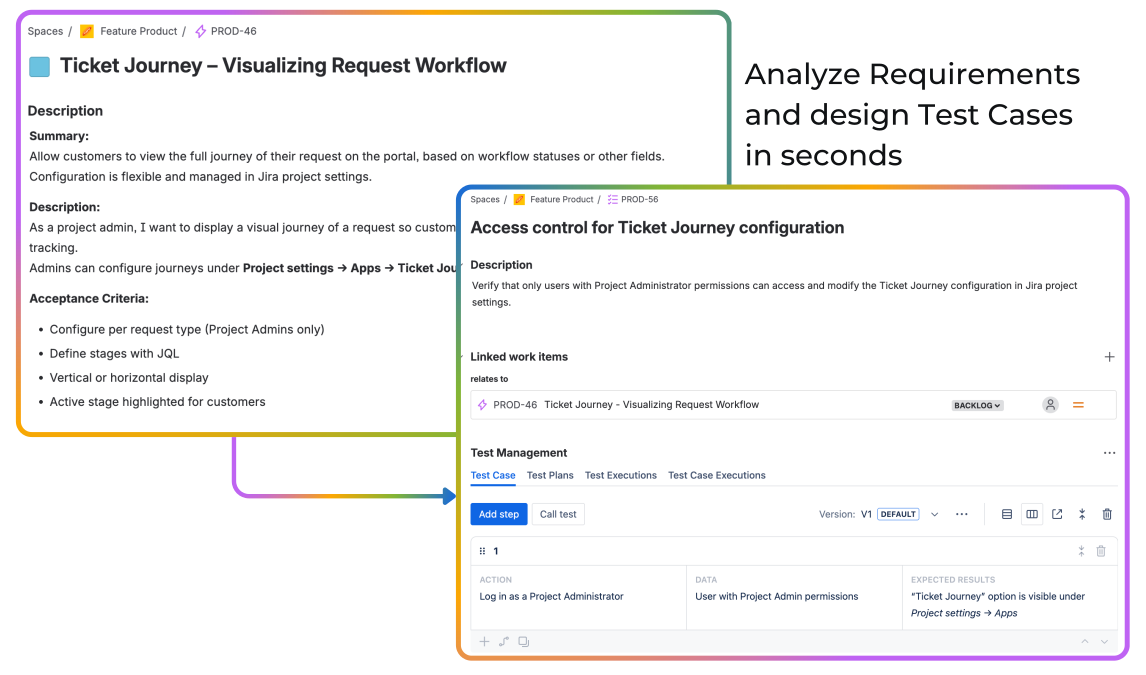
Test Case Generation Based on Requirement: Once the Jira Requirement is open, the tester invokes the Rovo Agent. Rovo instantly analyses the text of the Requirement, including the summary, description, and comments. It then suggests a set of relevant, comprehensive Test Cases.
-
Multiple Strategic Versions: The Agent doesn't just offer one static answer. It suggests multiple versions of the test case logic, such as a ‘Happy Path’ test, a ‘Negative Scenario,’ or a ‘Boundary Condition’ test. The QA expert remains in control, choosing whichever version or combination best fits the desired test strategy. This prevents the Agent from falling into the common trap of only covering the positive flow.
-
Actionable Test Steps with Precision: Crucially, the Rovo Agent automatically divides the suggested Test Case into fully actionable test steps. These steps are structured with the three core components necessary for execution:
-
Native Jira Work Item Creation: Once the tester is satisfied with the Agent’s suggestion (and has perhaps made a final tweak by adding missing test data or more specific edge cases), the Agent creates the Test Case. The Agent automatically generates this new Test Case as a native Jira work item (with the correct work type applied as per the Testing Setup). It links the Test Case back to the original Requirement, making it ready for inclusion in a Test Plan.
This integration fundamentally shifts the tester’s role from manual writer to strategic editor and quality gatekeeper. While human judgment remains as crucial as ever, Rovo handles the repetitive documentation.
How the Rovo Agent in ATM Empowers Your Team
The deployment of the ATM Rovo Agent delivers immediate, measurable benefits to testers and QA teams. It directly solves the bottlenecks outlined earlier and helps teams keep pace with development velocity:
|
Benefit
|
Impact on QA Teams
|
|
Massive Velocity Increase
|
The time required to design complex Test Cases is slashed from hours to minutes. This allows QA to start Test Execution earlier in the sprint, enabling true continuous feedback and faster time-to-market.
|
|
Guaranteed Coverage & Quality
|
By generating multiple strategic test cases (happy path, negative, boundary), the Agent significantly increases the breadth and depth of test coverage, reducing the risk of critical defects.
|
|
Focus on Strategic Value
|
The Rovo Agent handles the manual documentation work. This frees up seasoned QA Engineers to focus on high-value activities: exploratory testing, complex test automation scripting, and process improvement.
|
|
Seamless Traceability
|
The Test Case is a native Jira work item, meaning the link to the original Requirement is instant and automatic. This strengthens the Chain of Trust and makes generating Test Coverage reports - a critical task for QA Managers - simple and highly accurate.
|
|
Future-Proofing Your QA
|
By operating on the Forge platform, Appsvio Test Management ensures that your testing solution evolves alongside Atlassian’s commitment to AI, keeping your team at the forefront of the industry.
|
This change is not about replacing human expertise. It’s about augmenting your QA team in ways that let them tackle bigger challenges. They can then verify more complex systems and deliver better results with absolute confidence. The tester's strategic judgment and eye for detail are amplified, not diminished.
The Future is Fully Integrated
The AI-powered development lifecycle is no longer a concept - it is a reality. Just as a revolution transformed the transition from Requirement to Code, it now transforms the path from Code to Quality with the same powerful force. The Test Case Architect in Appsvio Test Management is the final piece that completes the entire AI software lifecycle within Jira.
It establishes a verifiable, intelligent link from the initial idea, through development, and into comprehensive quality assurance. This full integration is the key to maintaining competitive velocity while ensuring robust quality assurance in the era of AI.
Understand how to turn AI into a strategic partner for your QA team and see the complete AI development workflow in action.
Check out the webinar session on our Youtube channel!
