Hi there!
I'm Elena from Elevatic.
If your team is anywhere on the road from Data Center to Atlassian Cloud, this one's for you, because the number that gets your migration approved is rarely the number you end up paying.
Here's what I mean 👇
TL;DR
Atlassian's Data Center end of life on 28 March 2029 has turned cloud migration from a choice into a deadline, and most enterprise budgets model it as a like-for-like swap of one subscription line for another. That model is wrong. The real total cost of ownership (TCO) of Atlassian Cloud is driven by five compounding forces the sticker price hides: annual list-price increases that stack on every renewal, marketplace apps that re-price per user in the cloud, tier upgrades forced by feature repackaging, peak-usage billing, and 18–24 months of paying for two environments at once. This post gives finance leaders a structured way to model the real number, spot the budget surprises before they land, and build a business case the board will actually approve.
You approved the migration business case. The per-user cloud subscription looked competitive compared to the Data Center renewal, the payback math met the hurdle rate, and the project was funded. Eighteen months later, the run-rate is 30–40% above the number in that deck — and no single line item explains it.
This is the pattern finance teams keep repeating. The published per-user price is the one number everyone models, because it's the one number Atlassian puts on the pricing page. But per-seat pricing reflects the platform's cost in steady state. It says nothing about what it costs to get to that state, and very little about how the bill behaves once you're there.
The gap between the two is the hidden total cost of ownership. It isn't hidden because anyone is concealing it — every component is documented somewhere. It's hidden because it lives in five different places on the invoice, compounds at different rates, and never appears in the one comparison most business cases are built on: this year's Data Center renewal versus next year's cloud subscription.
This post is written for the person who has to defend the number to the board. It breaks down the real TCO into its drivers, shows where the surprises come from, and lays out how to build a business case that withstands scrutiny by the actual invoices.
Start from the deadline, because the deadline sets your leverage
Every TCO conversation now happens under a clock. Atlassian has confirmed that Data Center products reach end of life on 28 March 2029, after which subscriptions and associated Marketplace apps expire and environments become read-only — you keep view access, but create, edit, and workflow actions stop.
Two earlier dates matter more for budgeting than the 2029 headline. From 30 March 2026, new customers can no longer buy Data Center. From 30 March 2028, existing customers lose the ability to expand user tiers or add Marketplace apps to their Data Center estate. Because a full enterprise migration typically runs 18–24 months of planning, approvals, and execution, the practical window to begin in earnest closes around mid-2027.
Why this belongs in a cost discussion: leverage is a function of time. Atlassian's most aggressive cloud migration discounts — commonly cited in the 30–50% range, conditional on a multi-year cloud commitment — are offered in the final quarter of your Data Center renewal cycle. An organization that starts early can run those discounts against a modeled TCO and negotiate. An organization that starts late is negotiating against its own deadline, which is no negotiation at all.
Model five cost drivers, not one subscription line
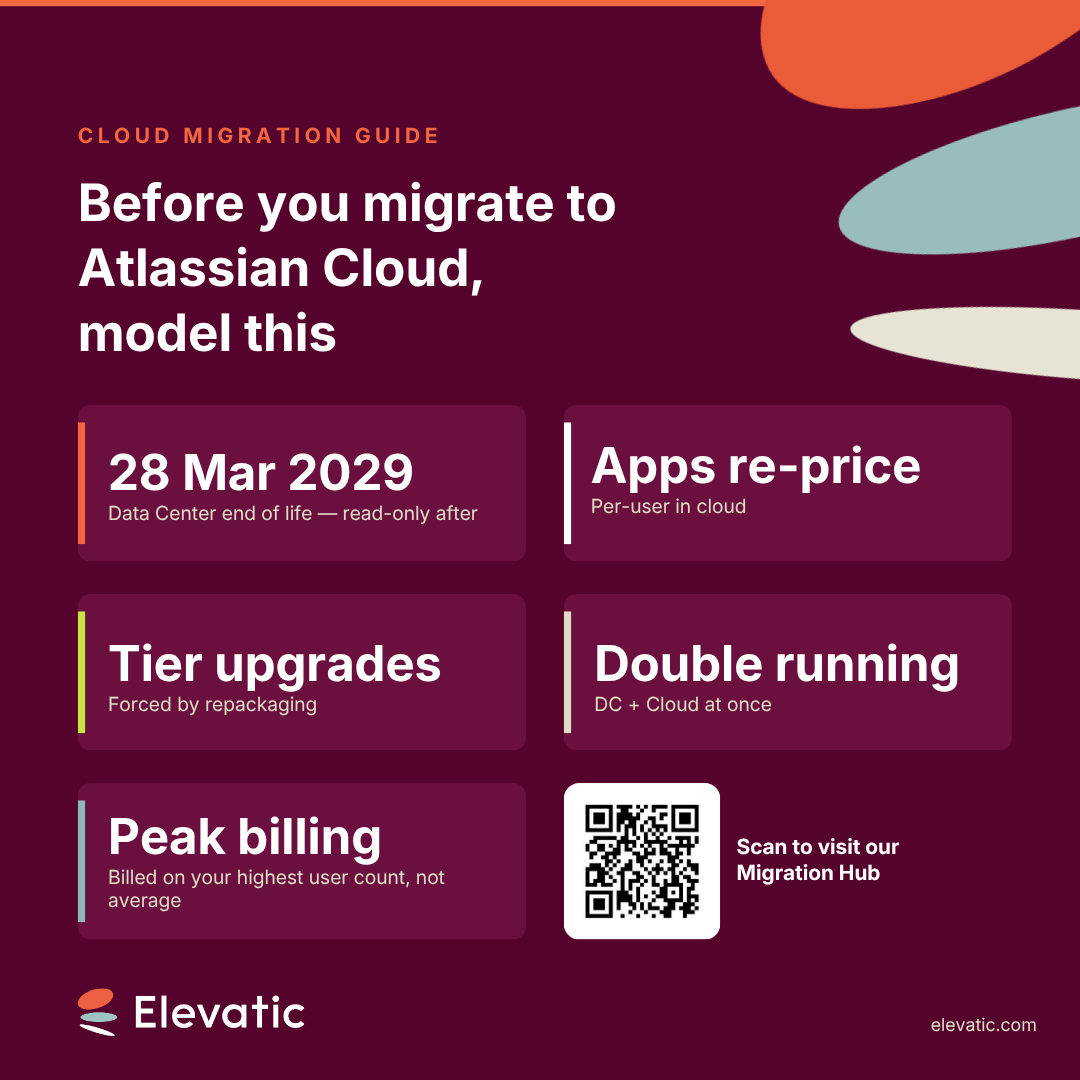
A defensible TCO model separates the recurring platform cost from the one-time transition cost, then breaks each into its real components. Here are the five that most often blow the budget.
DRIVER 1 — LIST-PRICE INCREASES THAT COMPOUND
Atlassian raises cloud list prices roughly every 12–18 months. The October 2025 increase was 5% on Standard, 7.5% on Premium, and 7.5–10% on Enterprise across Jira, Confluence, and Jira Service Management. On the Data Center side, a further increase took effect on 17 February 2026, with customers on legacy "Advantage" pricing reportedly seeing hikes as steep as 40% as their rates aligned to standard list.
The modeling error is treating any one increase as a one-time event. It isn't — each increase raises the base that the next increase is applied to. A three-year business case based on today's list price understates the year-three run rate. Model a recurring annual escalator (a mid-single-digit percentage is a defensible planning assumption) rather than a flat line, and your TCO will stop drifting north of the deck.
DRIVER 2 — MARKETPLACE APPS THAT RE-PRICE IN THE CLOUD
On Data Center, marketplace apps are licensed to your user tier. On Cloud, they become per-user subscriptions billed alongside the core products — and many cost more per user than their Data Center equivalent. Some Data Center apps have no cloud version at all, forcing a replacement that carries its own migration and retraining cost.
At enterprise scale the app bill is not a rounding error. Industry analysis puts a typical enterprise Jira deployment at roughly $80,000 to $250,000 per year in marketplace subscriptions on top of the Atlassian licence. For a 100-user team, apps typically add 35–75% to base Jira licensing. The discipline that controls this: inventory every installed app, confirm each is actually used, verify it has a cloud version and at what price, and drop the rest before you migrate — because every app that survives the move becomes a recurring per-user cost.
DRIVER 3 — FORCED TIER UPGRADES FROM FEATURE REPACKAGING
The least-visible driver is repackaging. In its 2024/2025 changes, Atlassian moved most incident, problem, and change management capabilities in Jira Service Management from Standard to Premium. Standard customers got a grace period, after which access was revoked unless they upgraded. For teams that had built their ITSM processes around those features, the move to Premium represented roughly a 124% per-agent increase for the same functional coverage they already had.
Related capabilities push the same way. SAML SSO and SCIM provisioning require Atlassian Guard, a separate paid add-on that applies to every user in your organization; for a 100-user Standard team that can mean $2,400–$4,800 per year on top of base licensing. The lesson for the model: don't budget the tier you'd like — budget the tier your actual feature requirements will force you onto, and treat future repackaging as a live risk rather than a fixed input.
DRIVER 4 — PEAK-USAGE (MAXIMUM QUANTITY) BILLING
Atlassian's maximum quantity billing model charges based on your peak user count during a billing period, not the average. For organizations with seasonal contractors, rotating staff, or M&A churn, this quietly inflates the bill without any change in steady-state usage. Two organizations with identical average headcount can pay materially different amounts if one has spikes. If your workforce fluctuates, model the peak, not the mean — and tighten user offboarding, because a licence that lingers is a licence that bills at the peak.
DRIVER 5 — THE PARALLEL-RUNNING PERIOD
This is the big one-time cost, and the one most often missing entirely. For the 18–24 months a migration takes, you run Data Center and Cloud simultaneously, paying for both. Atlassian often grants a free or discounted dual-running window as a migration incentive — but its length and scope are negotiable, and a window that's too short forces either a risky big-bang cutover or paying twice.
On top of dual-running sit the transition costs proper: professional services or internal labor to move data, re-subscription of every retained app, compliance re-certification, retraining thousands of users, and the productivity dip while teams learn new workflows. A common planning benchmark is to budget 20–30% of annual licensing for implementation services. None of this appears on the per-user pricing page, and all of it belongs in year one of the model.
Build the business case around net value, not gross cost
If the five drivers were the whole story, no CFO would ever approve the move. They aren't. The same rigor that surfaces hidden costs should be applied to the benefits — and the credible benefits are hard-dollar, not aspirational.
Forrester's Total Economic Impact study of Atlassian Cloud Enterprise modeled a composite 2,750-subscription organization and found a 230% three-year ROI with a net present value of roughly $2.4M and a payback period under six months. Crucially, that return is driven by quantifiable line items — eliminated Data Center license and infrastructure cost, recovered administrator time, avoided outage hours, reduced audit fees, and faster onboarding — rather than soft productivity claims. Treat vendor and analyst ROI figures as inputs to your model, not conclusions: re-run them against your own headcount, app estate, and infrastructure baseline.
A board-ready business case does three things a subscription comparison doesn't:
-
Models three and five years, not one. The steady-state cloud list price is often higher per user than Data Center; the case is won on eliminated infrastructure, admin, and outage cost over time, so the horizon has to be long enough to show it.
-
Separates one-time from recurring. Parallel-running and migration services are heavy in year one and gone by year three. Blending them into a single annual figure makes the run-rate look permanently worse than it is and gets good migrations killed.
-
Runs a sensitivity analysis. Stress-test the assumptions that move most: the annual price escalator, the app re-pricing delta, the length of the dual-running grant, and the tier you'll actually land on. A case that only works at the optimistic end of each isn't a case — it's a hope.
Key Takeaway
The mistake isn't migrating to Atlassian Cloud. For most enterprises, the move is both mandatory and, modeled honestly, net-positive. The mistake is treating a platform migration as a procurement swap — one subscription line traded for another — when it is a multi-year change to your entire cost structure.
Model the cloud the way you'd model any infrastructure investment: a recurring cost that escalates, a set of dependent costs (apps, tiers, add-ons, peak billing) that move with it, and a front-loaded transition cost that has to be earned back over three to five years. The organizations that get blindsided are the ones that budgeted the sticker price. The ones that build a defensible case — long horizon, one-time costs separated out, assumptions stress-tested — arrive in the cloud with the number they promised the board and the leverage to negotiate it down.
Treat total cost of ownership as infrastructure, not an afterthought. The deadline is fixed; the size of the surprise is still up to you.

