I'm sure that similar questions have been asked before, but the answers I've found either describe something I've already tried or are not quite what I'm looking for.
Background:
We are currently just one agile team within the organization, but it has been decided that we should adopt SAFe, primarily because of the long-term planning provided by Program Increments (PIs), I believe. Our Product Owner doesn't have much time to manage the backlogs, so we need a good way to organize and group the issues. Initially, we used Trello, but when I assumed the role of Scrum Master, I wanted a tool that better supported iterations than Trello.
We began with a team-managed project using the Scrum template, but we have discovered that some of the functionality we desire is only available in company-managed projects. I have never used Jira before, and I have been struggling for quite some time now to set up a new company-managed project with boards and workflows that accurately reflect the lifecycle of our issues, so any help regarding what I should do and in which order would be greatly appreciated.
I will attempt to describe the process that we need Jira to support.
Process:
The process can be divided into three phases. The first phase is the design phase, where issues originate as ideas and undergo maturation. Issues can remain in this phase for an extended period, and it is best supported by the Kanban project type. The Scrum project type, with its sprints, is not required here. At the end of this phase, ready issues are kept in a product (ART) backlog until they are selected for development.
The next phase is the development phase. During this phase, we utilize sprints, and only matured issues that are chosen for development should appear in the team backlog. Here, the issues can be ranked, estimated, and planned into sprints, making the Scrum project type ideal for this phase. If capacity is insufficient or priorities change, issues can be returned to the product backlog. The story points accumulated during development should contribute to the completion of the sprint. Once the sprint is finished, the completed issues should move on to the final phase.
The final phase is external validation. In many ways, this phase is similar to the first phase as it does not require sprints, and issues can remain here for an extended period until they are released.
I've tried to model the entire workflow like this: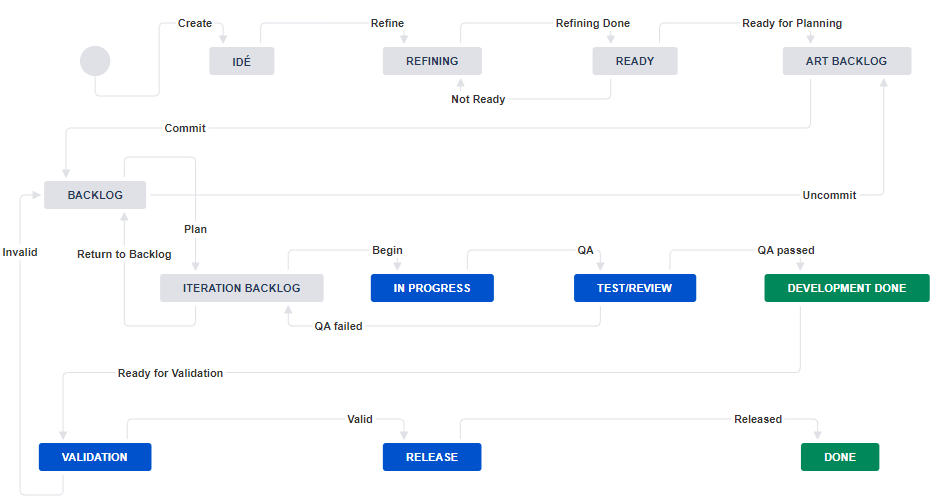
This almost worked, except that the "Backlog" would either be empty, contain the newly created issues from "Idé" (Idea) and/or require "Backlog" to be a column in the active sprint boards - although that column would be empty.
In time some issues types should only appear in some places which could be handled by different filters on different boards.

