Updated September 2026: References to "Rovo Service" have been updated to Request Resolver to reflect the agent's updated name.
Ready to ramp up AI-first employee service? We’re thrilled to share that Request Resolver (formerly known as Rovo Service), the latest in agentic AI for Jira Service Management, is rolling out this week for internal employee support workflows like ticket resolution and HR onboarding.
Today when a ticket is opened, employees and supporting teams often end up stuck in a loop of follow-up questions, chasing approvals and hunting for information. Simple asks like “I need access to Figma” or “Please give my new team member a laptop” quickly turn into multi-day scavenger hunts across tools and teams.
Request Resolver changes that by turning these moments into intelligently automated experiences rather than time-consuming manual tasks. It pulls in context from existing knowledge, past tickets, company policies, and common workflows to understand what someone is trying to do, then uses using AI to route, answer, and act across them.
We’re excited to show how you can integrate Request Resolver into two of the most common internal support workflows: Request resolution management and HR onboarding.
Resolve complex requests faster
What looks like a “quick question” in the queue often hides a complex, multi-step workflow. Without the right context at their fingertips, support agents are forced into back‑and‑forth pings, manual approvals, and copy‑pasting from past tickets just to move a single request forward.
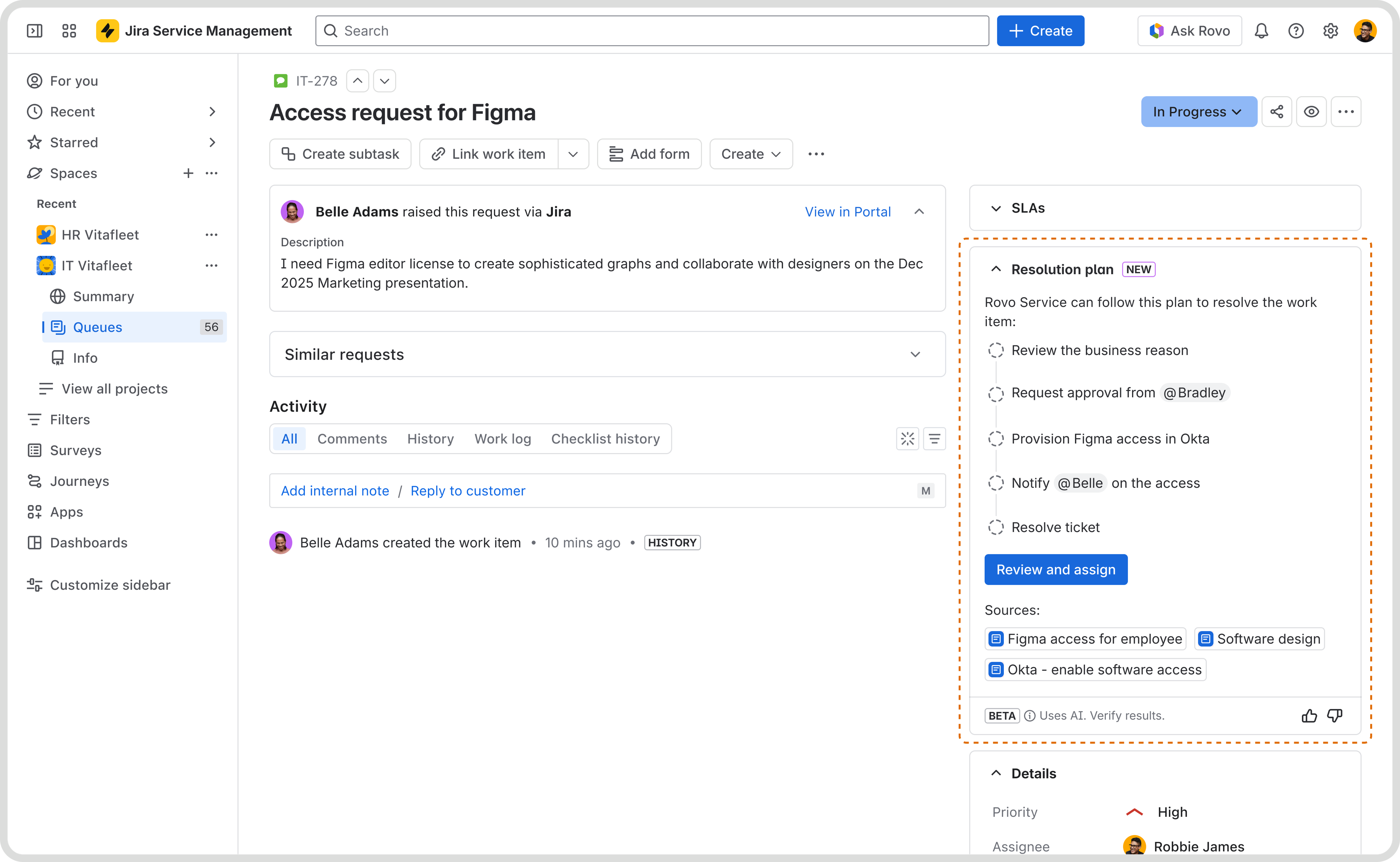
Request Resolver acts as a context-intelligent teammate, generating a recommended resolution plan for each incoming ticket and orchestrating multi-step workflows to resolve requests fast. Tapping into the power of the Teamwork Graph, Request Resolver pulls from trusted knowledge, troubleshooting steps from past similar tickets, and defined company policies to create the right path forward. The result? Less tedious back-and-forth, and faster resolution for employees.
Resolution management has two execution modes in Request Resolver:
-
Supervised: In supervised mode, Request Resolver proposes a plan to resolve a work item, then waits for a team member to select Assign Request Resolver. You can review and adjust the plan as needed, then let Rovo carry it out – keeping humans in control while minimizing manual work. This mode is great for request types where more control is desired, or where there is greater variation in resolution steps depending on key details.
-
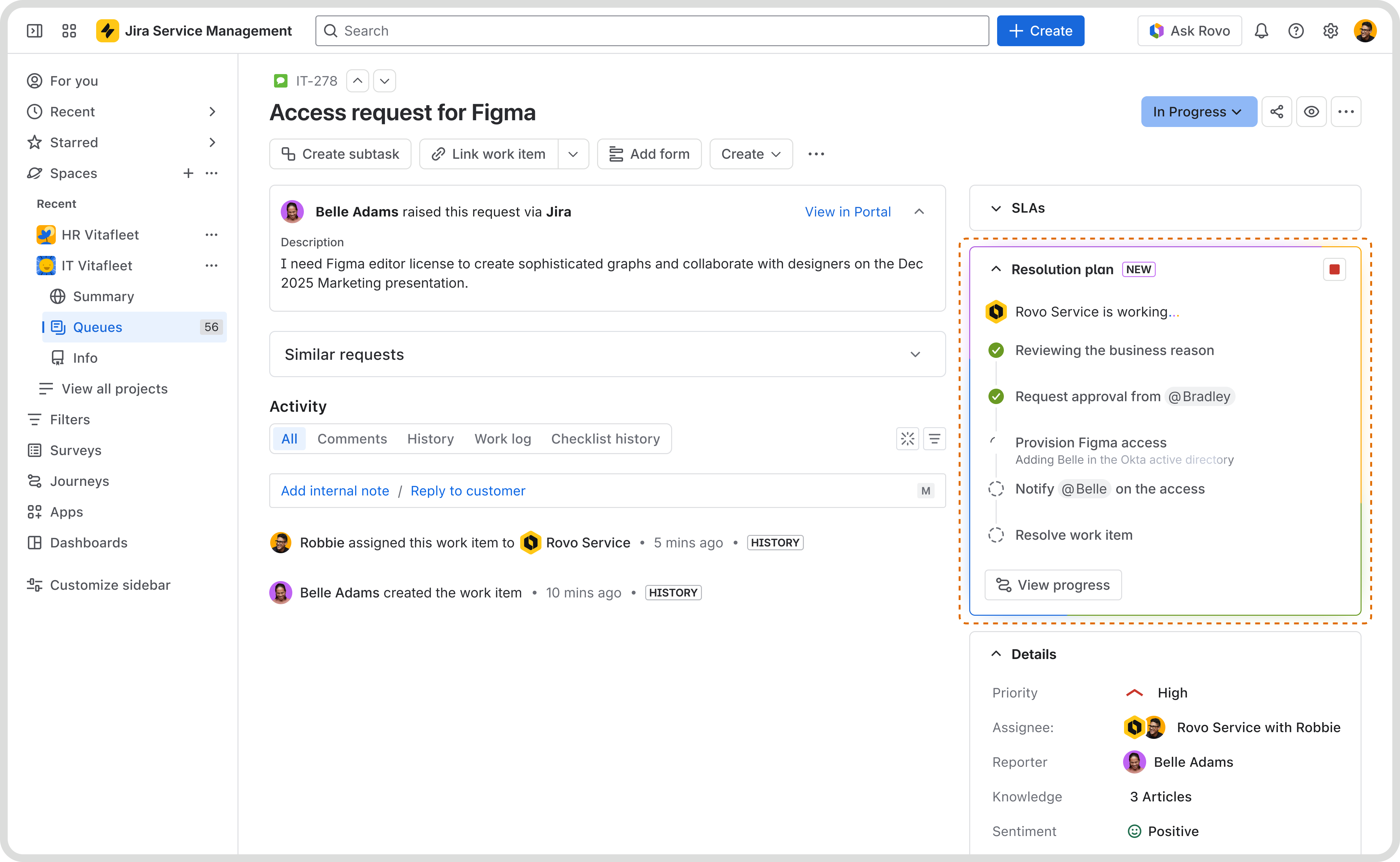
Autonomous: In autonomous mode, Rovo takes the lead on resolving all incoming requests. Request Resolver assigns itself to the work item, and starts working immediately. If it can’t generate a plan, encounters a step that needs a tool that isn’t configured yet, or has low confidence about executing a step without a team member’s review, it pauses and waits for a team member to intervene. This is most suitable for request types like app/group access, straightforward “How do I?” questions, or hardware/software access requests.
These can be changed for a request type at any time. Regardless of the execution mode you choose, Request Resolver will pause and wait for a team member to intervene if it encounters a step that it has low confidence in executing, for example: irreversible actions like deleting files or sending external emails, and actions that can’t be completed due to Request Resolver not having access to something it needs.
Where teams are using it today:
- Tool and group access (e.g., SaaS apps, internal groups, distribution lists)
- “How do I…?” questions about policies, benefits, and internal systems
- Simple help-seeker questions that can be resolved from existing content
See resolution management in action:
Read more about resolving requests with Request Resolver →
Resolution management in Request Resolver is available in all Standard, Premium and Enterprise Cloud editions.
Streamline new employee onboarding
Onboarding is one of the most important experiences in a company – and one of the messiest. HR, IT, managers, and facilities all own different pieces, and new hires often feel that fragmentation.
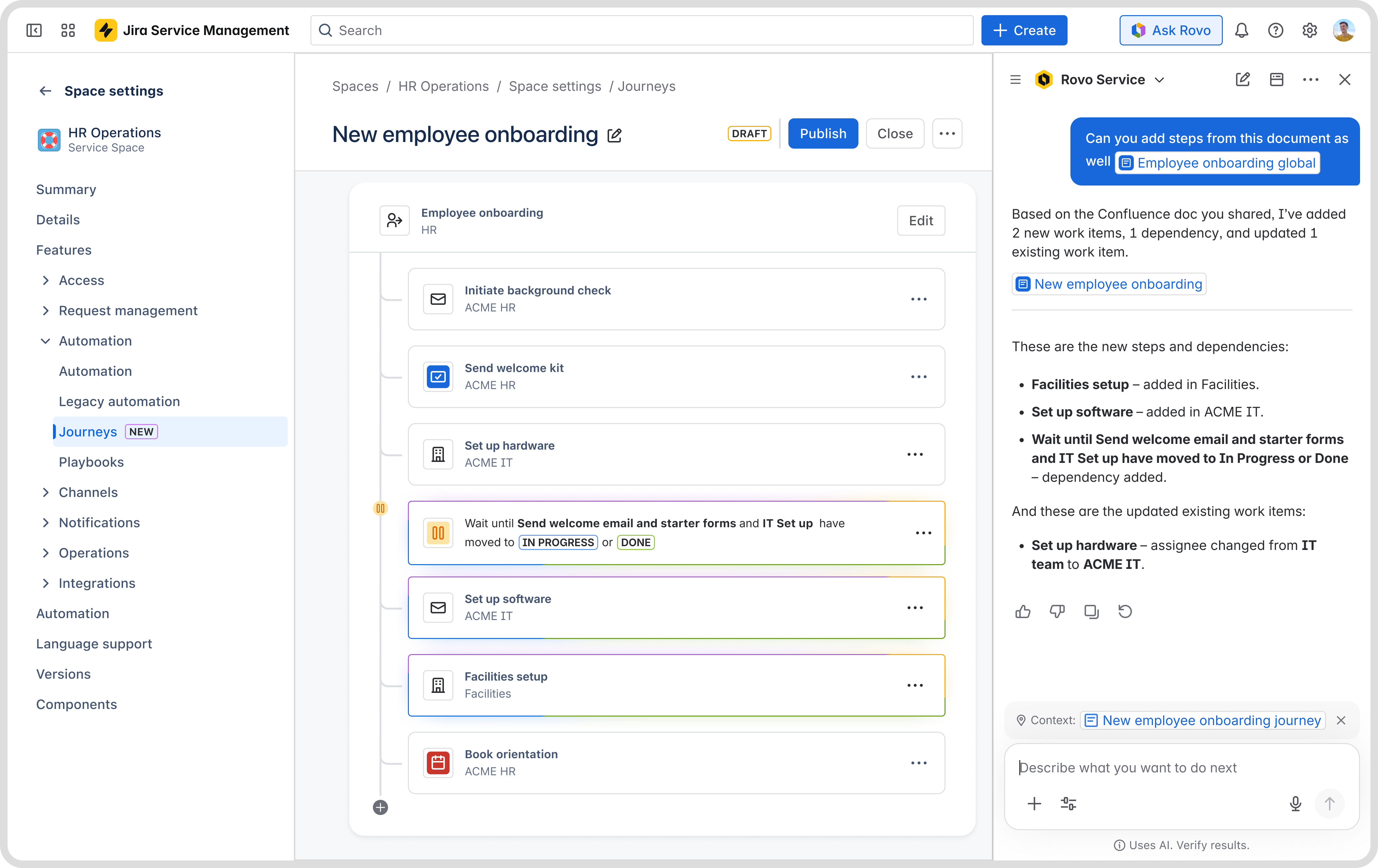
Request Resolver helps HR teams quickly create consistent onboarding journeys that are grounded in process documents and conversational inputs. HR admins and managers can create, edit and configure an onboarding journey with Request Resolver and also assign tasks such as software provisioning to the agent.
Request Resolver helps HR teams deliver journeys that feel like a single, guided experience: what to do now, why it matters, and where to go for help. For HR and People teams, it means fewer manual checklists, fewer one-off emails.
Where teams are using it today:
- Create and configure onboarding journeys
- Configure steps in an onboarding journey to be customisable
- Execute steps like software provisioning with human supervision
See HR onboarding journeys in action:
Read more about creating employee onboarding journeys with Request Resolver →
HR onboarding plans in Request Resolver is available in all Premium and Enterprise Cloud editions.
Let us know what you think!
This is just one step toward delivering fully autonomous service desks for Tier 1 requests, and we can’t wait to hear your feedback. Drop a comment below to let us know what you think, any questions you have, or what you’d like to see next from Request Resolver!


