Atlassian Learning philosophy
Unlock the power of learning
Welcome to Atlassian Learning’s Learning Philosophy. Our philosophy is grounded in learning science methods that will help you retain knowledge and apply it in the real world. Read on to see how our innovative approach to training can help you unlock your full potential and reach your goals.
Explore our science-based learning philosophy
Learning science combines insights from psychology, education, and neuroscience to make learning stickier. At Atlassian Learning, we use learning science methods that’ll help you retain knowledge and apply it in the real world. You can see our methods in action on the website, in the content structure, and, most importantly, in the content itself.

Make the most of your learning
Our research-driven best practices help you easily absorb and retain information so you can apply what you’ve learned to your work right away and make meaningful improvements long term.
You can use the following practices to make your learning experience even more valuable:
Connect to your experiences
Connecting new information to your experiences helps you understand and retain information better.
How we help you connect new information to your experiences:
We add prompts to lessons that ask questions like:
- Could your team benefit from a team calendar?
- What problems could a calendar help you solve?
- What kinds of events would be beneficial to include for your team?
How you can connect:
You can always reflect on your own! When taking a lesson, you can ask yourself:
- When would I use this?
- What am I currently using?
- How have I tried to meet this requirement in the past?
- Have I had a similar problem?
- How did I solve it?
Learn several concepts at once
One of the most effective ways to retain information is to quickly learn multiple concepts simultaneously, rather than focusing on one concept until you become an expert and then moving on to the next one. It may sound counterintuitive, but it works. We incorporate this research-based practice, known as interleaving, into our lessons, and you can apply it to the way you learn, too.
How we prompt interleaving:
We often conclude lessons with an example, scenario, or video that incorporates all the concepts introduced in the lesson. Our practice questions also ask you to combine and recall several concepts from the lesson.
How you can interleave:
Take a lesson on a specific subject, such as Jira project permissions. Then, instead of taking the practice quiz right away, move on to a lesson about another subject. When you finish that second lesson, go back to the quiz for your first lesson, and so on.
Test yourself frequently
Frequent testing is a proven method for measuring how effectively you can apply new information. If a test is challenging, don’t be discouraged. When your brain works hard, it helps you commit information to long-term memory, allowing you to retrieve and apply it when needed later.
How we frequently test:
We offer no-stakes practice questions at the end of our on-demand lessons.
Every practice question includes detailed feedback, so you can continue to learn.
How you can test frequently:
Try to solve practice questions before looking at the answer. If you get a question wrong, take a look at the feedback.
You can also get hands-on practice (and help the concepts stick) by following along in your own instance or sandbox site. It might take a little extra time, but we promise it’s worth it.
For an extra challenge, attempt the practice questions first. You may fail, but it will help you remember the key takeaways during the lesson.
Space out your practice
Active retrieval after some time has passed is one of the best ways to help you retain information. When you wait to revisit a topic rather than reviewing it right after learning, your brain has to work harder on retrieval. That work actually helps improve your memory over time and helps you remember concepts for the long term. So, the more you space out your learning of a particular topic, the easier it will be to remember those concepts in the future!
How we space out practice:
When you answer any of the practice questions we include in our lessons or when you analyze a use case or example, you're practicing retrieval — accessing information you’ve previously learned and applying it towards a solution.
Plus, our short, modular lessons make it easy to revisit a topic at any time.
How you can space your practice:
Let some time pass between practice sessions. Complete all the practice questions in the lessons, then wait a few days to allow the information to sink in. Later, retake the practice questions.
Actively reflect
The act of reflection exercises your ability to retrieve information and connect it to things you already know. Studies show that taking the time to think about what you’ve just learned helps you retain information better!
How we prompt reflection:
We add prompts to lessons that encourage you to solve a problem, answer a question, or consider a scenario before we walk you through the solution.
How you can reflect:
Ask yourself open-ended questions as you complete training content:
- How would I explain these concepts to a co-worker or a friend?
- How is this similar or different from other concepts I’m familiar with?
- What key terms did I learn?

Learn with Atlassian Learning
Whether you know where you’re headed on your learning journey or you’d like some guidance about where to begin, we have a place for you:
- Browse the home page: The home page is a great place to explore if you’re not sure where to start. You can find suggested content or click on featured pages to access free content, live team training, or certification preparation and exams.
- Explore learning paths: Our curated learning paths are designed to help you build confidence with Atlassian products and roles, expand your career opportunities, and earn certifications. Each path is a structured learning experience tailored to a specific outcome. Find a path relevant to your role and interests, or sample several paths to develop a broad range of skills.
- Search for content: Use the search bar at the top of Atlassian Learning webpages to search for content using keywords, like “Jira” or “developer productivity.” Once you reach the catalog page, you can further refine your search using filters.
- Track your learning activities: See a holistic view of your learning journey on the My Learning page, including your in-progress and saved content. Use this page if you need to revisit content at a later date without having to search for it in the catalog.
Solve a problem, gain a new skill, or grow your career
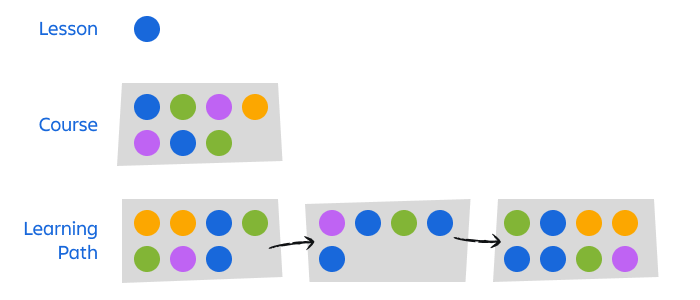
Modular content supports learners who need a quick solution or only have a short time to explore a new feature. Placing smaller learning chunks into a larger structure supports learners who want to dedicate time to advancing their careers. Our content structure does both. Here’s how we’ve reworked our on-demand catalog so it’s more accessible and useful:
Lessons
Lessons are our shortest bits of content. They take under 20 minutes to complete and will help you answer specific questions, learn how to do specific tasks in our products, and troubleshoot problems.
👉 For example: One of our lessons is Create Jira automation rules for developer productivity. It’s one of several lessons in the course Streamline software projects with Jira automation and integrations.
Courses
Courses are groups of lessons that help you learn about an entire feature or gain an ability. They take 10 minutes to up to two hours to complete. You can take the pieces that interest you and skip the ones you already know.
👉 For example: One of our courses is Streamline software projects with Jira automation and integrations. This course is part of a larger learning path called Configure software projects to support team efficiency.
Learning paths
Learning paths are groups of courses that help you accomplish a bigger goal. They are several hours long and contain all the information and resources you need for that goal. You might spend a couple of weeks taking bits and pieces of a learning path or complete a learning path while onboarding to a new role.
👉 For example: One of our learning paths is Configure Atlassian tools and practices for developer flow.
And don’t worry—any progress you make in your learning is tracked throughout our system! If you finish a lesson in one course, you’ll see that you’ve completed it anywhere you find it.
Share your learning journey
No one’s learning journey is the same. However, we hope our Learning Philosophy has given you a new outlook on your own. Connecting with other learners can help you apply and practice your skills, and stay motivated. If you’d like to share some of your learning best practices, we’d love to hear from you. Join us in the Training & Certification Community group and share how you learn.