🗒️ Request Lists Aren’t Service Catalogues
If your IT service catalogue can’t tell you what services you offer, who owns them, and how they deliver value, it’s not a service catalogue.
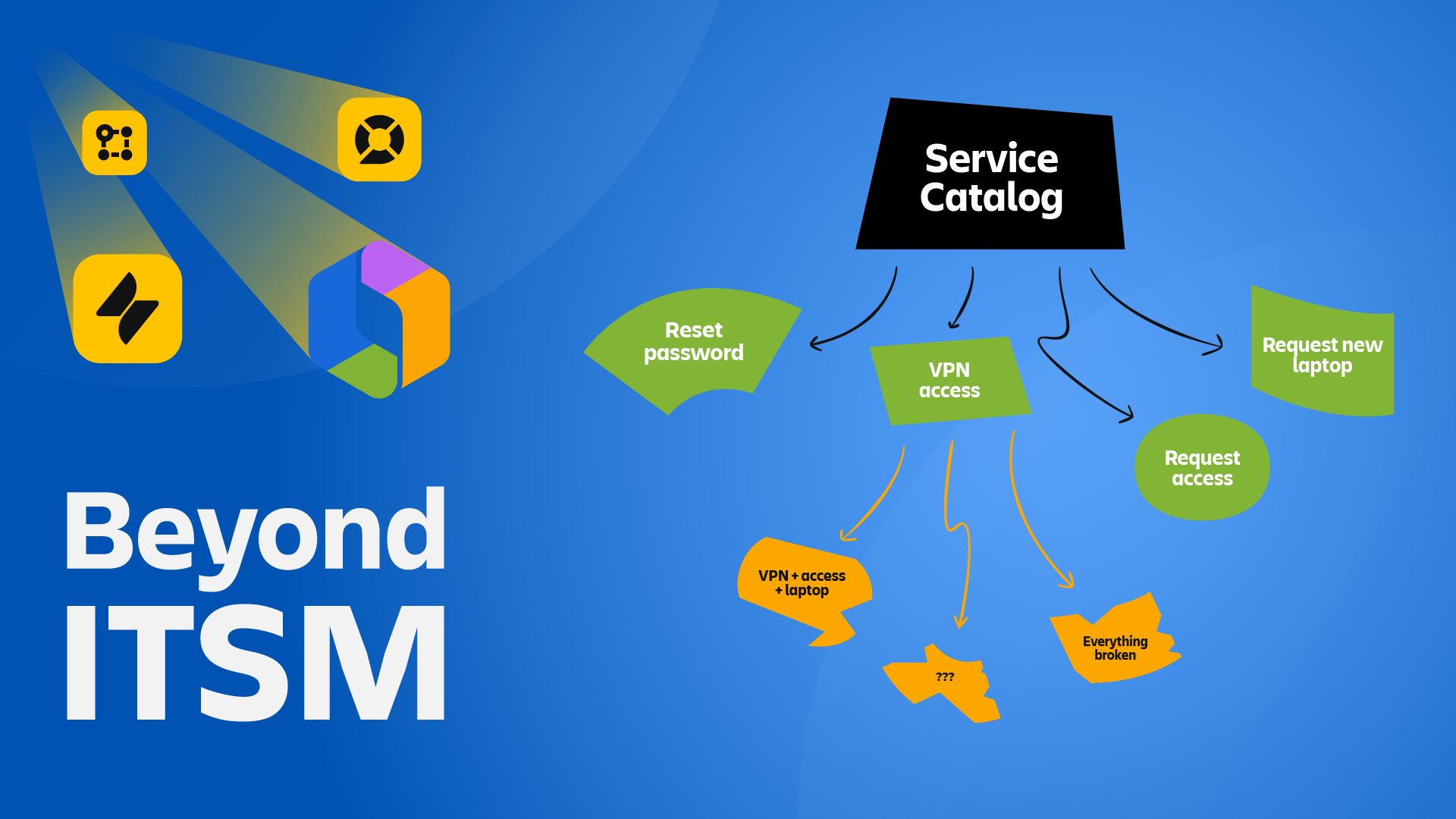
In many organisations, the “service catalogue” is really just a list of things people can ask for.
Too often, what shows up is: “Request a laptop,” “Get access,” or my personal favourite, “Ad hoc request.”
That last one is the giveaway: you’ve stopped defining services and started outsourcing the thinking to the user about what they actually need.
If everything is “ad hoc,” nothing is defined, owned, or measured.
🍕 Your Service Catalogue is an Online Menu
Think of your favourite takeaway shop. Whether it’s a chippy, a pizza joint, or a sushi bar, they all have one thing in common: a menu.
- Service = menu category (e.g., pizzas, sides, beverages)
- Offering / Request Type = menu item (e.g., margherita pizza, garlic bread, soda)
- Capability = the kitchen’s ability to deliver (e.g., cooking skills, equipment, supply chain) the stuff the customer doesn’t see, but that makes the menu possible.
A menu guides the customer to the right choice while giving the kitchen clarity on what to prepare. Similarly, a service catalogue guides users to the right request while giving the organisation visibility into demand, costs, and resources.
With clearly defined services and their supporting capabilities, you can:
- See where demand is really coming from (instead of everything looking like “tickets”)
- Understand what services are actually consuming cost
- Spot where delivery is inconsistent or overloaded
- Identify which services are worth improving, and which aren’t
🎯 The Core Problem
Most catalogues confuse requests with services.
- Request: a transaction, like ordering a laptop.
- IT Service: a stable offering that enables value, like End User Computing.
When your catalogue is just requests, IT becomes a fulfilment function. Visibility, ownership, and improvement paths disappear. Reporting measures activity, not results.
Downstream practices like capacity planning and portfolio management break: demand is unclear, accountability is lost, and linking delivery to business outcomes is impossible.
💡 What a Service Catalogue Should Do
A catalogue should answer three questions:
- What services do you offer?
- Who owns them?
- How do they deliver value?
Example:
Service: End User Computing
Capability: Workforce Productivity
Requests: Request a new device, Request device repair, Request a peripheral
Value: Enable staff to perform their roles with secure, supported devices
Owner: Head of Workplace Technology
This structure lets you manage cost, performance, risk, and use feedback to drive targeted improvements.
🚩 Why “Ad hoc Request” is a Red Flag
“Ad hoc” is not flexibility. It signals one of three issues:
- Demand is unknown
- Services aren’t defined
- Ownership or processes are missing
It hides work, creates inconsistent delivery, and removes accountability. If “ad hoc” dominates, your catalogue isn’t weak, it’s actively working against you.
🛠️ How to Fix Your Service Catalogue
Most organisations fail by redesigning the catalogue in isolation from the business, from actual demand, and from real services. That doesn’t work.
So how do you fix this? Start with value:
- Identify core capabilities
- Define services that support them
- Assign a single accountable owner per service
- Map requests underneath
- Remove or tightly control “ad hoc.” If it happens more than once, it’s not ad hoc.
This is not a tooling problem. A prettier interface won’t fix an undefined catalogue or connect your work to business value.
🏢 Expanding beyond IT
A service catalogue is not just for IT. HR, Finance, and Facilities all provide services, face demand, and encounter the same problems when services aren’t clearly defined.
Examples:
- HR Recruitment Service: enable hiring managers to onboard staff efficiently, reducing time-to-hire and improving candidate experience.
- Finance Expense Management Service: enable employees to submit and track expenses reliably, improving accuracy and speed of reimbursement.
Getting this right in IT creates a repeatable model, a template for services across the enterprise:
- Consistent service definitions
- Clear accountability
- Standard ways to request and manage services
- Alignment to business outcomes
This is where enterprise service management becomes real.
😬 The Uncomfortable Truth
Most catalogues exist to look structured, not to deliver value.
Fixing them forces questions organisations often avoid:
- What do we actually do?
- Why does it matter?
- Who is accountable?
Answering them is the only way to move from appearance to reality and from ITSM as process to service management as a discipline focused on value.
📚 Further Reading
This article is part of a "Beyond ITSM" series. Stay tuned for more.
See also…
🧚♀️✨ About the Author
Chrissy Clements is an Atlassian Community Champion and ITIL Master & Ambassador. She also helps organise the Brisbane ACE.
In her day job, she brings 💫 service management sparkles 💫 to Global Alliance Partner, Accenture.

