Hello Atlassian Community 👋
We’re excited to share that AI risk assessment is now generally available for Service Collection Premium and Enterprise customers! This new capability brings AI-driven risk scoring directly into your change issues, so approvers can quickly understand how risky a change is before it goes live and take action to prevent incidents from occurring.
Today, many teams still rely on manual judgment, scattered context, and tribal knowledge to assess change risk. With AI risk assessment, Rovo does the heavy lifting for you by analyzing a wide range of technical and operational factors and surfacing a clear, explainable risk profile right where you work.
Read on to learn more about the new capability!
What's launching
With this general availability release, AI risk assessment is available on Jira Service Management change issues (available in Service Collection Premium and Enterprise plans) and delivers:
1. An AI-generated overall risk score for every change
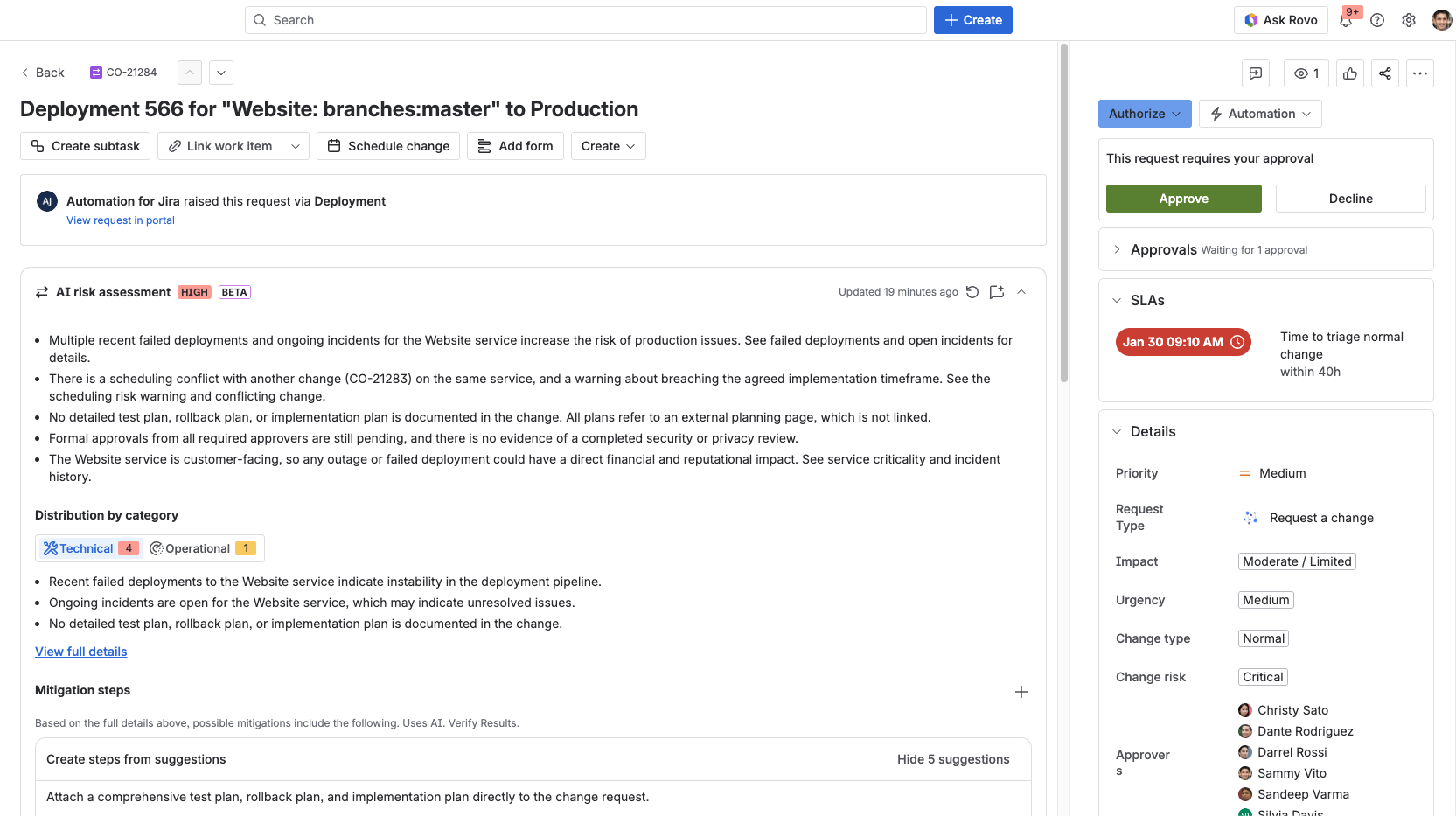
For eligible projects, change issues now include an AI-powered risk score (e.g. low / medium / high) that summarizes the likelihood that a change could lead to incidents or service disruption.
Under the hood, the model evaluates 10+ risk parameters across two core categories:
- Technical risk: Includes failed deployments, sub‑optimal implementation patterns, lack of rollback or test plans, recurring incidents tied to similar changes. Current CI/CD tools supported are GitLab, GitHub, and Bitbucket.
- Operational risk: Includes scheduling conflicts, freeze/maintenance window clashes, service and asset dependencies, rollback complexity, infrastructure changes that may introduce downtime.
Note: In future releases, we will be adding additional risk parameters for compliance and business risk.
2. Transparent “why” behind the score
One consistent feedback from customers is that AI results build trust only when the evidence is visible.
That’s why every AI risk assessment includes:
- A breakdown by category (technical, operational), with each category’s risk level.
- Evidence and drivers behind the score (for example, “3 failed deployments in the last 60 days for this service,” “missing rollback plan,” or “open P1 incident on a dependent service”).
- Clear labeling so it’s obvious what’s powered by AI and what’s coming from existing configuration and historical data.
This makes it easier for CAB members and approvers to defend decisions in audits, post‑incident reviews, and leadership conversations.
3. Recommended mitigation steps to reduce risk
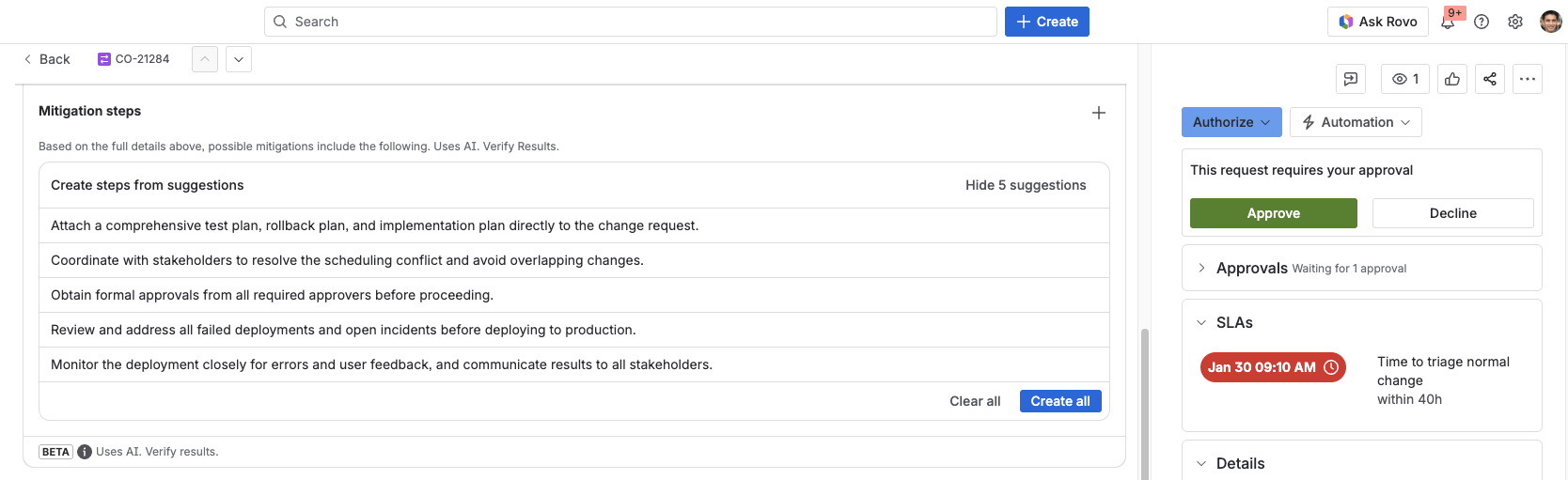
AI risk assessment isn’t just about flagging problems—it also suggests next best actions so teams know what to do next.
Based on the underlying signals, Jira Service Management surfaces mitigation recommendations such as:
- Add or strengthen a test plan, rollback plan, or implementation plan
- Re‑evaluate change timing due to conflicting changes or freeze/maintenance windows
- Investigate and resolve open incidents or PIRs related to the affected services or assets
- Review security, privacy, or accessibility gaps that appear to be out of alignment with your documented controls
- Consider the business impact (e.g. high‑tier services or changes aligned to revenue‑critical systems)
Why it’s important
AI risk assessment helps teams prevent incidents before they happen by automatically surfacing risk signals from existing operational data and guiding approvers with clear, explainable recommendations. This not only reduces manual toil for CABs and change approvers, but also strengthens trust in AI and advances your overall ITSM maturity and operational resilience.
- Prevent incidents, don’t just react: AI risk assessment proactively surfaces risk signals from past changes, incidents, and deployments before approval, helping CABs and approvers spot “hidden” risks. This keeps teams focused on the riskiest changes instead of treating every request the same.
- Reduce manual toil for CABs and change approvers: By automatically scoring risk using existing Jira and service data, AI removes much of the manual digging through logs and histories. It adds contextual analysis and concrete mitigation suggestions so approvers can move faster without starting from scratch.
- Build trust in AI with transparent evidence: Each risk score is backed by visible, auditable drivers and references, presented in clear, human‑readable language aligned with Atlassian’s AI guidelines. The experience makes it explicit that AI is advisory, ensuring humans remain firmly in control of approvals.
- Strengthen operations and ITSM maturity: AI‑driven risk assessment improves change controls, cutting down on recurring, change‑related incidents while accelerating AIOps adoption in Jira Service Management. For regulated and high‑stakes environments, explainable scoring and embedded guidance materially boost both resilience and compliance posture.
Designed for explainability and control
With the general availability of AI risk assessment, we’ve standardized on a clear set of risk categories (technical, operational) to give admins and teams a consistent mental model, ensured project admins can control AI risk scoring and choose which assessment parameters to include, and provided a fallback experience that still surfaces existing conflict and incident insights even when AI is disabled. For more details on how we are building AI features responsibly, check out this page.
Share your feedback with us!
We’d love to hear how AI risk assessment is working for your team and where we should go next (e.g. deeper integration with third‑party CI/CD tools, more advanced prevention dashboards, or additional risk categories).
Please use the comments thread below to share:
- How AI risk assessment is influencing your approval decisions
- Any false positives or blind spots you’re seeing
- What additional signals, explanations, or actions would make this even more useful in your environment
We’ll be actively monitoring feedback here and using it to guide future improvements for change management in Jira Service Management!


