If your world looks like this:
- OKRs live in Tool X (other goals platform, spreadsheets, whatever)
- Delivery lives in Jira
- Leadership keeps asking: "Can we show how Jira work ladders up to OKRs?"
…you're not alone.
The instinct for a lot of people is to over-engineer an integration or build some elaborate custom-field scheme to track OKR IDs on every story in Jira. Both paths tend to create more overhead than insight.
Accept that OKRs don't have to move right away
You don't need to migrate OKRs into Jira for this to work. Let the system of record for OKRs stay where it is for now. Your goal isn't to duplicate OKRs — it's to create clean linkages from Jira work items to those OKRs.
Resist the urge to recreate your entire OKR tree in Jira. That leads to two sources of truth, stale data, and a lot of "wait, which one is right?" conversations.
Use Atlassian Goals as the bridge
This is where Atlassian Goals (formerly Atlas) earns its keep. With the recent rollout of Goal Types (December 2025), you can now define types that match your framework — Objectives, Key Results, Big Rocks, "Other Tool" Tracking, whatever your org calls them — and even attach Success Measures for outcome tracking. That makes Goals a natural bridge layer between your external OKR tool and Jira execution.
Here's how to set it up practically:
- Create Goals that mirror your OKRs at a sensible level of granularity. Not every Key Result needs its own Goal. Think "what would I want to filter Jira work by?" A good rule of thumb: if you'd want to pull up all related epics in a review, it deserves a Goal.
- Name them so they're recognizable from both worlds — e.g. same exact name on both sides or
FY26 Q2 – Increase Activation – KR1. People jumping between your OKR tool and Jira should immediately know what maps to what.
Now you have a stable object in the Atlassian ecosystem to attach work to, without having to move where OKRs are authored and managed.
Attach work at the highest reasonable level
This is where teams most often go wrong. The temptation is to link every story or task directly to a Goal. Don't do this — it gets noisy fast and nobody maintains it.
Instead:
- Link Epics (or top-level parent work items in Jira) to the Goal. Let stories and tasks inherit meaning from their parent.
- Skip the custom fields. I've seen teams create "OKR ID" or "Strategic Objective" custom fields on every work item type. It sounds clean in theory, but in practice it becomes a data entry tax that developers ignore within three sprints.
In practice, a clean structure looks like:
Goal = "Increase activation by 10%" → Epic = "Improve onboarding checklist experience" → → Stories = design, build, experiment — all under that Epic
Your reporting becomes: "Show me all epics linked to Goal X, and their delivery status." That's a question Jira can answer natively. And Jira Plans can also show the work items grouped by the Goals (or stack ranked in a different way with the Goal as a column value).
Make review cadence part of the design
The magic isn't the link itself — it's the review rhythm. Links without reviews are just metadata. Links with reviews are alignment.
Before or after your OKR check‑ins, pull:
- "Issues linked to Goal X — what's in progress, what's done?"
- Are we working on the right epics?
- Are we actually finishing anything meaningful?
- Do we need to re‑scope, add, or remove epics?
This keeps OKR reviews grounded in real delivery, not just slideware. And it gives leadership what they're actually asking for: not a perfect OKR-to-task mapping, but confidence that the work happening in Jira is connected to the outcomes the business cares about.
The Overall OKR -> Goals -> Execution Framework Could Look Something Like This
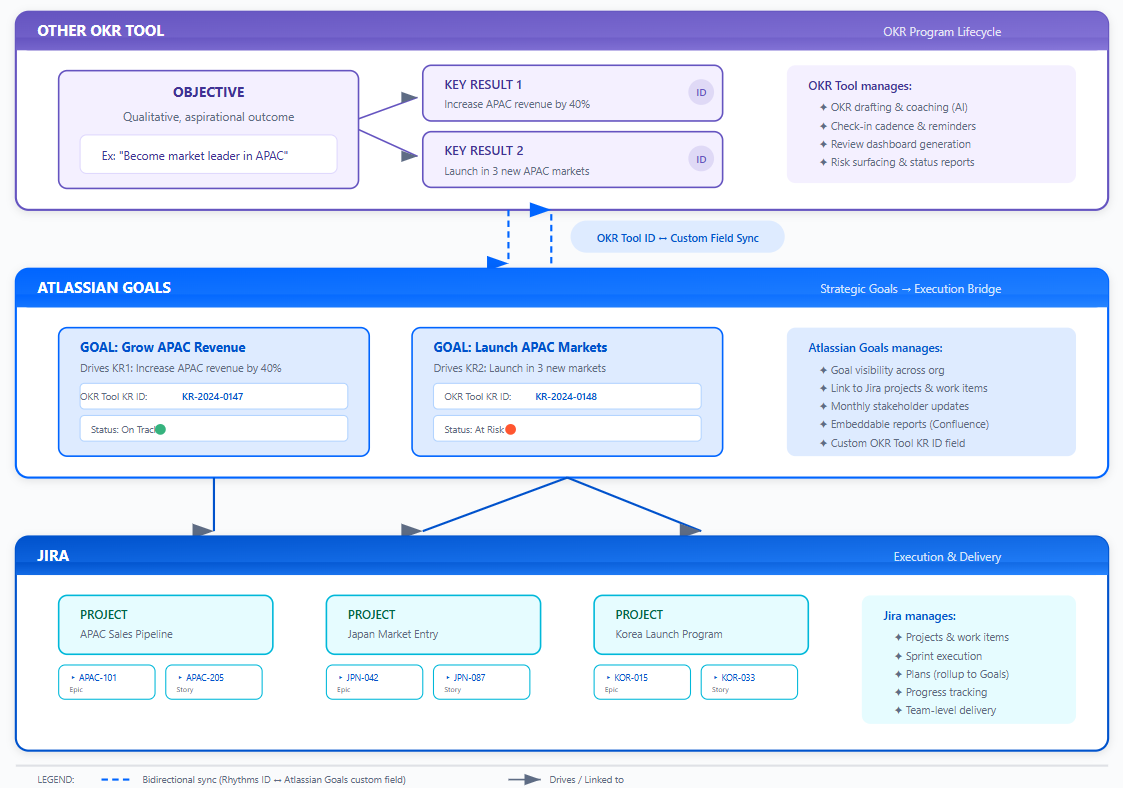
And the "Project" could be within the Atlassian Goals layer with that lightweight function of people owning weekly status updates there. You could also think about storing an ID on just the Atlassian Goal level too (then it opens the door for advanced automation until you decide to do everything directly in the Atlassian ecosystem or if you need to remain with the two-platform setup).
Over to you: How are you tying Jira work to OKRs that live in another tool today?
- Pure links/URLs?
- Atlassian Goals?
- Custom fields?
- Something else entirely?
Drop your pattern (or your horror story) below 👇


