The Changing Nature of Workplace Communication
Internal communication inside companies has traditionally been shaped by tools built for structure. Pages, documents, wiki hierarchies, and formal updates have long been considered the “proper” way to share information. Confluence, in particular, has become central to how teams document decisions, processes, and knowledge.
But if you watch how people naturally communicate - not how systems expect them to - a different pattern emerges.
People gravitate toward short, informal, low-pressure expressions. A single paragraph. A quick thought. A question. A light observation. Something that takes thirty seconds to write and doesn’t demand a perfect structure.
This shift isn’t random. It reflects deeper behavioural changes in how humans - across generations - prefer to talk.
The Problem With High-Threshold Communication
Creating a Confluence page is an act of intention. It signals that something is important enough to be documented. That threshold, while useful for clarity, creates an unintended consequence: it discourages everyday communication.
People hesitate because a page feels permanent. It feels official. It feels like something that needs to be “well-written” before it can be published.
So instead of sharing a brief insight or a moment of learning, they stay silent.
The result is a workplace full of untold stories, unshared reflections, and invisible progress. Teams end up with strong documentation but weak ongoing communication - plenty of knowledge, but not enough humanity.
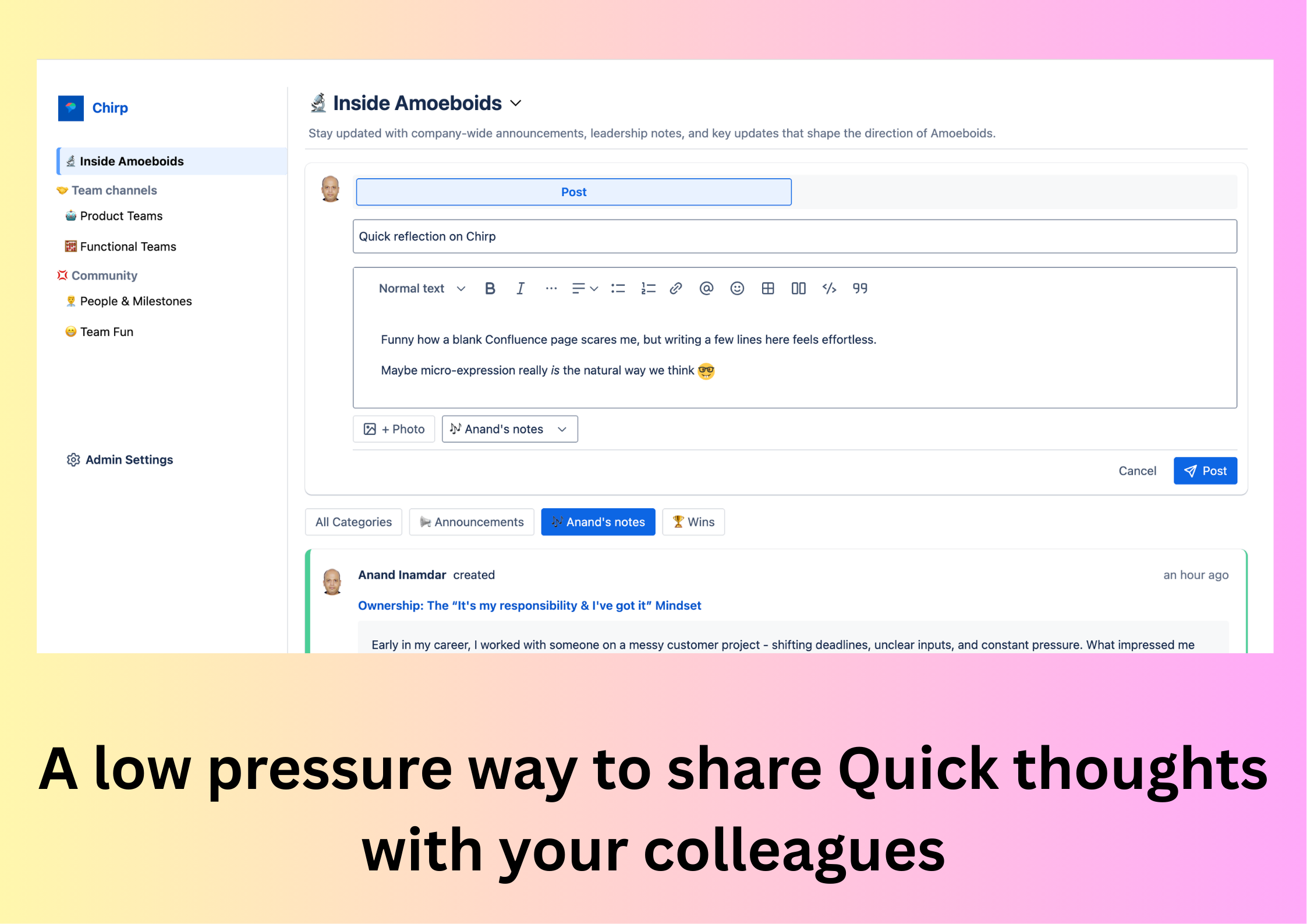
Micro-Expression: The New Default Language
Across generations - Gen Z, Millennials, even older cohorts - micro-expression has become the dominant mode of digital communication.
It shows up everywhere:
-
short tweets
-
Whats App voice notes
-
Slack messages
-
story posts
-
comment threads
-
lightweight reactions
People rarely think in documents anymore. They think in fragments, in small connected moments. They express themselves in ways that feel conversational rather than formal.
This behavioural shift matters because digital workplaces should adapt to how people naturally communicate, not force everyone into formats that belong to a different era.
Micro-expressions are not superficial. It is spontaneous, human, and revealing. It helps teams stay aligned emotionally, not just operationally.
The Comfort Gap
Teams don’t need more documentation. They need more comfort.
- Comfort to express half-formed thoughts.
- Comfort to ask questions without crafting paragraphs.
- Comfort to acknowledge a teammate’s effort without writing a formal “kudos” post.
- Comfort to participate without performance pressure.
When communication tools feel formal, communication becomes selective. When tools feel comfortable, communication becomes continuous.
This comfort is the real missing ingredient in most internal communication strategies.
Why This Matters for Hybrid and Remote Teams
In a physical office, the atmosphere takes care of half the communication burden. People overhear things. They bump into colleagues. They share small moments. Connection happens incidentally.
But distributed teams don’t have this luxury.
In a remote environment:
Micro-expression becomes the digital version of hallway conversations. It fills in the spaces between meetings, documents, and decisions.
It gives leaders visibility into team mood.
It gives peers awareness of each other’s efforts.
It gives culture the small signals it needs to stay alive.
A Product Design Perspective
Designing for internal communication today requires acknowledging a simple truth: People speak in short form now.
That means tools must support:
This is the philosophy behind what we built with Chirp - not as a replacement for Confluence pages, but as the expressive layer that Confluence never had.
When you remove the friction around communication, the volume and diversity of communication changes dramatically. The more comfortable people feel, the more they contribute.

Rethinking the Future of Internal Communication
Internal communication is no longer about broadcasting information from the top. It is about creating the conditions for teams to talk in ways that feel natural, safe, and human.
The more people express in small ways, the more connected the workplace becomes. The more comfortable they feel posting, the more context the organisation gains. The more visible these micro-moments are, the more culture evolves organically.
Teams don’t need more words. They need more ease. More flow. More everyday communication without ceremony.
Rethinking communication starts with accepting how people truly prefer to talk - and designing systems that honour that instinct.
Confluence already holds the knowledge. Chirp simply gives that knowledge a human voice.
