AI adoption is moving quickly across Jira environments.
Customers are experimenting with Atlassian Rovo, AI agents, coding agents, automation bots, and custom AI workflows.
But there is a question many organizations still cannot answer:
"How much value are our AI agents actually delivering?"
For Atlassian Solution Partners, this is more than a reporting problem.
It is a new customer advisory opportunity.
The AI conversation is changing
A year ago, customers were asking:
"How can we use AI?"
Now the more important questions are becoming:
-
Which AI agents are actually useful?
-
How much engineering work are they performing?
-
How much human time are they saving?
-
Which agents require the most rework?
-
Are we getting enough value from our AI investment?
-
How should we govern AI activity across Jira?
Most AI dashboards can tell customers about:
Tokens → API calls → Usage → Cost → Sessions
But those metrics don't necessarily answer the business question:
"Did AI help us get more useful engineering work done?"
That's where Solution Partners can add significant value.
Start measuring AI where the work happens
For Jira customers, the most useful place to understand AI productivity is often the Jira issue itself.
Instead of starting with tokens, start with three simple questions:
1. What did the agent work on?
Issues Touched
This connects AI activity directly to the engineering backlog.
2. How much work did the agent perform?
Active Agent Time
This helps establish machine capacity and compare AI activity over time.
3. Was the work actually useful?
Outcome Quality
Did a human accept the result, require rework, or take over?
This creates a much more useful framework:
AI Value = Work Performed + Time Invested + Outcome Quality
Consider these two AI agents
Imagine a customer has two AI agents.
| |
Agent A |
Agent B |
|---|
| Tokens |
100,000 |
40,000 |
| Active time |
3 hours |
45 minutes |
| Jira issues touched |
2 |
8 |
| Issues accepted |
0 |
7 |
| Rework |
High |
Low |
Which agent created more value?
Probably Agent B.
Yet a traditional AI usage dashboard could easily make Agent A look more "productive" because it consumed more tokens and ran for longer.
This is the measurement gap Solution Partners can help customers close.
A new KPI: Machine Velocity
Engineering organizations already measure human capacity and velocity.
As AI agents become part of the delivery team, customers will increasingly need to understand machine capacity too.
Think of it as:
Machine Velocity
Issues Touched + Active Time + Outcome Quality
This doesn't mean treating AI exactly like a human developer.
An agent might investigate an issue, analyze a problem, update documentation, make a change, or hand the work back to an engineer.
The important point is to make that activity visible and measurable.
Why this matters to Solution Partners
This creates several valuable conversations with existing Jira customers.
During an AI adoption assessment
Ask:
"Do you know how many Jira issues your AI agents are actually working on?"
During an engineering productivity engagement
Ask:
"Can you separate human engineering capacity from machine-generated activity?"
During an Rovo adoption project
Ask:
"How will you demonstrate that Rovo and your AI agents are delivering measurable value after deployment?"
During an AI governance discussion
Ask:
"Who is accountable for monitoring AI activity, human intervention and quality?"
These questions move the conversation from:
"Let's enable AI."
to:
"Let's measure whether AI is working."
That is a much more strategic conversation.
Turning the framework into something measurable
This is the problem we built AgentWorkLog to address.
AgentWorkLog automatically tracks AI-agent activity in Jira and turns otherwise invisible machine work into measurable activity. It captures issues touched, agent session duration, human takeovers and human quality feedback.
Solution Partners can use this data to help customers establish an AI workforce baseline.
For example:
AI Activity
-
Issues touched
-
Sessions triggered
-
Active agent hours
AI Effectiveness
AI Governance
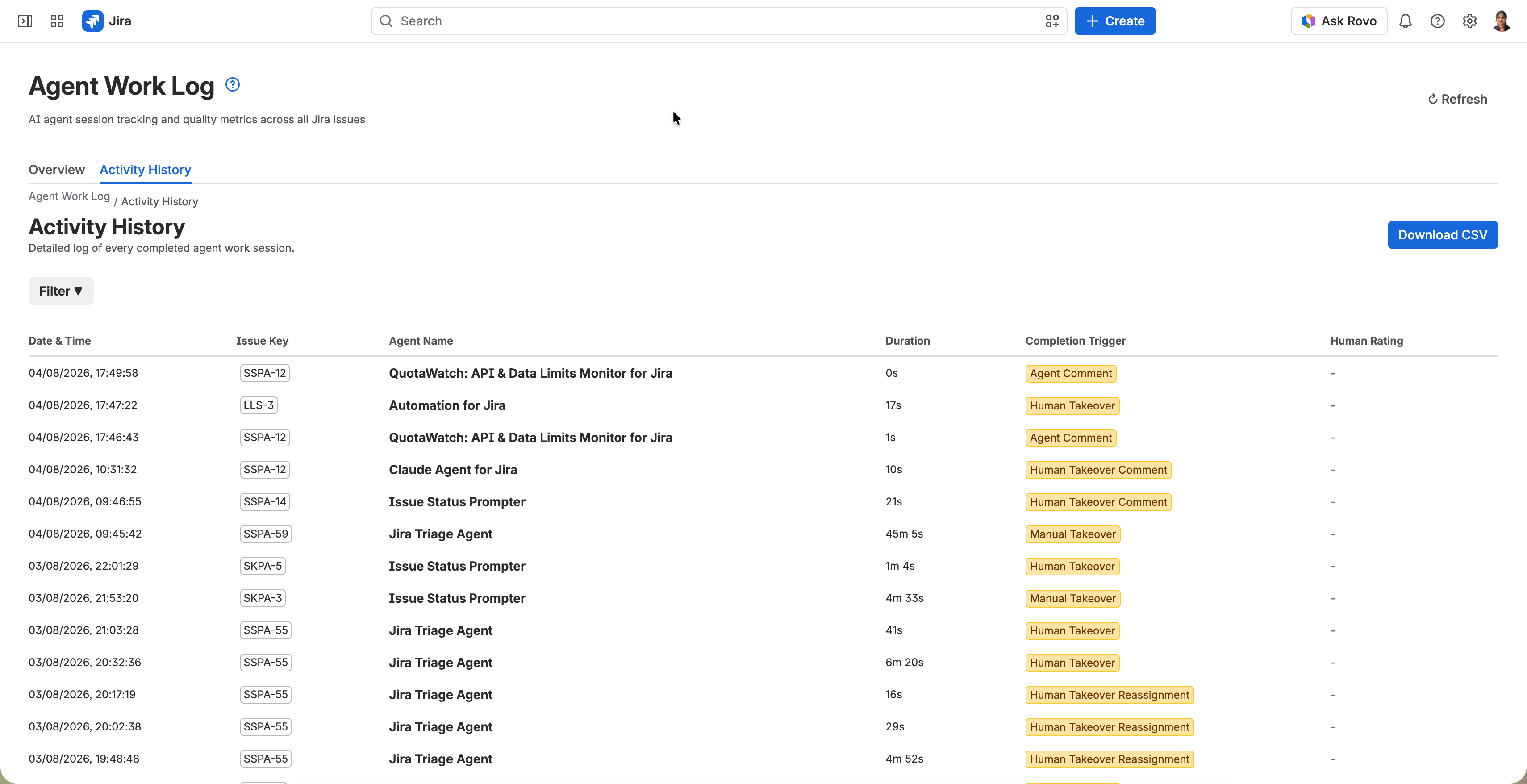
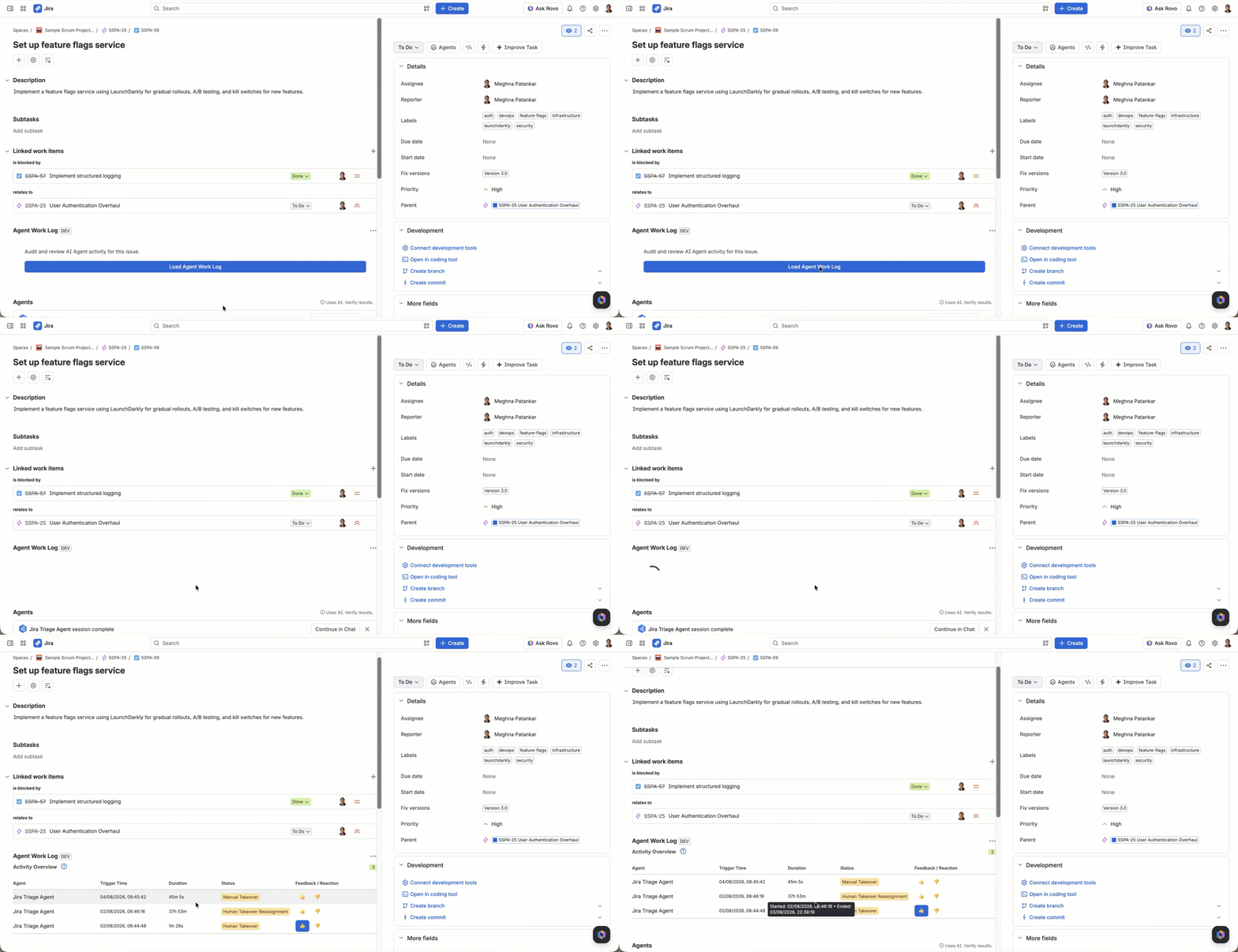
The platform provides site-wide and project-level reporting, making it possible to look at AI activity across an entire Jira environment or within a specific customer project.
 The opportunity for Solution Partners
The real opportunity isn't simply installing another Jira app.
It is creating a repeatable customer service around AI productivity and governance.
A Solution Partner could help a customer:
1. Establish a baseline
How much AI activity is happening today?
↓
2. Identify high-value use cases
Which agents and workflows are producing useful outcomes?
↓
3. Measure adoption
Are teams actually using the agents?
↓
4. Measure quality
How much work requires human intervention or rework?
↓
5. Demonstrate ROI
Is AI generating enough productive capacity to justify the investment?
↓
6. Continuously optimize
Which agents, workflows and teams should be expanded?
This can become a natural extension of Jira transformation, Rovo adoption, AI governance and engineering productivity engagements.
The question to take to your next customer
Don't ask:
"Are you using AI in Jira?"
Most customers will soon answer yes.
Ask instead:
"Can you show me how much engineering work your AI agents are actually performing, how long they spend doing it, and how often humans accept the result?"
If the answer is no, there is a measurement gap.
And that gap is becoming increasingly important as customers move from AI experimentation to AI at scale.
AgentWorkLog provides the measurement layer inside Jira to help close that gap.
For Solution Partners, it can also become a practical starting point for a broader conversation around:
AI adoption → AI governance → Engineering productivity → AI ROI
The organizations that deploy AI fastest won't necessarily be the ones that win.
The ones that can measure and improve the value they're getting from AI will.


