What businesses, legal teams, and digital professionals need to know
As digital transformation accelerates across Europe, secure and legally recognised electronic signatures have become essential for business, legal, and governmental processes. This is especially true for medical device companies, which must sign large volumes of internal documents for ISO and quality management purposes. Under the EU eIDAS Regulation, companies in the EU can use qualified and advanced electronic signatures that are legally valid and often more efficient, secure, and auditable than the traditional approach of printing, signing by hand, and scanning documents.
What is eIDAS?
The eIDAS Regulation (EU Regulation No. 910/2014) (short for electronic Identification, Authentication and trust Services) is a European Union regulation that:
-
Sets common standards for electronic identification, authentication, and trust services across all EU Member States.
-
Ensures that electronic signatures cannot be denied legal effect or admissibility in court solely because they are digital.
This regulation applies directly in Greece and every other EU country without needing separate national implementation.
How Greece Implements eIDAS
In Greece, eIDAS is embedded in the national legal framework:
-
Law 4727/2020: Greece’s Digital Governance Code incorporates the principles and requirements of eIDAS into Greek law.
-
EETT Regulations: The Hellenic Telecommunications & Post Commission (EETT) oversees trust service providers and the practical application of eIDAS in Greece.
-
Civil Law and Procedural Rules: Signature requirements and evidential effects are also shaped by substantive civil law and civil procedure rules.
Together, these ensure electronic signatures are legally recognised for commercial, public-sector, and court-related uses throughout Greece.
Legal Recognition and Cross-Border Validity
One of eIDAS’s most significant strengths is mutual recognition across the EU:
This interoperability makes eIDAS a powerful enabler for cross-border business and legal processes.
National Oversight & Trust Service Providers
In Greece:
-
EETT supervises qualified trust service providers, maintains registries, and ensures compliance with eIDAS.
-
Qualified validation and preservation services help verify signatures and ensure long-term legal value.
These measures increase trust and reliability for public, private, and judicial use.
Types of Electronic Signatures Under eIDAS
eIDAS recognises three main types of electronic signatures, each with different legal assurances and use-cases. These classifications are fully applicable in Greece:
|
Signature type
|
Description & Legal effect in Greece
|
Examples of documents you can sign in Greece
|
|---|
|
Simple Electronic Signature (SES)
|
Basic electronic indication of intent to sign (e.g. click, tick‑box, typed name).
Legally valid and cannot be rejected just because it is electronic, but has weaker evidential value and can be easier to challenge in court if there is a dispute about who signed or whether the content was changed.
|
-
Low‑risk internal approvals (e.g. internal memos, meeting minutes)
-
Routine HR or admin documents where no strict written‑form is required (e.g. holiday requests, training attendance)
-
Day‑to‑day business communications and acceptance of standard terms online
|
|
Advanced Electronic Signature (AES)
|
Electronic signature uniquely linked to the signer, capable of identifying them, created under their sole control, and linked to the document so that tampering is detectable. Typically implemented using stronger authentication and cryptography.
Stronger evidential value than SES and well‑suited for most commercial use cases. Admissible as evidence in Greek courts but not automatically equivalent to a handwritten signature where the law explicitly requires “written form” with a signature.
|
-
Commercial contracts without a strict statutory written‑form requirement (e.g. NDAs, many supplier agreements)
-
Internal company policies and quality procedures (e.g. ISO‑related SOPs, work instructions and quality records in medical device companies)
-
Procurement and purchasing documents, offers, and acceptances
-
Acceptance of internal regulations and acknowledgements of receipt of policies
|
|
Qualified Electronic Signature (QES)
|
An advanced electronic signature created using a qualified signature creation device and based on a qualified certificate issued by a recognised Qualified Trust Service Provider (QTSP).
Under eIDAS and Greek law, a QES has the same legal effect as a handwritten signature. When Greek law or a contract requires a “written” and signed document, a QES is generally needed to fully meet that formal requirement.
|
-
Employment contracts where signed written form is required
-
Termination, renewal, or modification of employment relationships
-
Acknowledgements of debt and many finance/loan agreements
-
Commercial lease agreements and certain high‑value B2B contracts
-
Filings and submissions to Greek public authorities and courts
-
Public procurement documentation and official tenders
|
When Qualified Electronic Signatures Are Required in Greece
The following table gives a practical overview of which documents typically need a Qualified Electronic Signature (QES) under Greek/EU practice.
Document category (Greece)
|
|
Why QES is required / strongly recommended
|
|---|
|
Employment contracts & key HR decisions
|
-
Employment contracts and some amendments
-
Termination notices and certain settlements
-
Some restrictive covenant/non‑compete agreements
|
Greek labour law and practice often treat these as needing a signed written form. A QES is the electronic equivalent of a handwritten signature and provides strong evidential value in case of disputes.
|
|
High‑value/long‑term commercial contracts
|
-
Certain high‑value B2B contracts
-
Long‑term, high‑risk supply or distribution agreements
-
Some IP licensing and technology transfer agreements
|
Even where not strictly mandated by statute, parties frequently contractually require handwritten or QES signatures to manage risk and avoid enforceability challenges.
|
|
Real estate, leases & secured transactions
|
|
These areas are typically form‑sensitive under Greek civil law. To mirror the legal effect of a handwritten signature, a QES is generally needed (often alongside notarial or registry formalities).
|
|
Dealings with public authorities & courts
|
-
Filings and submissions to Greek public authorities
-
Court documents and procedural acts (where electronic filing is allowed)
-
Public procurement offers and official tenders
|
Many government and judicial e‑services explicitly require a QES issued by an eIDAS‑recognised QTSP or a specific state e‑ID; other electronic signatures (including those in Confluence) are not accepted.
|
Which Documents Can Be Signed in Confluence
In the Greek and EU eIDAS framework, Confluence is generally suitable for documents that do not legally require a Qualified Electronic Signature (QES) or handwritten signature. In practice, this usually includes:
-
Internal policies, procedures and ISO/QMS documentation, such as quality manuals, SOPs, work instructions, CAPA and deviation records, change controls and training records – including those used by medical device companies.
-
Routine internal HR and administrative documents, such as leave requests, timesheets, internal approvals, meeting minutes and acknowledgements of internal guidelines that are not subject to strict formal requirements.
-
Standard commercial documents without specific written‑form formalities, such as many NDAs, supplier agreements, service contracts, purchase orders, offers and acceptances, where the parties have not explicitly required QES or handwritten signatures.
How to sign documents using QC Approvals for Confluence Cloud
For documents that do not legally require a Qualified Electronic Signature (QES) or handwritten signature, organisations can implement a robust, auditable signing process directly in Confluence using the QC Approvals for Confluence Cloud app.
QC Approvals for Confluence Cloud allows organisations to digitally sign official documents in compliance with eIDAS. Here’s how it works:
Preparing the Document for Signing
-
Identify the document type eligible for signing (e.g., an internal process for Change Control).
-
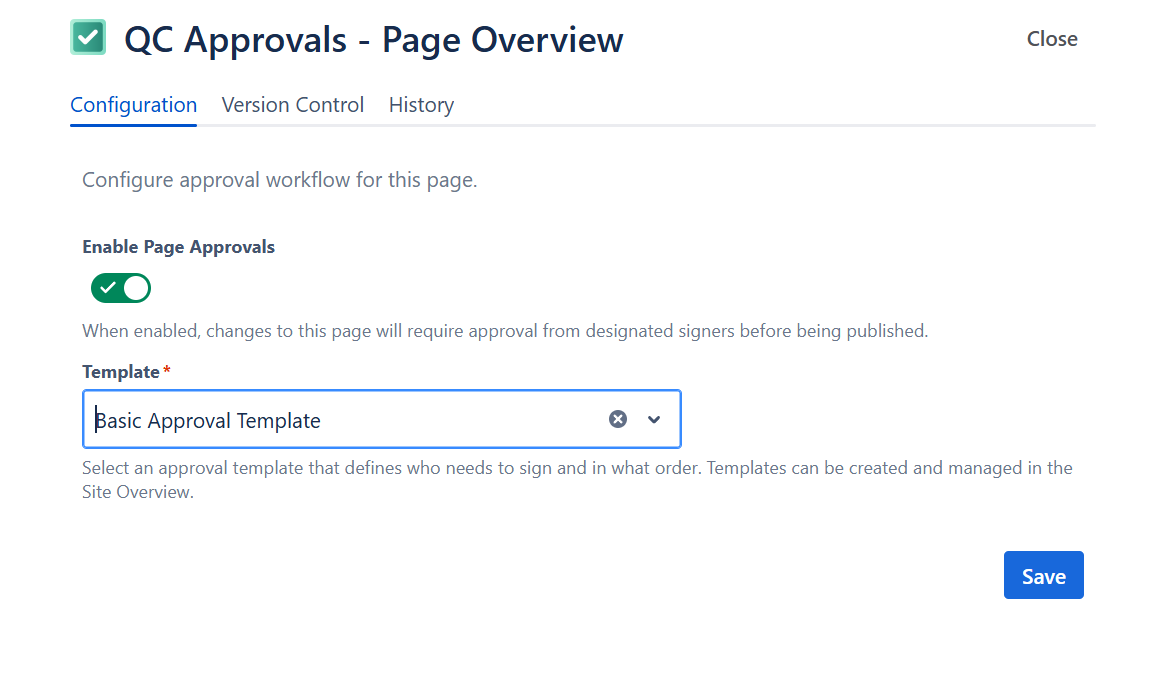
Apply an approval template to the page
Signing the Document
Tracking and Organizing Signed Documents
-
QC Approvals automatically records:
-
Signer identity
-
Timestamp
-
Version of the document
-
Provides a complete audit trail and allows exporting signature certificates as PDF.
-
Users can view all signed documents using:


