A recurring challenge when reporting on cycle time and lead time in Jira is that these concepts are semantic, while workflows are structural.
In real Jira environments:
-
Stories, bugs, and tasks often follow different workflows
-
Some issue types include rework states such as Reopened
-
Others skip entire stages or use alternative names
Yet when teams talk about cycle time or lead time, they usually mean the same business concept, regardless of how the workflow is implemented.
This raises a practical question:
How do you measure the same metric consistently when different issue types follow different paths?
Using Status Groups Instead of Individual Statuses
One approach that works well in complex environments is grouping multiple workflow statuses into a logical status group that represents business meaning rather than workflow mechanics.
Examples of such groups include:
-
Cycle Time
-
Lead Time
-
Waiting
-
Blocked
Instead of tying these concepts to fixed statuses, they can be defined as groups that aggregate several statuses.
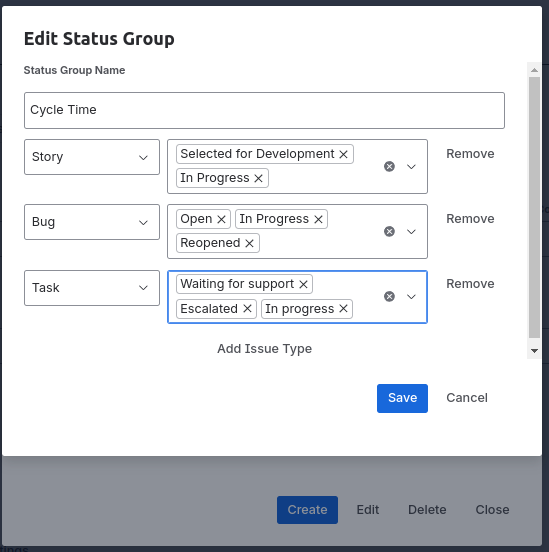
A key detail is allowing different status mappings per issue type, while keeping the same group name.
For example:
-
Cycle Time for Stories might include Selected for Development and In Progress
-
Cycle Time for Bugs might include Open, In Progress, and Reopened
-
Cycle Time for Tasks might follow yet another path
All of these still contribute to the same semantic concept without requiring workflows to be aligned or renamed.
Balancing Organizational Standards and Individual Needs
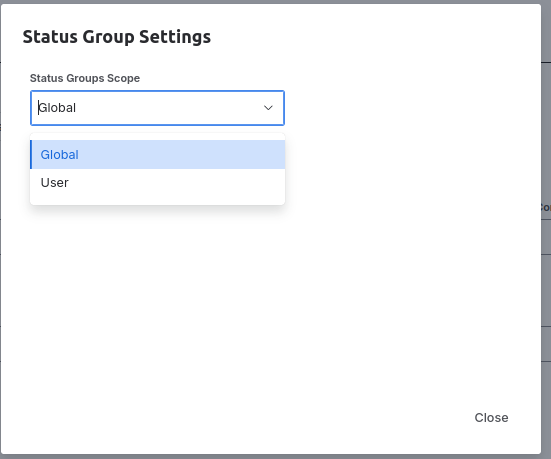
In larger Jira instances, reporting needs usually exist at two levels:
-
Organization-wide definitions, maintained by administrators and used for consistent reporting
-
Individual or team-level perspectives, used for local analysis or experimentation
Supporting both allows:
-
Admins to define shared, enterprise-wide meanings
-
Users to explore data without impacting global standards
Clear separation between global (admin-defined) and user-defined configuration helps these needs coexist without conflict.
Getting the Right Data Before Reporting
Reporting accuracy depends heavily on how issues are selected in the first place.
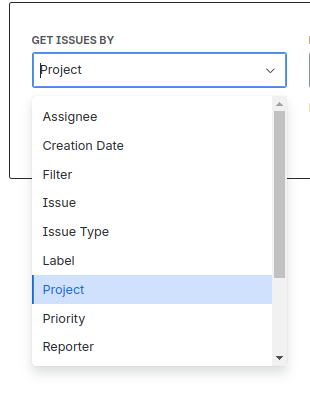
In practice, users may start from different entry points:
-
Projects
-
Sprints
-
Versions
-
Saved filters
-
Direct JQL
Providing multiple ways to load issues reflects how Jira is actually used day to day and reduces friction when answering different questions.
Filtering That Reflects the Loaded Data
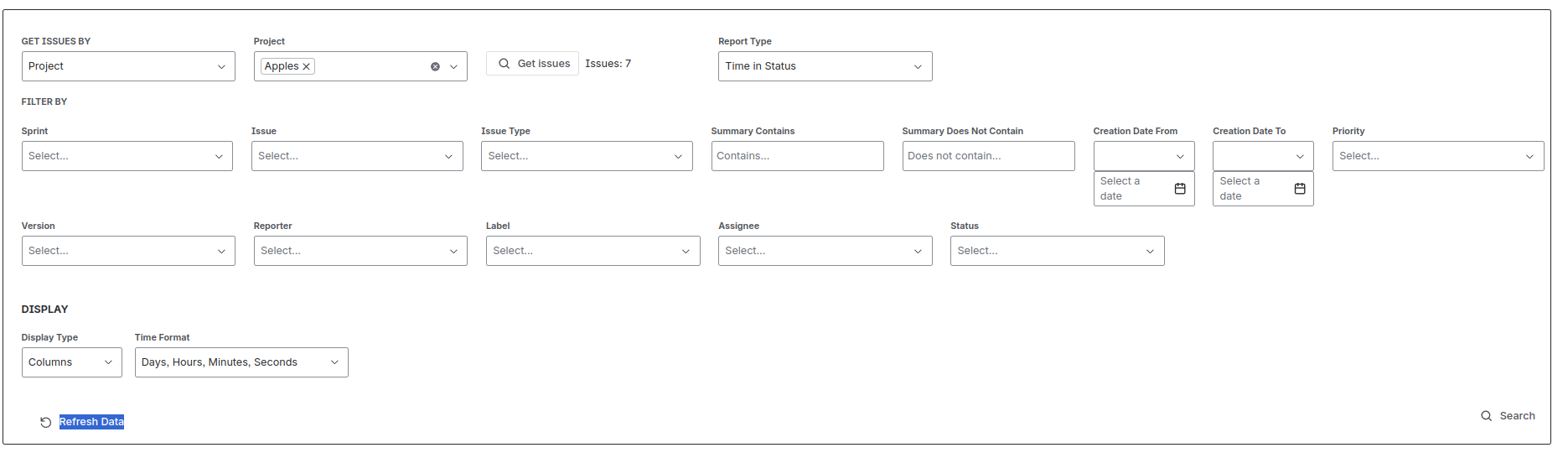
Once issues are loaded, filtering is most effective when filter options reflect only what exists in the current data set.
Instead of showing every possible value for a field, filters can be limited to:
This avoids a common frustration: applying filters that can never return results simply because the values aren’t present in the loaded scop
Looking Beyond a Single Report
Time in status is often just one lens on team performance.
Depending on the audience, it can be useful to look at:
Supporting multiple report views makes it easier to answer different questions without reshaping or reloading data each time.
A Practical Implementation Example
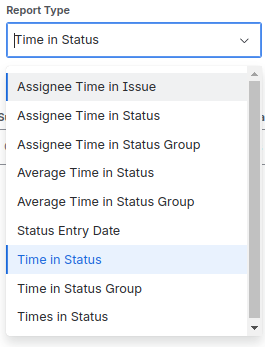
If you are looking for a concrete implementation of the approach described above, Time in Status Reporter for Jira , released by our team is a tool built around these principles:
-
Status groups are defined as semantic concepts, not fixed workflows
-
The same group can map to different statuses per issue type
-
Groups can be managed globally by administrators or locally by individual users
-
Reporting is based on raw time-in-status data, rather than predefined cycle formulas
This allows teams to define metrics that reflect how they actually work, while still supporting organization-wide standards.
Closing Thought
Cycle time and lead time are not workflow properties — they are business concepts.
Treating them as such, by grouping statuses semantically, accounting for issue-type differences, and supporting both organizational and individual perspectives, can make Jira reporting more accurate and more usable in real-world environments.
![Photo of Petru Simion [Simitech Ltd.]](https://us.v-cdn.net/6038660/uploads/avatars/c7/df/nc7dfc3cdcefb50b8aef7269c429d3d29.png)