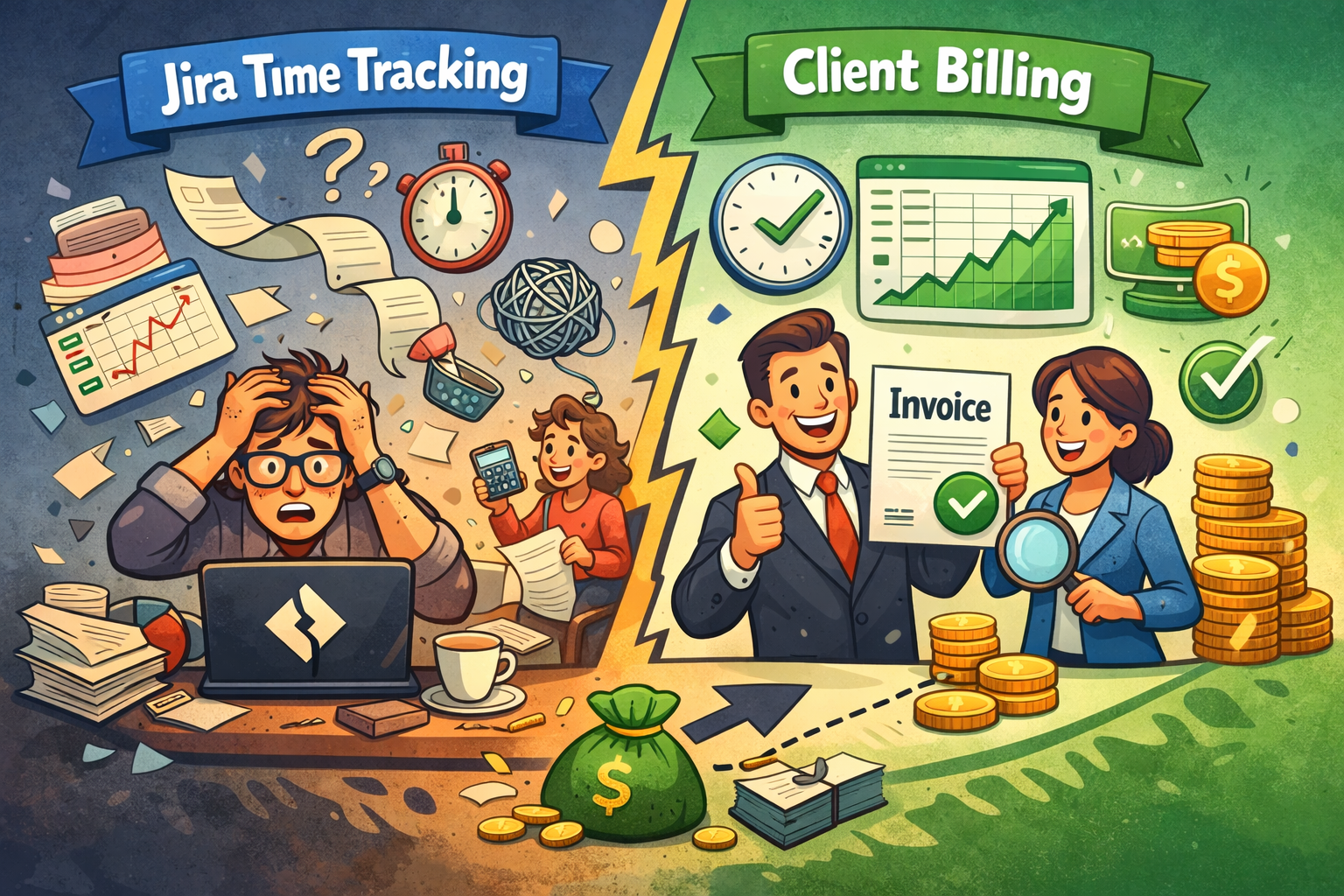
For many service organizations, Jira is already the operational center of delivery. Work happens there. Time is tracked there. Progress is monitored there.
And yet — when it’s time to bill clients, calculate profitability, or close the financial loop on delivery — teams often leave Jira.
Finance exports data. Operations builds spreadsheets. Project managers double-check numbers manually. Delivery leads get pulled into invoice validation cycles.
The problem is not that Jira lacks time tracking.
The problem is that time tracking is not the same as financial execution.
Service companies don’t just need to know what work was done. They need to know:
- What work is billable under the contract
- At what rate
- Against which budget or retainer
- With what client-approved structure
- And whether the work was profitable
This is where the gap between time tracking and client billing begins — and why many Jira-based service teams still struggle to turn delivery data into reliable financial outcomes.
Why Jira time tracking is not enough for service teams
Jira worklogs are excellent for answering delivery questions:
- Who worked on what
- How long it took
- When work was performed
- Which issue or project it belongs to
For engineering productivity and delivery visibility, this is powerful.
But service organizations operate under a second layer: commercial reality.
Real example: Digital Product Agency
A digital agency working in Jira might:
- Track time per issue
- Use epics for features
- Use versions for releases
But client contracts often define billing differently:
- Fixed monthly retainers
- Time & Materials with blended rates
- Role-based pricing (Senior vs Junior)
- Non-billable internal tickets
- CAPEX vs OPEX cost classification
Jira itself does not enforce contract billing logic. It captures activity — not commercial interpretation.
This creates downstream questions:
- Which worklogs are billable vs non-billable?
- Which rate applies?
- Did this exceed budget?
- Should this be invoiced this month or next?
Without a financial layer, teams end up rebuilding contract logic outside Jira.
The gap between worklogs and invoice-ready billing
The biggest hidden cost for service teams is not time tracking — it’s time reconciliation.
Moving from worklogs → invoice requires transformation:
|
Delivery Data
|
Billing Reality
|
|
Worklog hours
|
Billable hours under contract rules
|
|
Jira user
|
Billable role or rate card
|
|
Issue / Epic
|
Client billing grouping
|
|
Work date
|
Billing period alignment
|
|
Project time
|
Budget or retainer consumption
|
Real example: Software Consulting Company
Consulting company contract:
- Senior Dev → $160/hour
- Mid Dev → $120/hour
- QA → $90/hour
- Monthly retainer cap → 400 hours
In Jira, worklogs only show user + time.
To invoice correctly, teams must:
- Map users → billing roles
- Apply contract rates
- Filter internal work
- Check retainer remaining balance
- Group by invoice structure
If this transformation happens manually, risk increases:
- Missed billable time
- Overbilling risk
- Slow invoice cycles
- Finance distrust in delivery data
This is why many service companies say:
“We track delivery in Jira — but we trust billing only after finance rebuilds the dataset.”
Why teams still export to spreadsheets
Despite modern tooling, spreadsheets remain the default “financial glue” between Jira and invoicing.
Not because teams love spreadsheets.
Because spreadsheets are flexible enough to recreate contract logic.
Typical export workflow
- Export worklogs from Jira
- Clean data in Excel / Google Sheets
- Apply rate formulas
- Remove non-billable tickets
- Align to billing period
- Build invoice lines
- Send to accounting system
This workflow survives because:
- Contracts are complex
- Billing rules change per client
- Finance needs control
- Jira alone doesn’t model billing datasets
Real example: SaaS Implementation Partner
They deliver implementation + support.
Delivery reality:
- Support tickets logged anytime
- Escalations mixed with delivery
- Internal enablement work mixed with client work
Billing reality:
- Only production support is billable
- After-hours work billed at premium rate
- Some tickets included in retainer
Spreadsheet becomes the “truth builder”.
But spreadsheets introduce:
- Manual effort
- Version confusion
- Audit risk
- Delayed invoicing
- Lost profitability visibility
This is where many teams realize:
“We don’t have a time tracking problem.
We have a financial execution gap.”
What a client billing workflow inside Jira looks like
A mature service workflow keeps delivery and financial interpretation connected.
Instead of exporting raw worklogs, teams work with billing datasets built directly from Jira data.
Step 1 — Capture clean delivery time
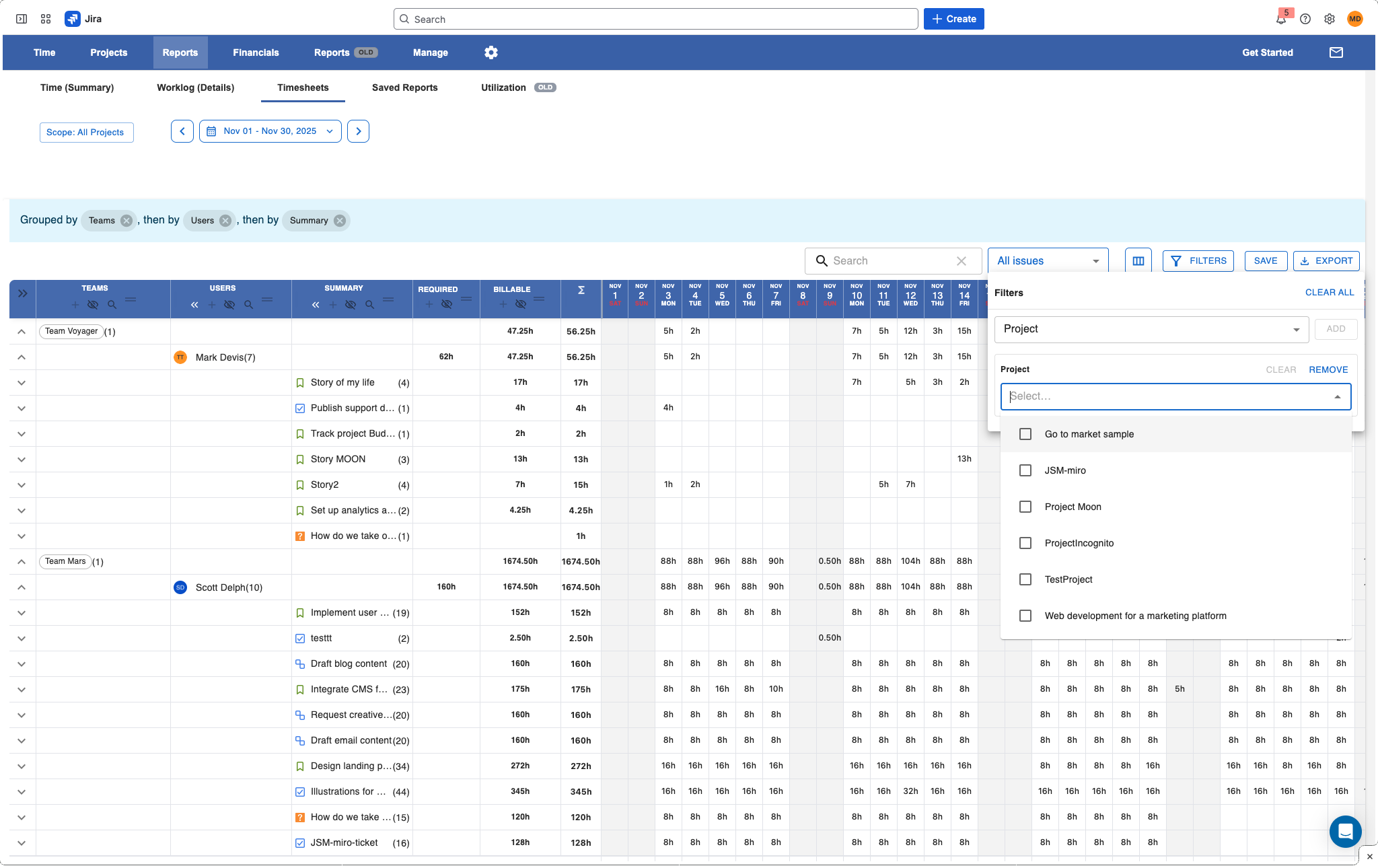
Delivery teams:
- Track time naturally inside Jira
- Submit timesheets for approval
- Classify work as billable / non-billable
- Tag work by client / account / cost center
Goal: Reliable delivery data
Step 2 — Transform into billing dataset
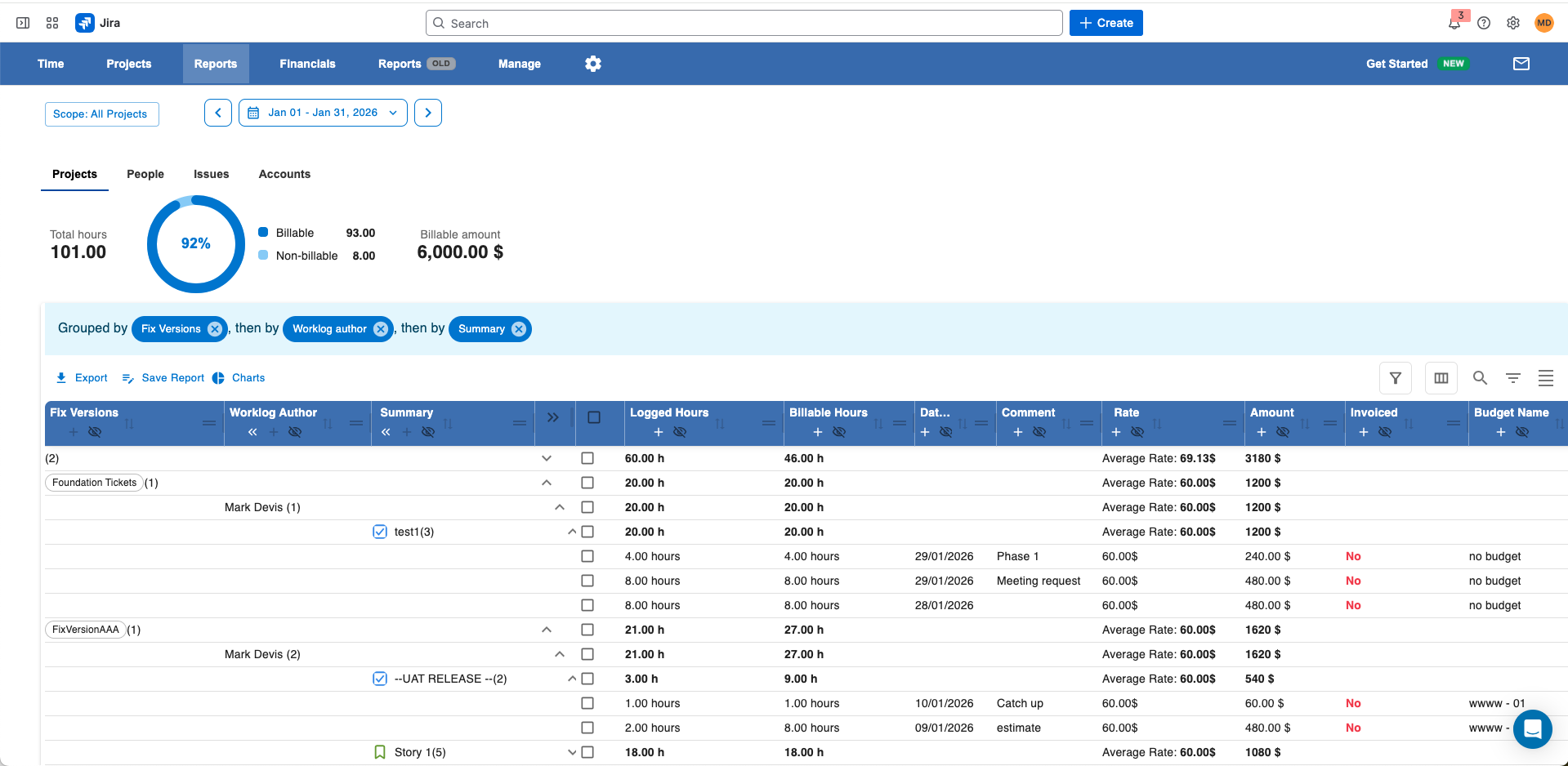
Operations / Finance:
- Apply contract rate cards
- Apply billing rules
- Map users → billing roles
- Filter internal or excluded work
- Align to billing period
- Track budget or retainer burn
Goal: Contract-correct billing data
Step 3 — Generate invoice-ready output
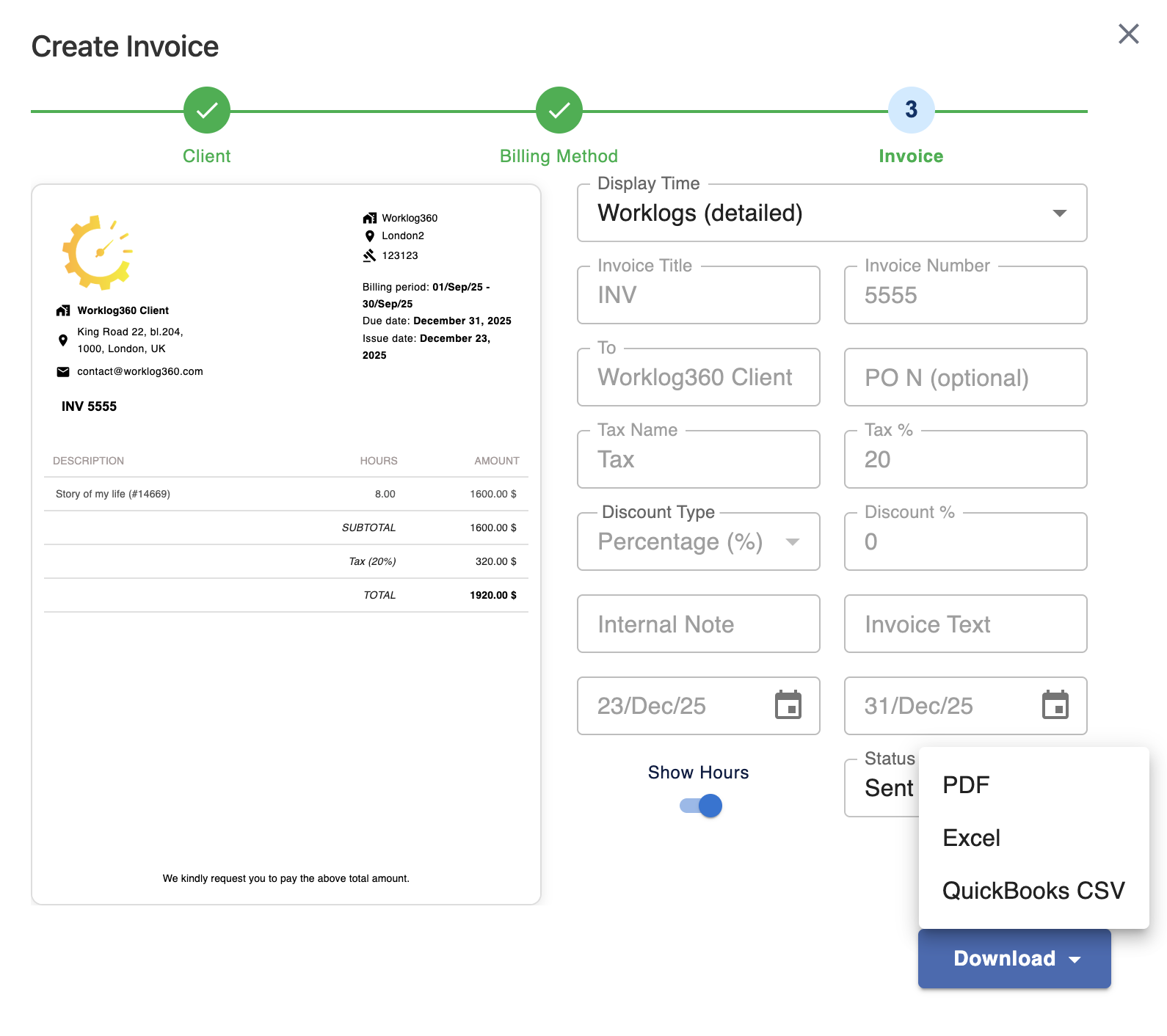
Finance:
- Generate invoice line structure
- Validate billable totals
- Export to accounting system
- Keep traceability back to Jira issues
Goal: Defensible invoices + audit trail
Step 4 — Measure profitability in real time
Leadership sees:
- Revenue vs cost per project
- Margin per client
- Budget burn vs plan
- Team utilization vs billable yield
Goal: Financial control during delivery — not after
How Worklog360 closes the gap
Many Jira teams try to bridge delivery and finance using integrations, exports, or custom reporting.
Worklog360 approaches this differently — by acting as a financial execution layer directly on top of Jira worklogs.
Instead of replacing Jira, it extends it into financial workflows.
What changes operationally
Teams can move from:
Jira → Export → Spreadsheet → Accounting → Profit analysis
To:
Jira → Billing dataset → Invoice → Profit visibility
Example: Agency moving from spreadsheet billing
Before:
- 2–3 days per month invoice prep
- Manual retainer calculations
- Late discovery of budget overruns
After:
- Billing dataset generated from approved worklogs
- Retainer burn visible during delivery
- Invoice draft generated from validated dataset
Example: Consulting company with multiple rate cards
Before:
- Complex Excel formulas per client
- High dependency on finance analyst
- Difficult audit trail
After:
- Rate cards applied automatically
- Billing rules stored per client
- Full traceability to worklog level
Why this matters strategically
Service companies increasingly want:
- One source of truth
- Faster invoice cycles
- Predictable profitability
- Less delivery-finance friction
When billing workflows live outside Jira, delivery and finance become disconnected.
When billing workflows live inside Jira data, teams can align around the same dataset.
The bigger shift: From Time Tracking → Financial Execution
The industry is slowly shifting from:
“Did we track time?”
To:
“Did we execute financially correct delivery?”
Because revenue risk rarely comes from missing time entries.
It comes from:
- Incorrect contract interpretation
- Late billing
- Missed billable scope
- Poor cost visibility
- Manual reconciliation errors
Jira already holds the most valuable asset for service companies: delivery truth.
The missing layer has historically been: financial interpretation of delivery.
Where this matters most
This model becomes critical when companies have:
- Multiple contract types
- Retainers + T&M mix
- Role-based pricing
- Cost tracking (CAPEX / OPEX)
- High delivery volume
- Strict client audit requirements
For small teams, spreadsheets may survive.
For scaling service organizations, financial execution inside the delivery system becomes a multiplier.
Final Thought
Jira solved delivery coordination for technical teams.
The next evolution for service organizations is solving financial coordination on top of delivery.
Not by replacing Jira.
But by extending it into contract-aware billing and profitability workflows.
Worklog360 is one way teams are doing this today — by turning Jira worklogs into structured, contract-correct billing datasets and invoice-ready outputs, while keeping the entire audit trail inside Jira.
If you’re exploring how to move from time tracking → client billing → invoice → profitability without leaving Jira, it may be worth looking at how financial execution workflows are evolving inside the Jira ecosystem.

