In portfolio management, there’s one question that matters more than any other: do you have the right people, with enough time, to deliver what you’ve promised?
Most organizations struggle to answer this honestly.
You might build a flawless strategic roadmap in Jira Plans (formerly Advanced Roadmaps), mapping out every epic, dependency, and milestone for the year ahead. But without validating resources, that roadmap is just a hopeful projection — not a plan.
True portfolio management connects strategy to execution. It ensures that initiatives are not only well-prioritized, but also realistically deliverable. If you don’t clearly understand who will do the work and whether they have the capacity, delays, overload, and budget overruns become inevitable.
This article explains why resource planning is the missing layer in Jira portfolio management — and how ActivityTimeline closes that gap by aligning long-term strategy with real operational capacity.
What Portfolio Management Really Means
Portfolio management is the centralized practice of overseeing all ongoing and planned projects to ensure they support business objectives, deliver maximum value, and use resources effectively.
In Jira environments, portfolio management is typically supported by tools such as Jira Align, Advanced Roadmaps, and other plugins that help structure initiatives, visualize timelines, and track progress. These tools help organizations:
-
Align execution with strategic priorities
-
Balance investments across initiatives
-
Monitor delivery at scale
However, while Jira excels at planning what to build and when, it often lacks precision around who will build it.
Why Portfolio Management Matters
Effective portfolio management transforms chaotic project execution into a structured system. It helps organizations:
-
Keep all initiatives aligned with strategic goals
-
Prioritize high-impact projects
-
Allocate resources where they generate the most value
-
Provide leadership with transparency into delivery progress
When portfolio management is done right, decision-making becomes data-driven instead of reactive, and organizations move faster with fewer costly surprises.
Where Strategy Breaks Down: The Execution Gap
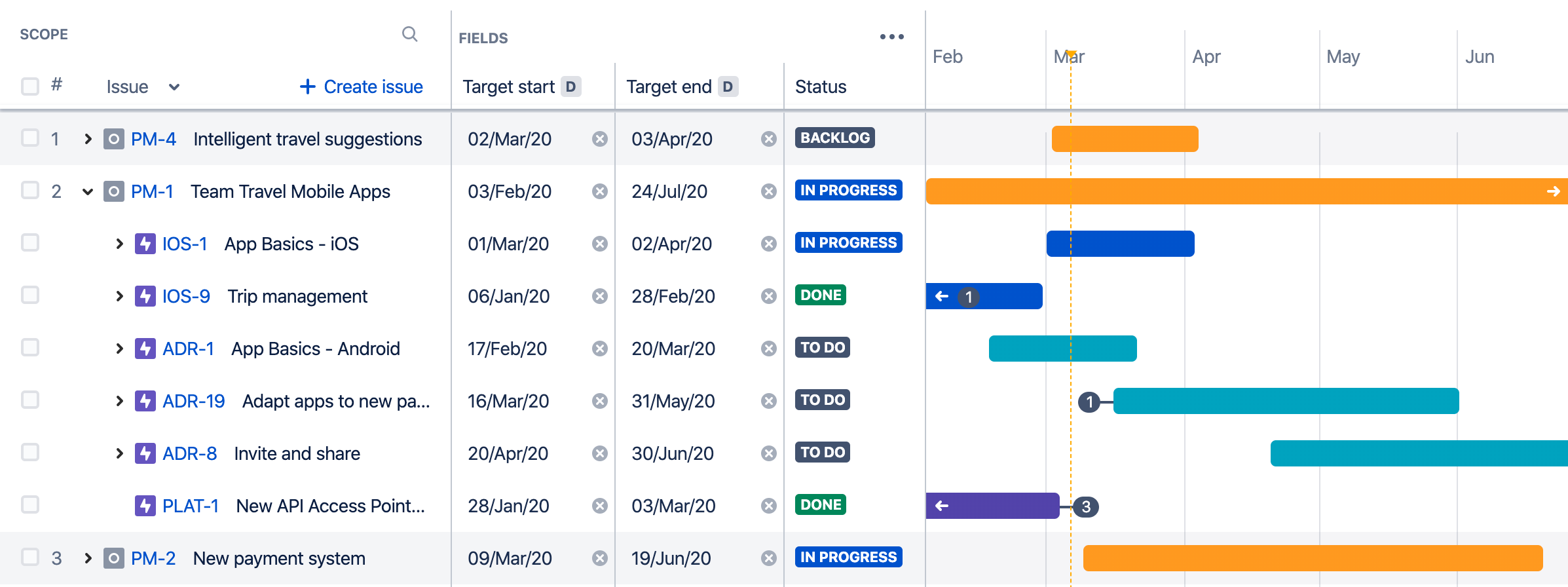
Jira Plans is excellent at mapping timelines, dependencies, and hierarchies. It gives leaders clarity on the “what” and the “when.” But it often struggles with the “who.”
Capacity is usually estimated at a high level, assuming ideal conditions — ignoring vacations, sick leave, context switching, shared resources, and fragmented workloads.
This leads to what we can call the Portfolio–Reality Gap, which shows up as:
-
Overloaded teams: Key contributors are unknowingly booked across multiple initiatives.
-
Invisible bottlenecks: Critical roles become single points of failure.
-
Firefighting management: Leaders spend their time resolving conflicts instead of driving strategy.
Without accurate capacity planning, even the most beautiful roadmap becomes detached from operational reality.
To bridge this gap, you need a resource planning engine inside Jira that operates with real-world precision.
Building a Realistic Portfolio Roadmap
A portfolio roadmap visualizes how projects align with business goals and how resources are distributed over time.
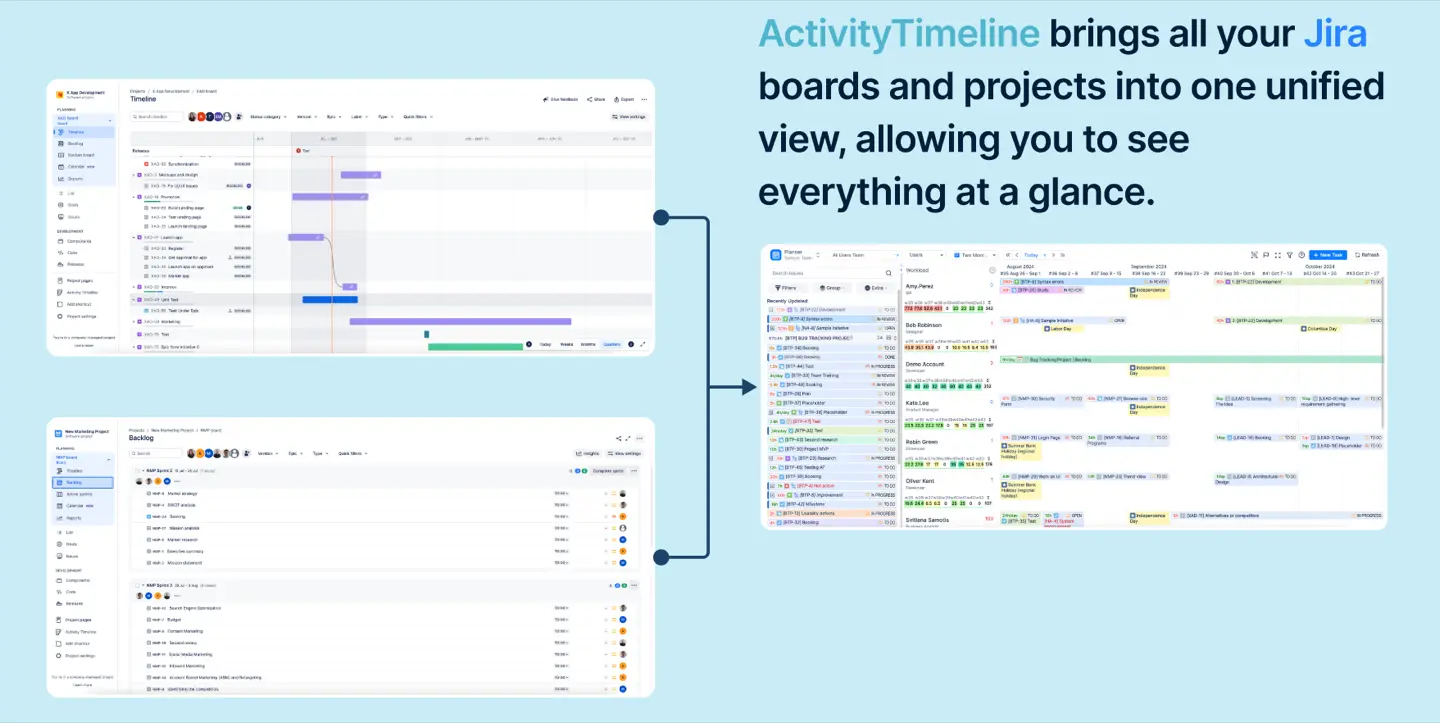
Creating one involves:
-
Identifying initiatives that support strategic objectives
-
Prioritizing them based on value, urgency, and capacity
-
Continuously adjusting plans as business conditions change
Tools like Advanced Roadmaps and BigPicture simplify roadmap creation, but without detailed resource modeling, roadmaps remain theoretical.
Smart Project Categorization & Prioritization
Strong portfolio management depends on structured prioritization. Projects should be categorized and ranked using factors such as:
-
Strategic importance
-
Business impact
-
Risk level
-
Resource demand
Jira’s custom fields, ranking, and scoring mechanisms make this possible — but prioritization alone isn’t enough. Without understanding capacity, prioritization turns into political negotiation instead of operational clarity.
ActivityTimeline: Turning Strategy into Executable Plans
ActivityTimeline upgrades Jira into a fully resource-driven portfolio management system.
Where Jira Plans defines strategic direction, ActivityTimeline validates whether execution is realistically possible — and then helps orchestrate delivery.
It provides portfolio managers with a real-time operational view of:
-
Teams
-
Projects
-
Workloads
-
Capacity
-
Availability
1. Planner: Operational Command Center
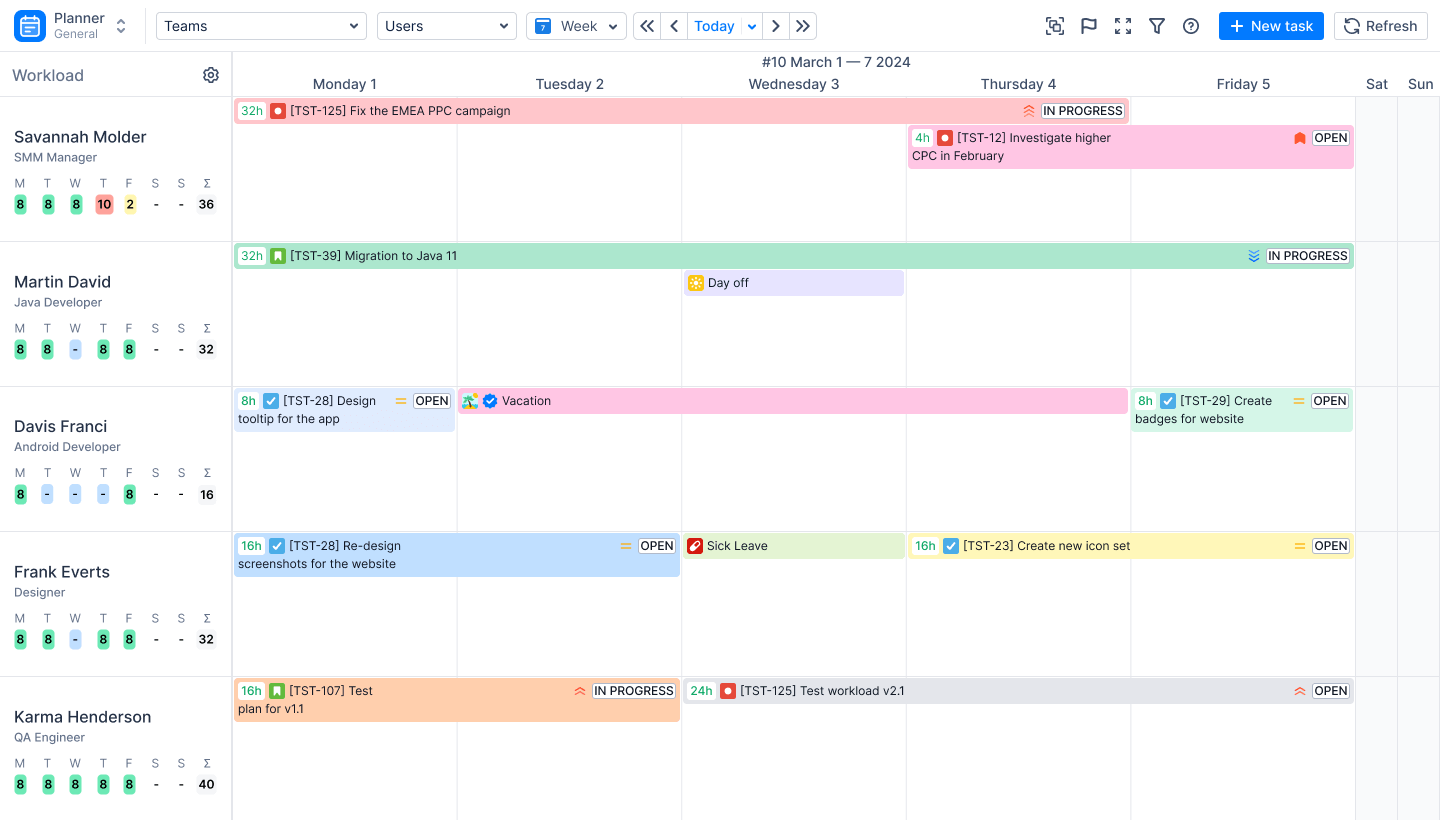
The Planner consolidates all work across teams and projects into one unified timeline. Instead of jumping between disconnected Jira boards, managers gain a single execution dashboard showing:
-
All resources: Individuals, teams, departments
-
All commitments: Jira tasks, meetings, events, and time off
-
Live capacity signals: Color-coded workloads instantly highlight overload and availability
This makes capacity visible, tangible, and actionable — enabling managers to validate strategic plans against actual human bandwidth.
2. Team Panel: Portfolio-Level Capacity Planning
The Team Panel shifts planning from micro-task scheduling to macro-level portfolio balancing.
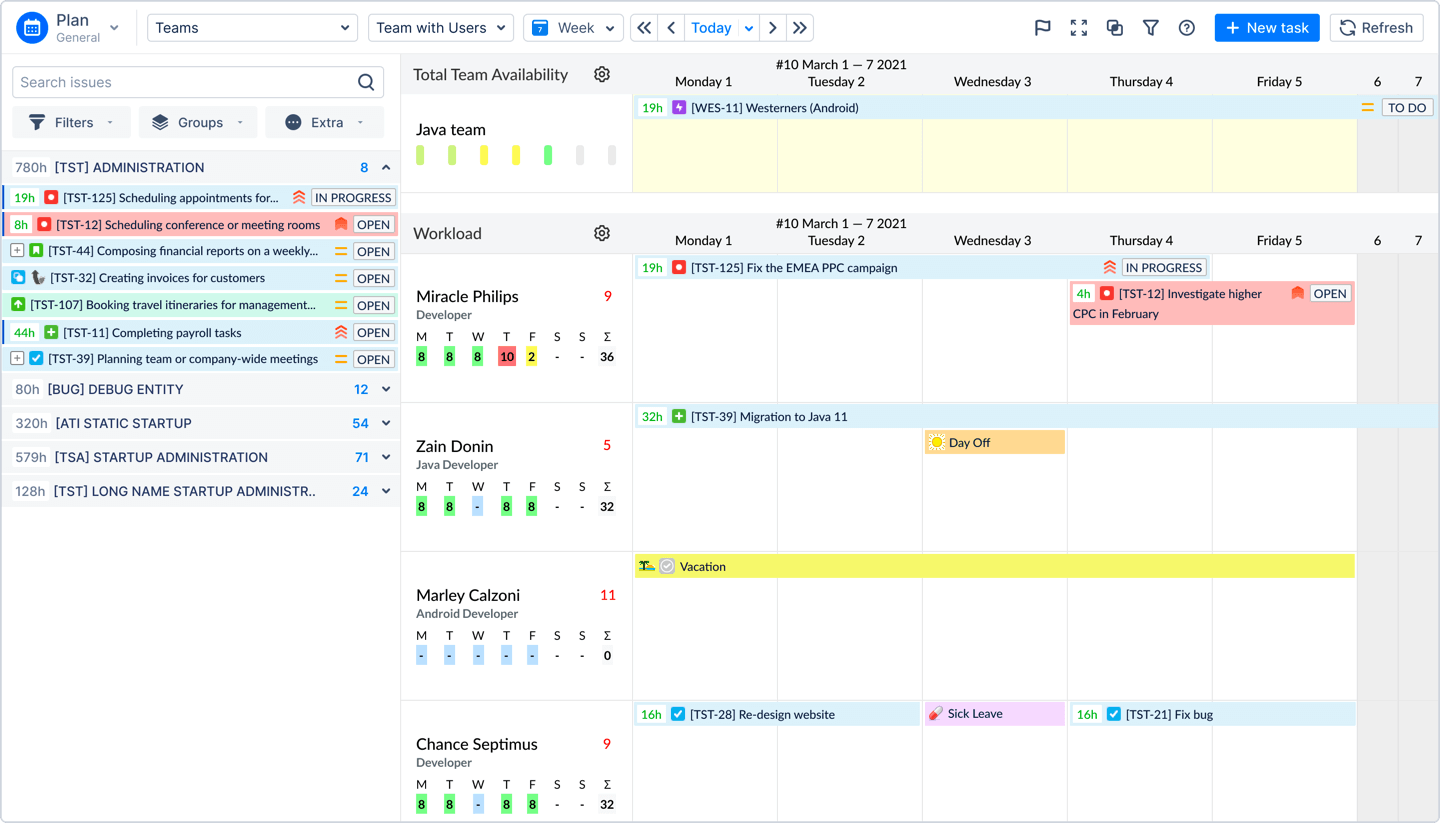
With it, you can:
-
Reserve team capacity months ahead by dragging entire epics or programs
-
Instantly check whether teams can absorb new initiatives
-
Run scenario planning to test different allocation strategies
This allows portfolio managers to optimize execution before problems appear.
3. Resource Utilization Forecast: Predicting the Future
The Resource Utilization Forecast report turns historical and planned Jira data into forward-looking insights.
It enables organizations to:
-
Spot upcoming bottlenecks months in advance
-
Justify hiring or contractor budgets with real data
-
Redistribute work proactively across teams
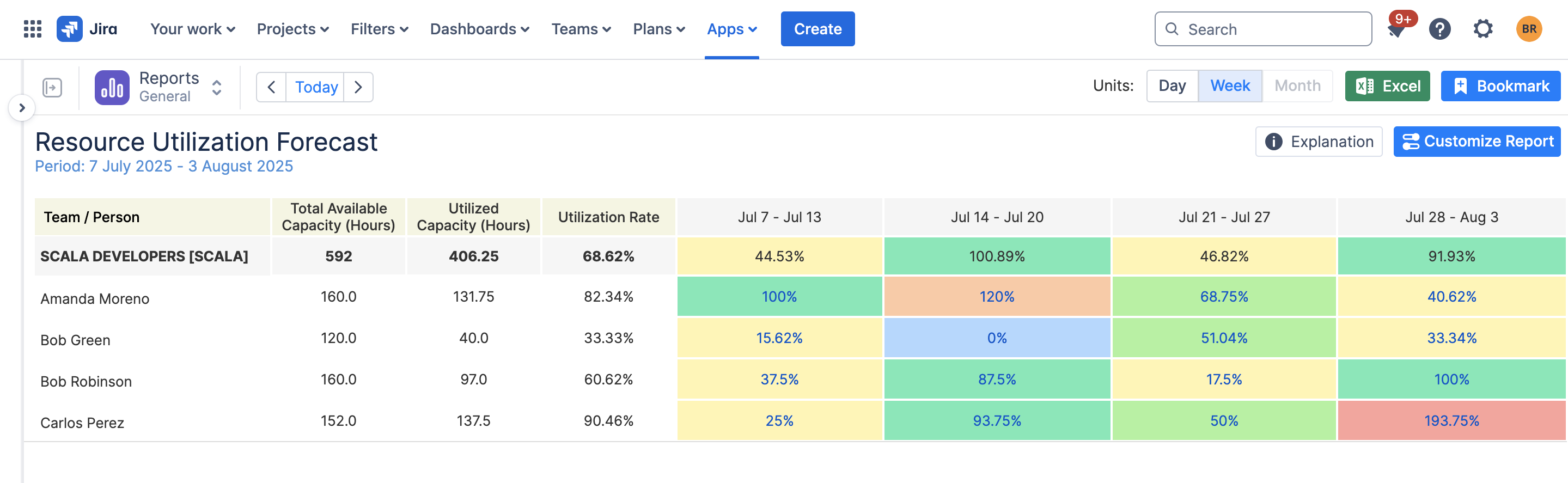
Instead of reacting to overload, organizations can anticipate it.
Why Jira Plans + ActivityTimeline Work Best Together
Individually, each tool solves part of the puzzle. Together, they create a closed-loop portfolio management system.
| Function |
Jira Plans |
ActivityTimeline |
|---|
| Strategic planning |
✔ |
– |
| Timeline modeling |
✔ |
✔ |
| Resource validation |
– |
✔ |
| Capacity forecasting |
– |
✔ |
| Execution control |
– |
✔ |
Workflow:
-
Plan – Build strategic roadmaps in Jira Plans
-
Validate – Sync with ActivityTimeline to confirm capacity
-
Execute – Assign tasks and manage workloads in the Planner
-
Adapt – Continuously adjust strategy based on real delivery data
This creates a tight feedback loop between strategy and execution.
Best Practices for Strong Portfolio Management
To maximize portfolio effectiveness:
-
Review and update roadmaps regularly
-
Track delivery metrics and capacity indicators
-
Use real-time data instead of assumptions
-
Balance strategic ambition with operational reality
By combining Jira’s planning capabilities with ActivityTimeline’s execution intelligence, organizations gain clarity, speed, and confidence.
Final Thoughts
A portfolio roadmap without capacity validation is a gamble.
By integrating ActivityTimeline into your Jira environment, you replace guesswork with certainty. You gain control over workloads, protect teams from burnout, and ensure that strategic goals are built on realistic execution plans.
Don’t just plan projects. Plan the people who make those projects possible.
