Dear Connect apps,
You were fast.
You were flexible.
You let vendors build almost anything, anywhere, however they wanted.
And for a long time — that freedom felt like progress.
This postcard isn’t about pretending the transition to Forge was easy.
It wasn’t.
For vendors or for users.
But it’s also not a complaint letter.
It’s a year-end reflection — on what hurt, what improved, and why this change matters more than it first appears.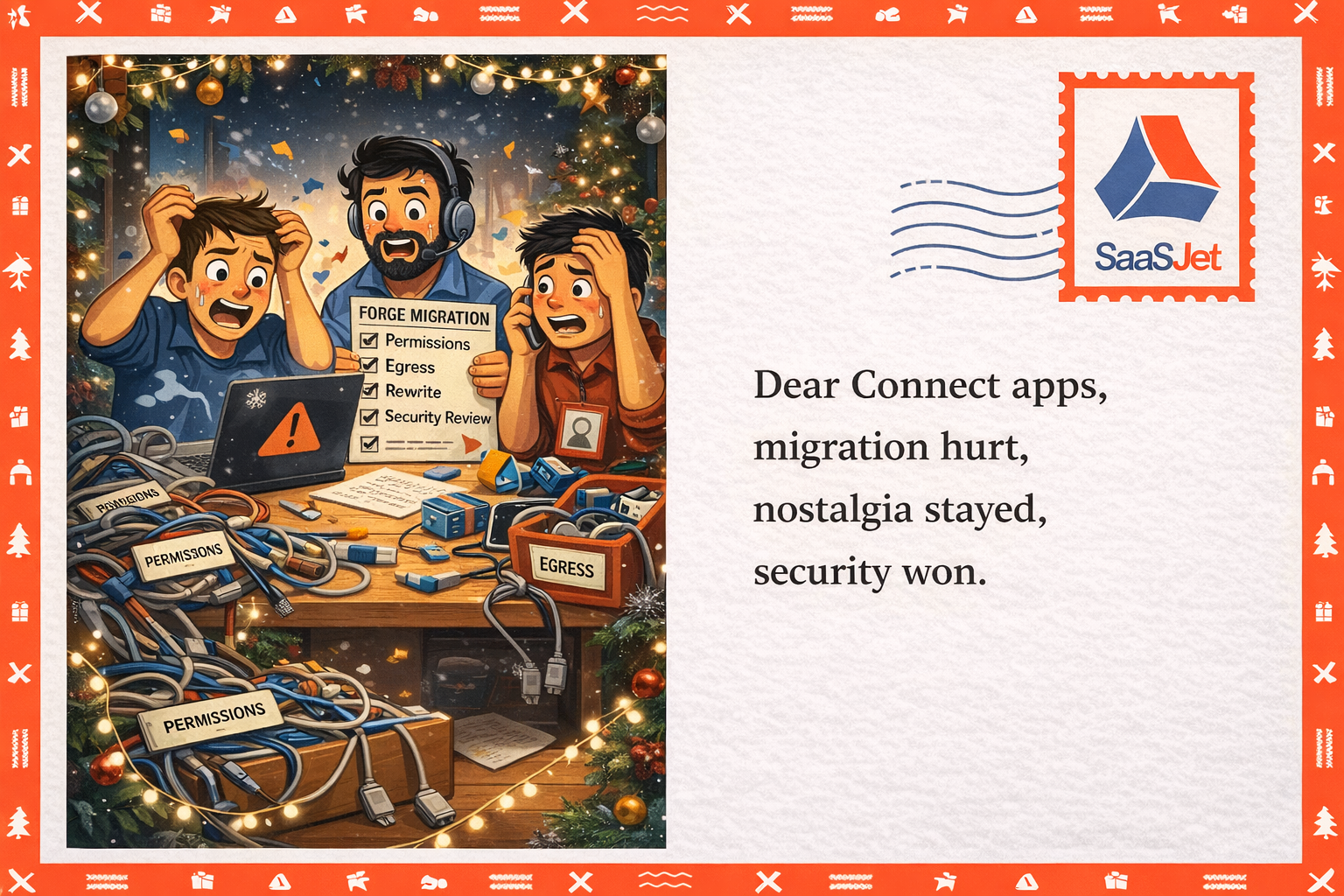
❄️ Let’s start honestly: Forge migration comes with real pain
If you were around during a migration, you probably felt at least one of these:
“Some things just don’t exist the same way anymore”
Not every Connect module has a perfect Forge equivalent yet.
Some UI extension points behave differently.
Some flows need redesign instead of simple migration.
From a user perspective, this can look like:
That frustration is valid.
“Our integrations suddenly became… complicated”
Forge places strict controls on outbound connections.
What used to be “just connect to this external service” now requires:
-
declared egress
-
explicit allowlists
-
architectural changes
For users, this sometimes meant:
Security improved — but not without friction.
“We paid the migration cost, even though we didn’t ask for it”
Vendors rebuilt.
Users retested.
Admins revalidated.
Security teams reapproved.
All while the app mostly looked the same.
And yes — that can feel unfair.
🎄 Now the other side of the postcard: what actually got better
Once the dust settled, something quietly changed.
🔐 Security stopped being “trust us”
Forge apps run inside Atlassian’s infrastructure.
For users, this means:
-
clearer answers to “where does our data live?”
-
fewer unknowns during security reviews
-
stronger alignment with Atlassian’s compliance model
Not abstract security — practical, explainable security.
🧭 Permissions became understandable
Instead of broad, opaque access scopes, Forge enforces tighter, more explicit permissions.
That made life easier for:
Less “we hope this is fine,” more “we know exactly what this app can do.”
⚖️ Stability started to outweigh flexibility
Connect was powerful — but power came with variability.
Forge trades some freedom for predictability:
-
fewer environment-specific surprises
-
more consistent behavior across tenants
-
better resilience during Atlassian platform changes
🎄 The uncomfortable truth: this isn’t optional anymore
Atlassian has been clear: by late 2026, Connect apps must move to Forge.
So this shift isn’t about trends or preferences.
It’s about the ecosystem maturing.
Forge isn’t saying:
“Build less.”
It’s saying:
“Build responsibly — in a way that scales for millions of users.”
Our own Advent milestone
This month, we reached an important checkpoint ourselves:
Smart Forms for Jira has completed its Forge migration.
Not because it was easy.
Not because it was fast.
But because it was the right thing to do — for long-term security, trust, and alignment with Atlassian’s platform.
Like many vendors, we:
And now, the app runs fully on Forge — inside Atlassian’s cloud.
🎁 A year-end wish for everyone migrating
To users navigating change:
May your apps be secure, predictable, and transparent.
To admins and security teams:
May your reviews be simpler and your answers clearer.
To vendors rebuilding quietly behind the scenes:
May your migrations be steady and your users patient.
Dear Connect apps —
thank you for getting us here.
And welcome to a safer, calmer, more responsible Jira ecosystem.
Wishing everyone a secure end of year and a confident start to the next one. 🎄✨
