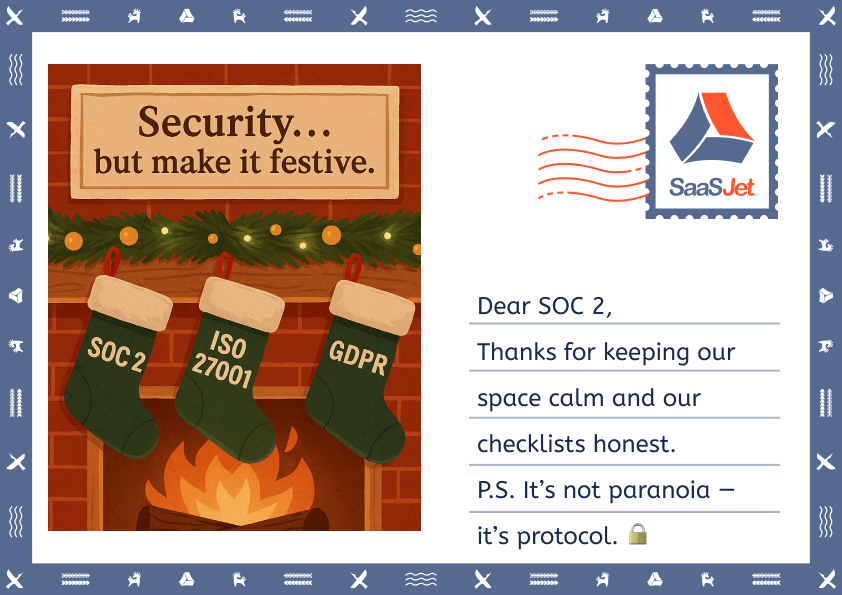
SaaSJet Advent Calendar — The Postcards We Never Sent
Marketplace apps don’t just extend features — they extend data paths. That means the real question isn’t only “Does it work?” but also:
“Can we defend this choice when security, legal, and audit ask the obvious follow-ups?”
That’s where certifications help. Not as a flex — as a shared language between vendors, users, and risk teams.
Where to find these certifications (quick check)
If you’re doing a fast first-pass review of a Marketplace app, start with the app’s Privacy & Security tab. Atlassian’s Marketplace listing questionnaire includes a field where vendors can specify whether the app has compliance certifications (for example, SOC 2 and ISO 27K / ISO 27001, among others).
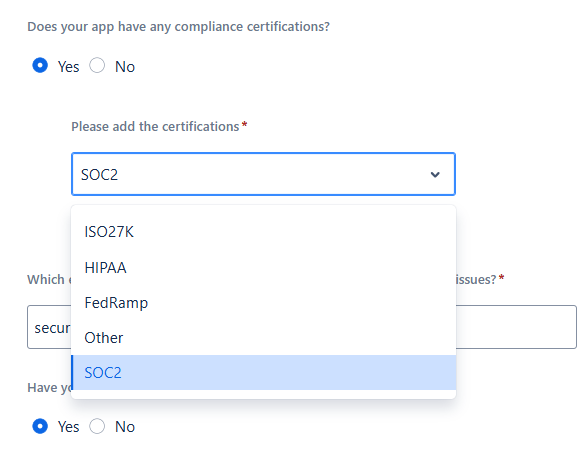
It won’t replace a full vendor assessment — but it’s a quick way to spot which apps are ready for deeper questions.
Tiny follow-up checklist (30 seconds, not a spreadsheet):
-
Scope: what part of the product/service is covered?
-
Recency: how recent is the report/certification?
-
Evidence: can the vendor share a report summary or supporting details, if needed?
What these certifications signal (in practice)
✅ SOC 2 (especially Type II)
Think of SOC 2 as: “Show me the receipts.”
It’s evidence that controls exist and operated consistently over a period of time. The useful signals are usually around:
- Access controls (least privilege, reviews, offboarding)
- Audit trails (what happened, when, and by whom)
- Change management (how releases are approved and tracked)
- Incident response (how issues are detected, handled, and documented)
✅ ISO 27001
ISO 27001 is about having a working security management system — not a “security hero” who remembers everything. It typically signals:
- Ongoing risk management (not once-a-year panic)
- Clear ownership + policies (who decides what, and why)
- Training + internal checks (security as habit)
- Continuous improvement (because threats don’t stand still)
✅ GDPR
GDPR is the reminder that privacy is not a checkbox — it’s governance. It pushes clarity on:
- Roles and responsibilities (who’s the controller/processor)
- Data minimization (collect what you need, not what you can)
- Data subject requests (deletion/export without drama)
- Data transfers and safeguards (where data goes, under what protection)
Certifications don’t guarantee perfection — but they reduce uncertainty and speed up due diligence when choices need to scale across teams and regions.
💌 Dear SOC 2, thanks for turning “we should probably check that” into “we can prove that.”
P.S. It’s not paranoia if it’s protocol. 🔒✨
