The pain point every manager feels – how to make Reps Respond on Time

Picture this scenario. The funnel is full, leads are flowing steadily, and the CRM glows with green "Closed Won" statuses. Sales managers are getting their bonuses. Everything is great, right?
Now, look between the lines.
A client sent a request (which was logged into Jira as a Work Item). The Sales Rep took the deal into work… and vanished.
❌ The client waits a minute. ❌ Then an hour. ❌ Then half a day.
In many cases, clients reach out to competitors within a few hours if no response is received. Meanwhile, in the CRM, the manager closes another, less profitable deal, gets a bonus – and no one sees that a potentially high-value client simply slipped away due to silence.
The Paradox: The CRM creates the illusion of success but fails to show the most crucial metric – the quality and speed of communication. This is the biggest leak in your funnel.
Why standard Sales KPIs are failing
In most companies, sales rep motivation is based on the final outcome:
✅ Invoice sent.
✅ Deal marked with a Closed Won status.
💰 Bonus received.
However, this model incentivizes quantity of deals, not the quality of client work and communication discipline.
|
Behavior (Consequences)
|
The Core Problem
|
|
"Invoicers": The Rep sent the CP and forgot to follow up.
|
The lead went cold; the deal was lost due to negligence.
|
|
"Willful Ignorance": Sale is complex and time-consuming → the Rep switches to an easier lead.
|
Loss of a large cheque due to lack of prioritization.
|
|
Slowness: The Rep doesn't respond for hours, even to urgent queries recorded in the Work Item.
|
The client goes to a competitor, as they expect a response within an hour.
|
The Main Thesis: A KPI on "invoice sent" ≠ a KPI on "client brought to purchase". We need a metric that evaluates communication discipline and speed of reaction.
✅ SLA as the New Sales KPI: Response Time and Follow-up Discipline
The solution is to implement a Service Level Agreement (SLA). In sales, an SLA is the maximum allowed time for a manager to perform a necessary action (like replying to a question or sending a document).
To improve sales performance and response discipline, SLAs can be segmented by deal value. For example, a common setup is: deals over $1000 get a 1-hour SLA, while smaller deals get a 4-hour SLA.
📌 Premium Jira Clients (> $1000): Action must be taken within 1 hour.
📌 Standard Jira Clients (< $1000): Action must be taken within 4 hours.
What SLA Changes:
|
Before
|
After
|
|
Rep thinks, "I'll reply later."
|
Rep must reply before the red deadline.
|
|
No one sees who is delaying communication.
|
SLA reports show specific violators with timestamps.
|
|
Focus only on the final result.
|
Focus on systemic quality of service.
|
A B2B SaaS company manages its deals in Jira – each deal is a separate work item in a Sales project.
Before using SLA:
- Sales reps often sent a commercial proposal and then forgot to follow up.
- Sales managers had no visibility into how long each client was waiting for a reply.
- CRM showed “Closed Won/Closed Lost”, but not communication discipline.
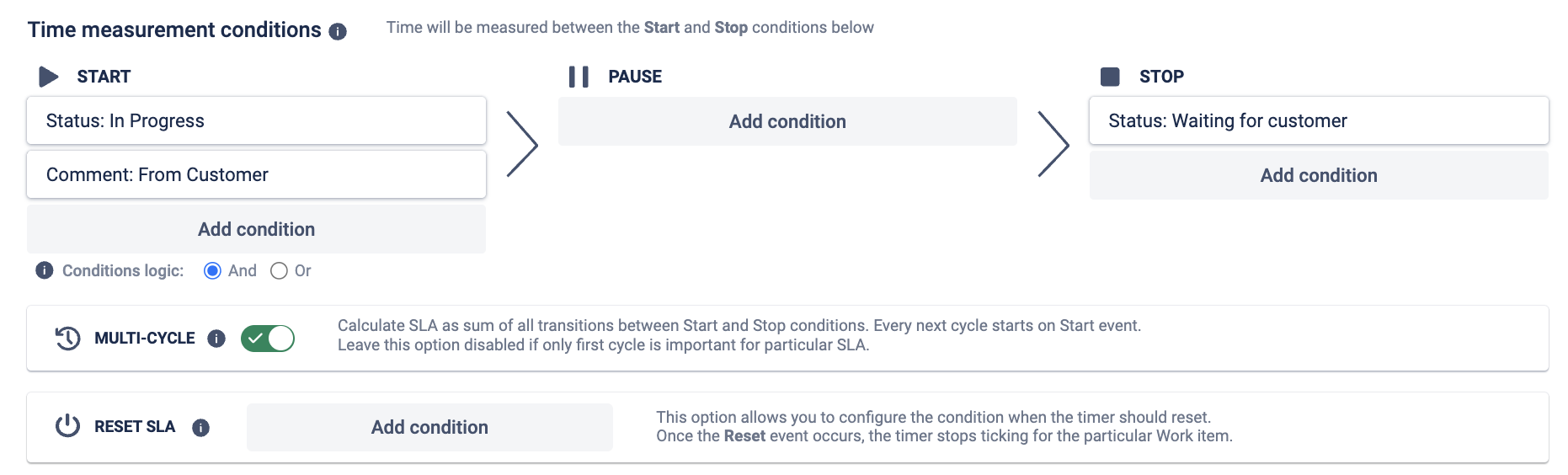
▶️ Start condition
⏹️ Stop condition
🔔 Thresholds and notifications
-
A pre-breach alert triggers at 80–90% of the allowed time, automatically added as a comment on the issue.
(You can also add Automation actions (with SLA Time and Report app) if you need to change the assignee or status, or receive an alert in Slack or email when the SLA is breached.)
⚡️ SLA segmentation by deal value (JQL)
Create a custom field such as Deal Size, and apply different SLA rules based on JQL filtering:
Reports & Dashboards
On the Jira Dashboard, SLA Time and Report provides multiple visual widgets:
-
Pie Chart (SLA met vs breached),
-
Met vs Exceeded Chart (distribution of completed SLAs),
-
Met vs Exceeded per Criteria (filtered by Sales Rep / deal value / projects / time period).
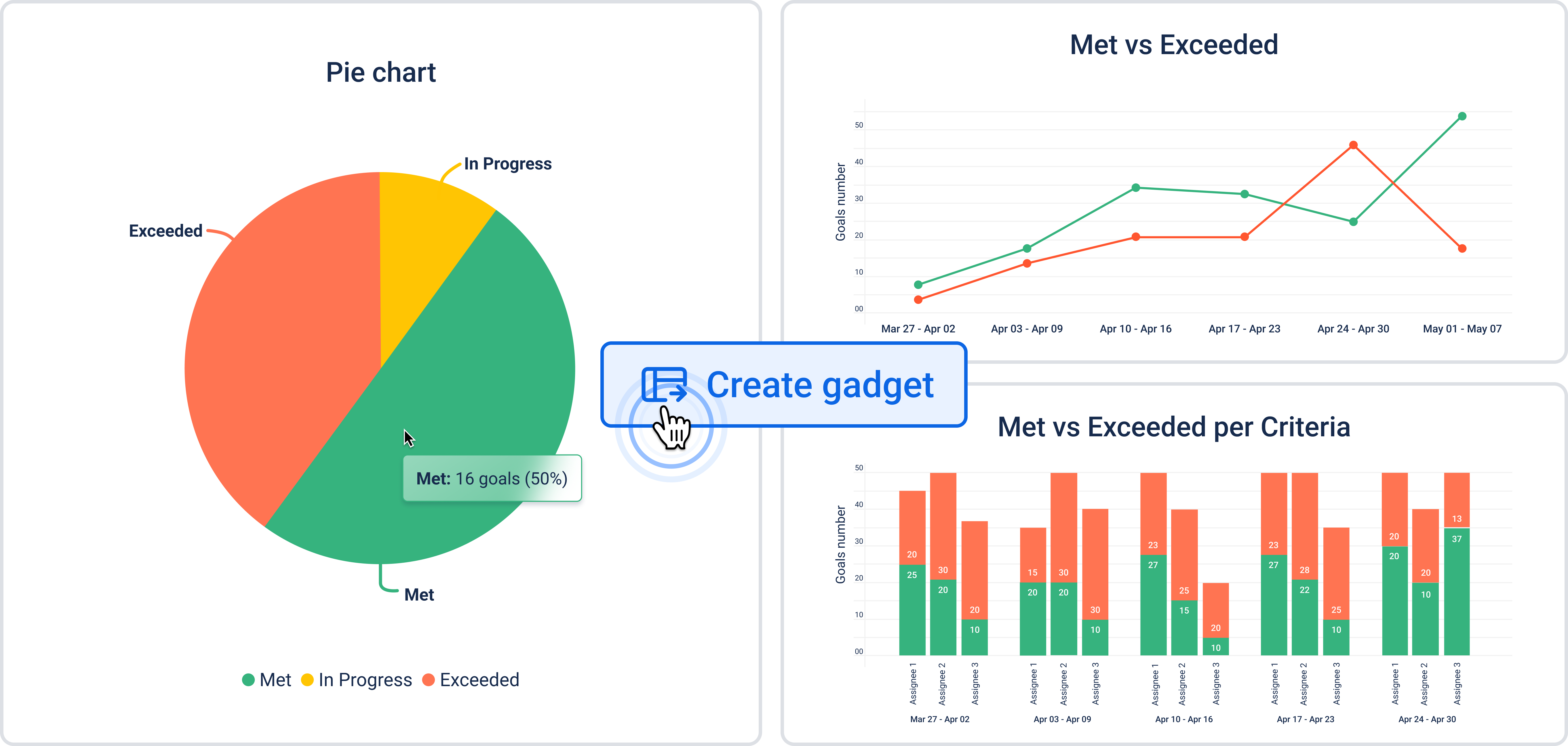
These reports allow the Sales Manager to see not just whether SLAs are met, but who is consistently meeting or violating response-time expectations, and at which stage of the sales funnel delays occur.
📊 Metrics That Truly Show a Rep's Effectiveness
SLA creates transparency and discipline. Management no longer only looks at "total sales volume." In Jira, using the SLA Time and Report app, managers can see:
- Time to First Response (Action taken)
- Time Between Follow-ups
- Missed SLAs
- % of deals where SLA was breached
If a rep systematically violates the SLA, the problem is not with the clients, but with their work discipline.
💰 Bonus tied to SLA (example framework)
Not a rule – but a tested approach used in several sales teams to align motivation:
|
% SLA Compliance (Monthly)
|
% Closed Won Deals
|
Impact on Bonus
|
|
95–100%
|
≥ 70% deals
|
Maximum Bonus (+20% to standard)
|
|
80–94%
|
≥ 60% deals
|
Standard Bonus (1.0 multiplier)
|
|
< 80%
|
Any
|
Bonus reduced by 15–20%
|
This approach transforms thinking: "Timely response = saved deal = maximum reward."
🚀 Sales = Not "They'll Buy Anyway," but Systematic Work
SLA in sales is not about micromanagement. It's a way to protect company revenue from human error and the "I'll reply later" mindset.
SLA provides:
✅ Discipline and accountability from Sales Reps.
✅ Predictability of the sales funnel.
✅ Helps maintain consistency in follow-ups and often correlates with higher close rates.
If a rep doesn't respond on time, they are knowingly giving your client away to a competitor.
Want your Sales Reps to act on time, using the tools they already have?
👉 You can experiment with this approach using SLA Time and Report for Jira to track response times and communication discipline.
