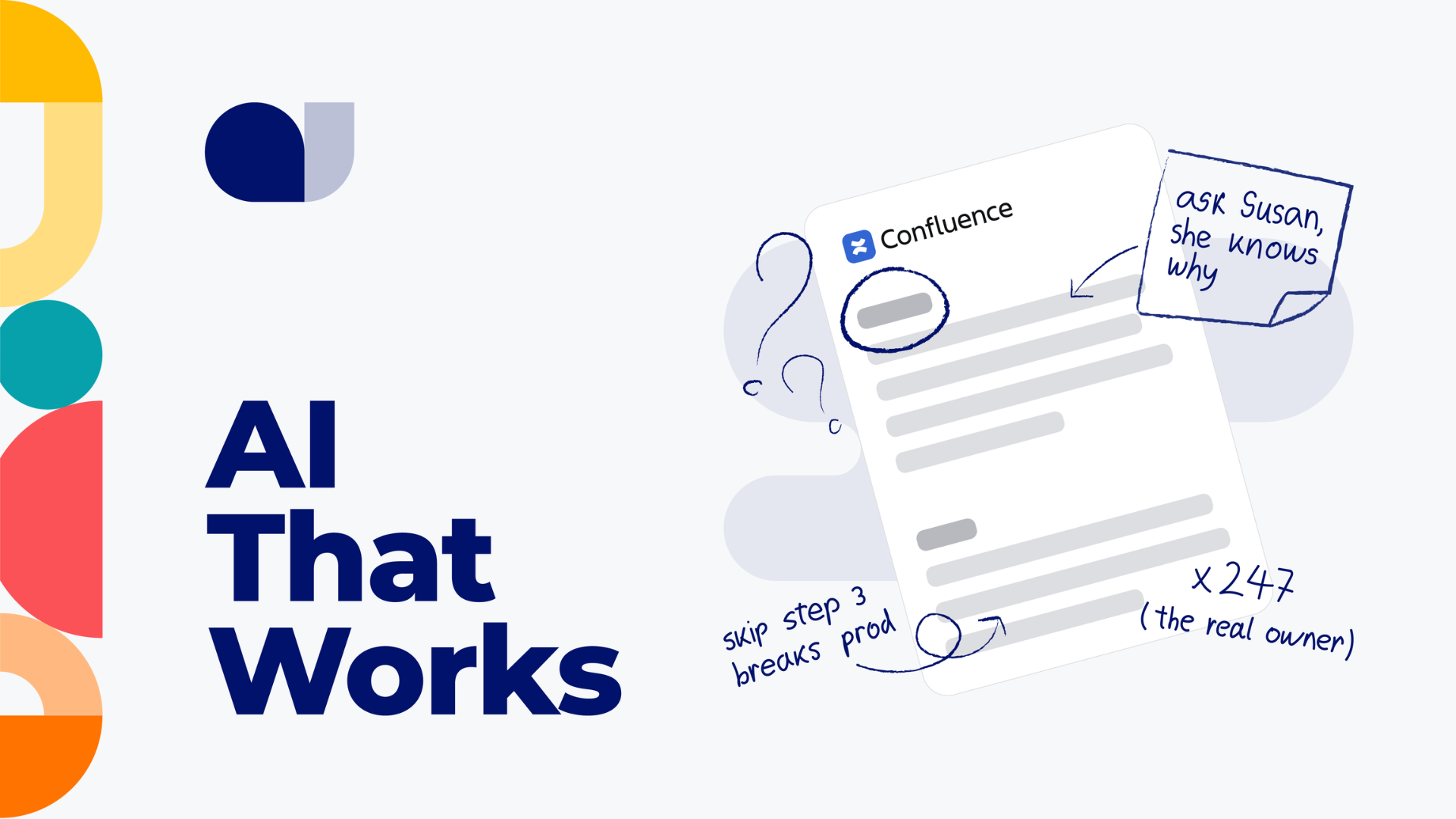
Your systems don't run your operation. Your people do, along with everything they never wrote down.
The pattern I kept seeing
Over the past eight months, I've written about what prevents organizations from making AI work from several angles. A pattern emerged: AI often returns answers that are well written, confident, and wrong.
At first I blamed the usual suspects: messy, incomplete, or insufficient data and poorly crafted prompts.
If you follow this series, you've seen me circle and repeat this point.
Then I realized: that explanation isn't good enough.
We've only been looking at half of it
Say "AI is only as good as its data" and every practitioner in the room nods, because we've all lived it. Garbage in, garbage out. There's an entire industry pointed at that sentence.
But the conclusion is incomplete.
You can clean every record, reconcile every system, and pass every audit, and AI will still get things wrong.
Watch what your people do
Watch an experienced professional work and you can see the missing part, because they're the one supplying it.
They know which fields in the system are trustworthy and which are obsolete. And when the documented process and the actual one have drifted apart, they know who to ask.
None of this is anywhere you could look it up. It's judgment, built over years, applied so constantly that nobody notices it's there.
Here's what this looked like in practice
A colleague recently told me a story that captures this perfectly.
He'd worked with a change-management team in a larger enterprise. That team had twenty years of experience. And almost none of it written down.
They approved every change, insisting they had to, because they were the only ones who knew what would break. For years they were right. They'd seen the failures. They remembered the "routine change" that took the payment gateway down one Friday night, the one nobody had flagged as risky. They knew what depended on what.
And none of it was stored in a system.
Then Agile and DevOps arrived. The volume of change outran them, and the change-management team became a change-management queue.
People started routing decisions around them, because a process that can't keep up stops getting followed. The knowledge that made them valuable was the same thing that made them impossible to scale. It lived in their heads and nowhere else. If one of them left, twenty years of judgment left with them.
Here's the part worth remembering. Nobody entered bad data; there was barely any data to enter. The operation ran on people who knew things, and it ran fine, right up until it had to run faster than the people could.
I bet you know similar situations in your own organization.
The layer nobody documents
Recently, I started calling this the unwritten layer. The part of how an organization works that never made it into a system, because the people doing the work were the system.
It's the most valuable layer in the operation, and the only one that appears on no diagram, in no budget, in no governance model.
It isn't a problem to be solved. It's where expertise lives. The mistake is pretending it isn't there.
That layer doesn't hold itself together. It lives in a handful of people who cover the distance between what the record says and what's true. I've called that the human compensation layer, and it's the reason the gap has never really mattered.
AI can't see it
An AI agent has none of that. It can't read the room, ask the person who knows, or feel that a record is too stale. It only knows what's written, and it moves fast, before anyone can catch it.
Drop an agent where a person used to sit and the compensation just stops. Everything that used to get quietly corrected now gets executed.
So, when someone tells me a data-cleanup project is getting them ready for AI, I think they've done the part that's easy to see. But clean data doesn't create context. It just makes the absence of it easier to miss.
The work nobody wants to do
The same colleague eventually found a repeatable way through the company's change-management bottleneck, and it wasn't a cleanup project. He brought in a tool that scored change risk from history instead of memory and let the teams with a strong track record earn automatic approval on their low-risk changes, the way a bank approves a loan. The knowledge started moving out of a few heads and into something the whole organization could see. That was a few years ago.
Today, with GenAI on the table, he'd go further and sit the most experienced person down to build an agent that carries their judgment directly.
Call that what it is. It isn't documentation. It's capture, and it's the actual work most AI programs haven't started, because it's slower and less satisfying than buying another tool.
What AI is about to reveal
Here's where I've landed, after writing enough of these articles.
None of it was ever written down, because a person was always there to supply it. That held for exactly as long as the person stayed in the loop. And the loop is what we are automating.
The bigger thing is what that exposes. Today, most of us worry about whether our data is ready for AI. Now I think that was always only half the question.
The other half is whether we ever understood our own operations well enough to write them down, or whether we just had good people quietly making up the difference.
Most of us are about to find out. AI may not break your operation. But it will reveal it for what it is: one that relies on unwritten rules and knowledge.
📚 Further Reading
This article is part of an AI That Works article series, and it's the one I'll point back to when this idea comes up again, instead of retelling it each time.
In particular, check out what happens when AI reads a broken CMDB literally, and why the systems that look automatable often aren't for more context.


