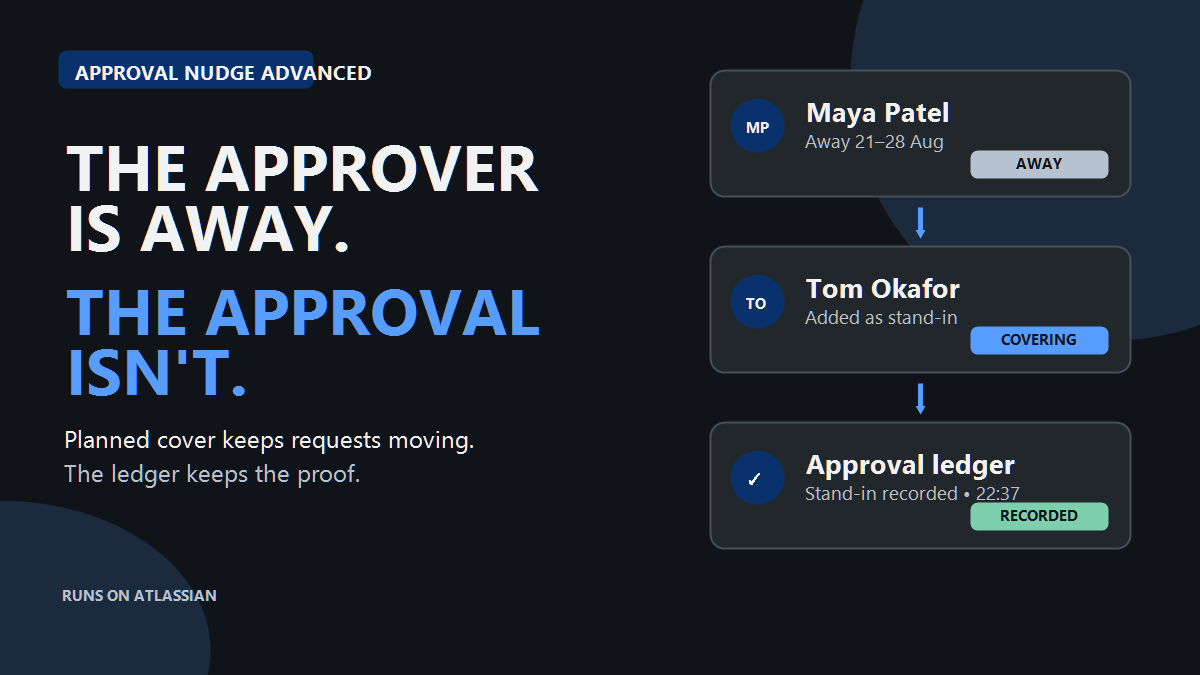
Disclosure: I build Approval Nudge at Quietmill, the app discussed below.
Someone books two weeks off. Their out-of-office turns on. Jira keeps waiting for that same person to approve a laptop, an access request or a change.
Nothing is technically broken. Nothing moves either. The requester waits, the service desk chases, and sooner or later an admin edits the Approvers field by hand—then has to remember to undo it when the person returns.
Version 3.13 added two connected Advanced features: planned cover while an approver is away, and a ledger that records what happened afterwards.
Version 3.14 made the admin screens easier to live with: tabbed project settings, a clearer Approvals Overview and ledger, consistent dates and better people pickers.
Set the cover before the leave starts
Add the person who is going away, their first and last day away, and the person covering for them. While that absence is active, the next scan adds the stand-in to any approval still waiting for the absent person. It does not wait for the normal reminder threshold; the leave is already known.
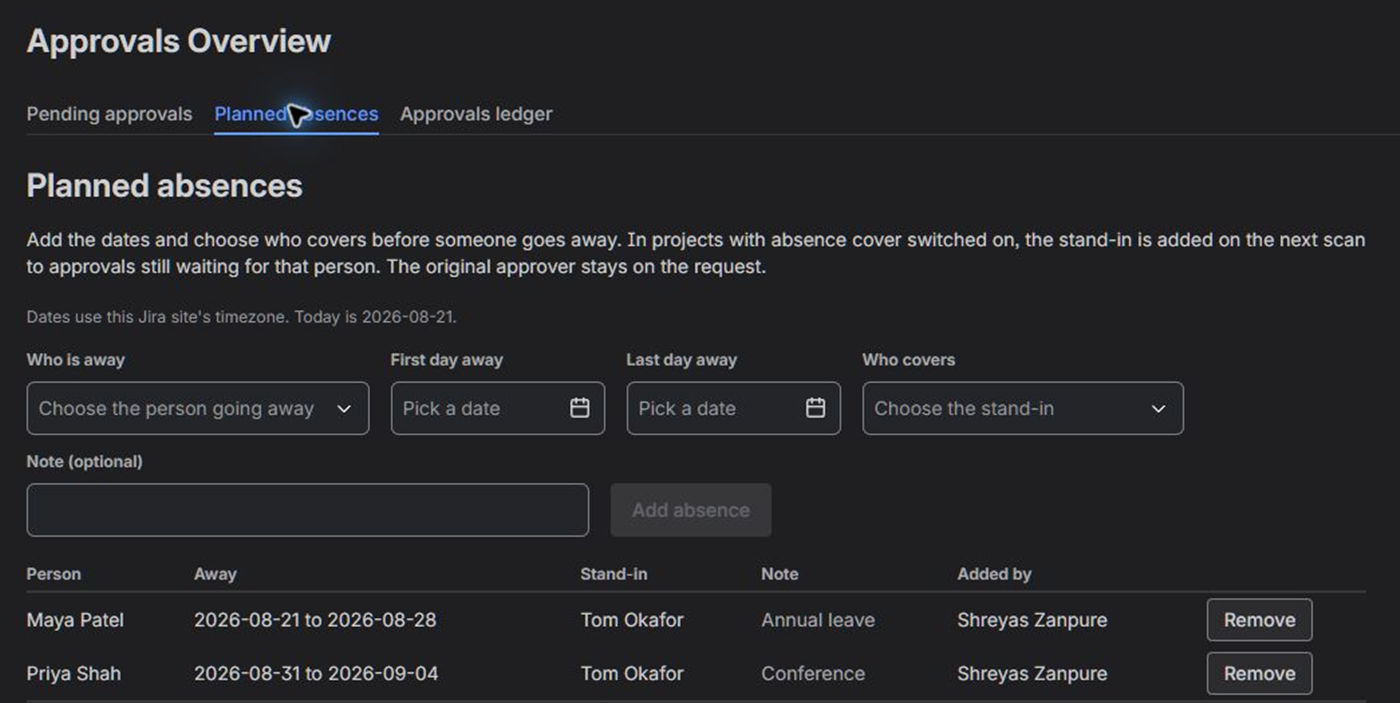
Schedule the dates once. Approval Nudge checks them during the scans it already runs.
The important word is adds. Approval Nudge does not replace the original approver or transfer their identity, authority or decision. The stand-in joins the request as another approver, and the original approver can still respond. If anyone approves or declines, the app leaves the approval alone.
When cover is added, the request gets an internal note naming both people and the last day of the absence. The Jira Approvals panel shows both approvers, so an agent can see the handoff without opening another screen.

The stand-in is additional. The original approver remains on the request.
It includes the people who actually approve
This matters on migrated sites and on service desks where customers do the approving. Those approvers may be portal customers rather than licensed agents, and JSM customer accounts do not appear in Atlassian's standard user picker for apps. A leave feature that cannot find them would work in a demo and fail on the real service desk.
Approval Nudge therefore searches both Jira users and JSM customers when an admin chooses who is away and who covers. It is the practical version of the temporary-approver request in JSDCLOUD-7867, which was opened in 2018 and currently has 249 votes.
Answer the audit question without Jira archaeology
Keeping an approval moving solves today. The approvals ledger is for the question that arrives weeks or months later: Who was asked? Who answered? When did it happen? What did the app do in between?
Without one record, the answer is scattered across issue history, internal comments and app activity. The ledger puts the approval lifecycle and the app's actions in time order: approval started, approved or declined, reminders, resent Jira approval emails, escalations and stand-ins.
Filter by project and date, follow a request key back into Jira, or export the rows as CSV. A Jira administrator chooses whether entries are kept for 90 days, 180 days or one year; older entries are removed automatically during the daily cleanup.
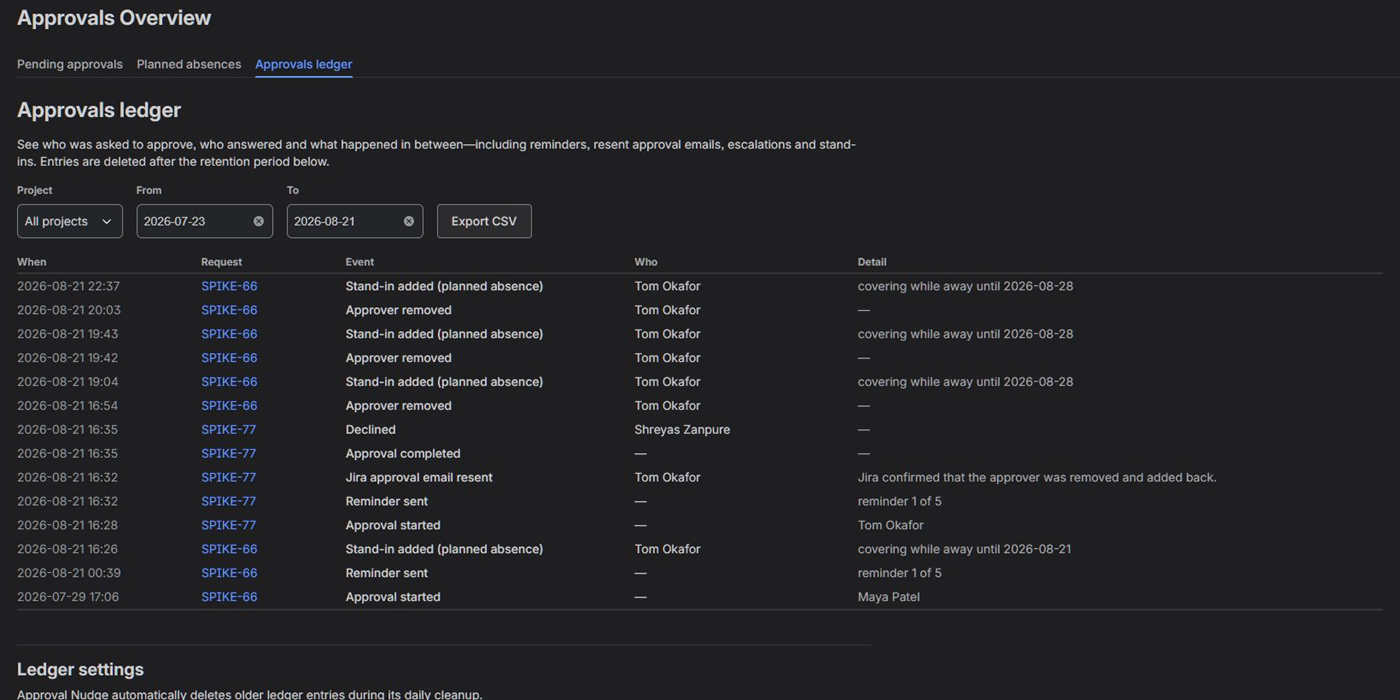
One place to see what Jira did, what Approval Nudge did, and when.
That record also stays where the approval lives. Approval Nudge has no vendor servers and no data egress. It runs on Atlassian's infrastructure, so the approval history remains inside your Atlassian site rather than being copied into a separate vendor database.
The boundaries, before you test it
Planned cover needs individual people in Jira's Approvers field. Group-based steps and team-managed approvals do not give the app that list, so Approval Nudge leaves those approvals alone.
The ledger is not retroactive. It starts recording when Approval Nudge next scans an approval after the upgrade; it cannot reconstruct decisions that happened before the ledger was watching.
Both features are available in the Advanced edition. Standard reminders, resends and escalation continue as before.
Where this fits in the series
The complete guide to JSM approval workflows maps the approval journey from workflow setup to reporting. The previous episode, The Approvals Nobody Should Be Reminded About, covers requests your scans should leave alone. This release handles the opposite case: a real approval still needs an answer, but the person Jira is waiting for is away.
How does your service desk handle approver leave today—manual edits, a rota, shared accounts, or an admin who remembers everything? I would genuinely like to hear what works and where it breaks. Those answers are how features like these get built.
