A Champions Slack discussion started when @Arkadiusz Wroblewski shared a Community post with a provocative title:
Has anyone else noticed AI usage killing your Jira instances?
Short Answer
Yes—but usually not in the way people think.
For most organizations, normal Rovo usage is unlikely to overwhelm Jira or Jira Service Management. Modern cloud platforms include rate limits, throttling mechanisms, and capacity management designed to handle growing demand.
However, AI can amplify existing issues by generating more work, more automation, more requests, and more system activity than organizations previously experienced.
In that sense, Rovo can expose scaling problems that were already there.
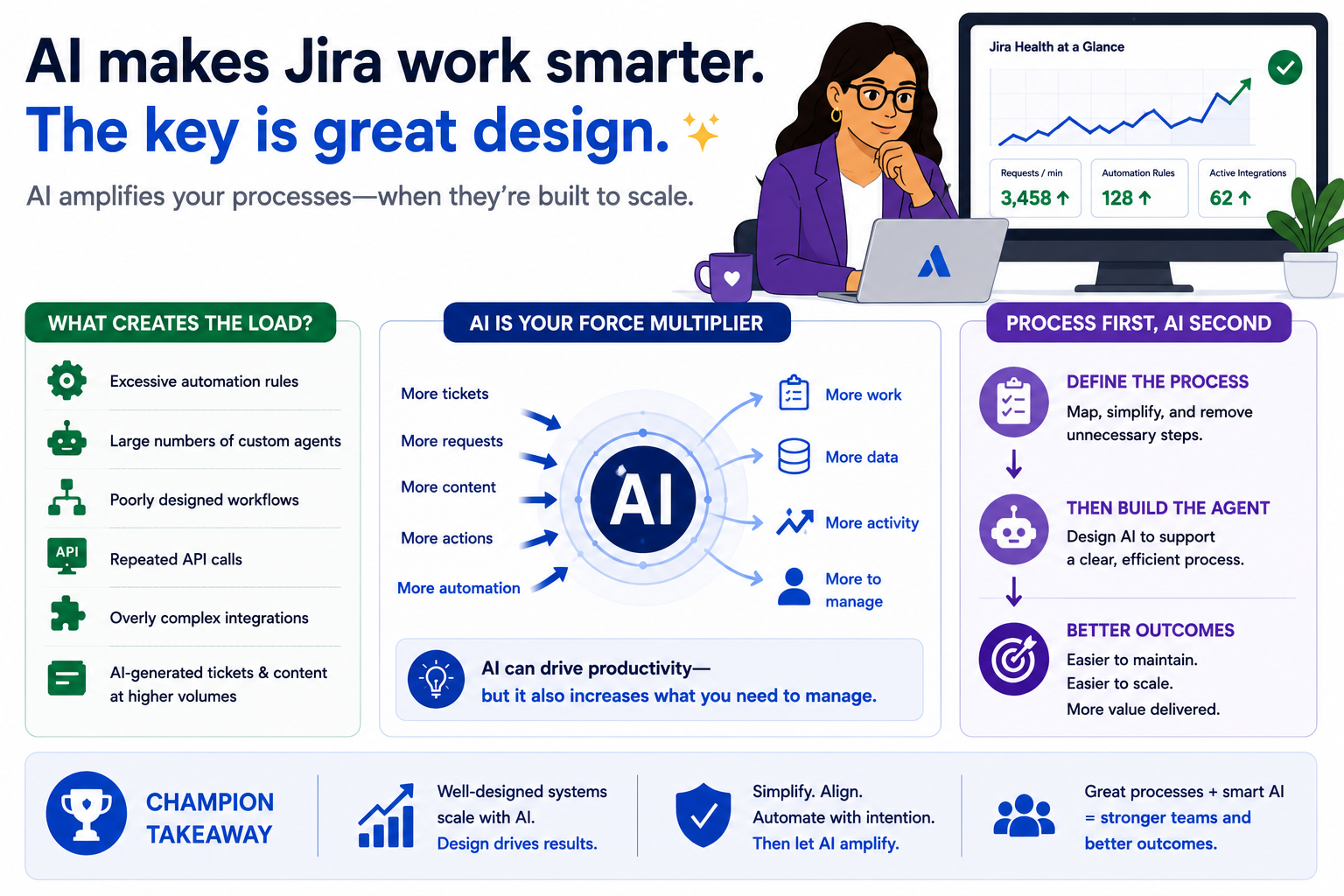
What Actually Creates the Load?
The discussion quickly moved beyond Rovo itself. In many cases, performance challenges come from:
- Excessive automation rules
- Large numbers of custom agents
- Poorly designed workflows
- Repeated API calls
- Overly complex integrations
- AI-generated tickets, requests, and content at higher volumes than before
AI isn't necessarily the bottleneck. Sometimes it is simply increasing the amount of activity flowing through the system.
The Rovo Ticket Explosion
One Champion pointed to an emerging trend: AI-generated work items. As Rovo becomes easier to use, organizations can generate:
- More tickets
- More documentation
- More requests
- More suggested work
- More automated actions
From one perspective, this can increase productivity. From another, it can create more information for teams to manage, prioritize, and maintain.
Generating work is easy. Managing the work remains the hard part.
A Process Problem Before a Rovo Problem
One observation from the discussion stood out:
First define the process, then build the agent.
Many organizations are racing to create increasingly sophisticated AI agents before simplifying the underlying process. In practice, a complicated workflow often becomes a complicated AI workflow. If a process can be simplified by half before introducing Rovo, the resulting solution is usually easier to maintain, troubleshoot, and scale.
AI rarely fixes process complexity. More often, it accelerates it.
What About Platform Stability?
There was also recognition that temporary outages and service disruptions can sometimes be mistaken for Rovo-related performance problems.
Cloud platforms experience incidents, feature rollouts, and service interruptions just like any other software platform. When troubleshooting, it is important to distinguish between:
- Platform incidents
- Configuration issues
- Automation overload
- Integration bottlenecks
- Legitimate capacity concerns
Champion Takeaway
The biggest lesson from this discussion is that AI acts as an amplifier. Well-designed processes often become more efficient. Poorly designed processes often become more visible. Before creating another agent, automation, or AI workflow, ask:
Are we solving a process problem—or automating a process problem?
The answer often determines whether Rovo reduces workload or simply generates more of it.

