A seemingly simple question sparked a surprisingly complex discussion:
If Rovo Studio creates an app for me, who owns the code?
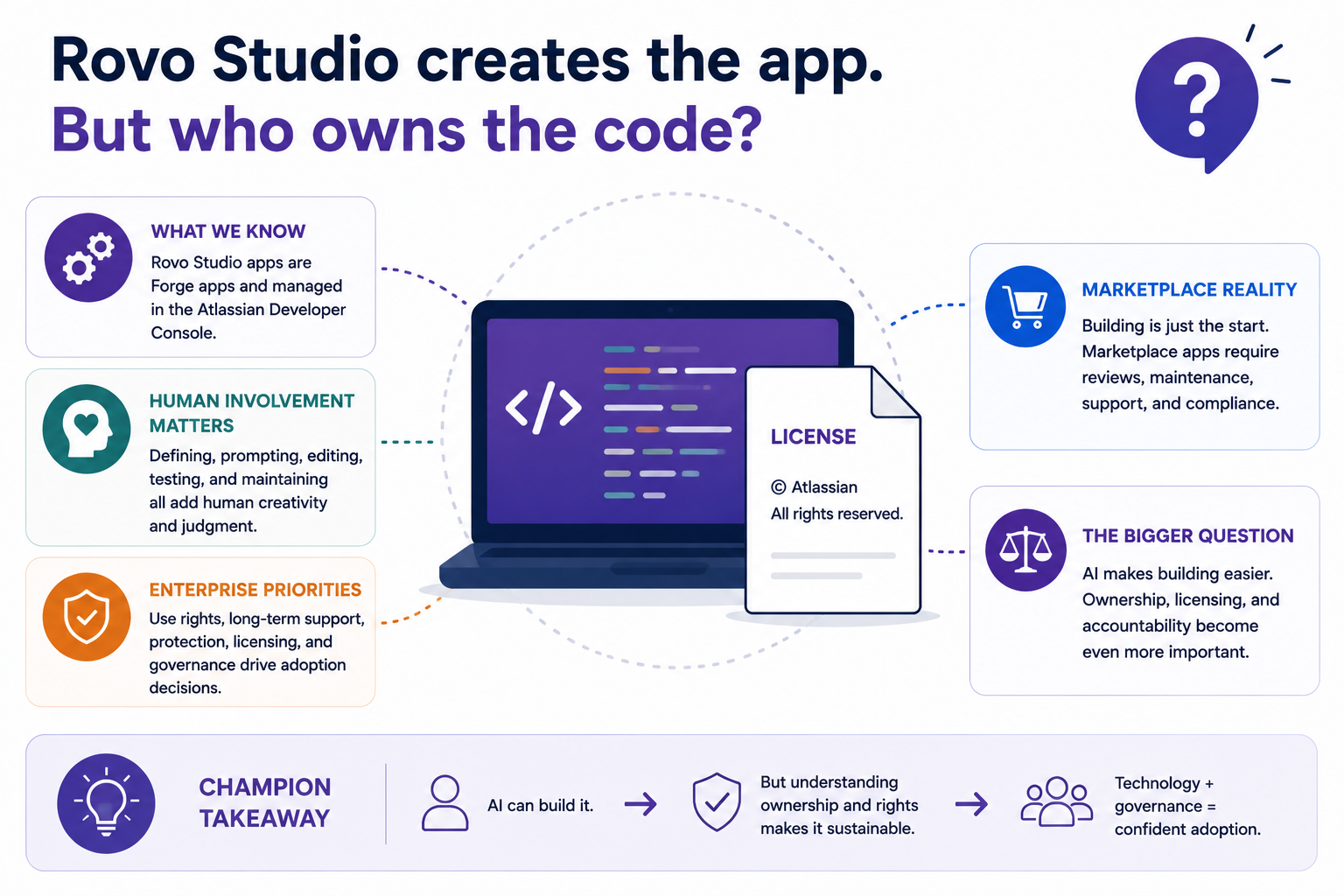
The question surfaced when @Darryl Lee downloaded the source code for a Rovo Studio-generated app and noticed a LICENSE file containing Atlassian copyright language.
Why This Question Matters
For hobby projects, the answer may not seem particularly important. But for organizations building internal tools, Marketplace apps, or commercial products, ownership can become a significant legal and business consideration. If an AI-assisted tool generates code, customers naturally want to understand:
- Who owns the application?
- Can it be commercialized?
- Can it be published?
- Can it be modified?
- What rights does the platform provider retain?
The answers are not always as straightforward as many people expect.
What We Know
Several Champions pointed out that Rovo Studio-generated apps are ultimately Forge apps. Once created, they appear in the Atlassian Developer Console alongside other Forge applications and can be managed through the same tooling.
From a technical perspective, they are not a separate category of application. However, the presence of Atlassian licensing language in generated code packages understandably raises questions about how ownership and licensing are intended to work.
The Bigger AI Ownership Debate
The conversation quickly expanded beyond Atlassian. Current copyright guidance in many jurisdictions generally centers around one principle:
Copyright protects human-created works.
Purely AI-generated output may not qualify for copyright protection on its own. However, real-world software development rarely involves a simple "AI did everything" scenario.
Human involvement often includes:
- defining requirements
- writing prompts
- selecting outputs
- editing code
- debugging
- testing
- deploying
- maintaining the application
The more human judgment and creative contribution involved, the more nuanced the ownership discussion becomes.
Why Enterprises Care
For most organizations, the question is less about copyright theory and more about risk. Legal teams often ask:
- Can we use this code internally?
- Can we support it long-term?
- Can we protect it?
- Can competitors copy it?
- Are we introducing licensing obligations we don't understand?
If those questions cannot be answered clearly, AI adoption becomes much harder. This is one reason governance conversations often appear alongside discussions about AI-generated code.
Marketplace Considerations
The discussion also touched on a practical question:
Could someone create an app with AI and immediately publish it to the Marketplace?
While AI can accelerate development, publishing a commercial application still involves:
- security reviews
- maintenance responsibilities
- support obligations
- licensing considerations
- Marketplace requirements
Building an app is only one part of the process. Operating and supporting it is another challenge entirely.
Champion Takeaway
The most interesting part of this discussion wasn't whether Atlassian owns AI-generated code or whether customers do. It was how quickly the conversation revealed a larger reality:
As AI becomes more capable, ownership, licensing, governance, and accountability become just as important as the technology itself.
Organizations aren't only asking:
Can AI build this?
They're increasingly asking:
Who owns it when it does?
And that question is likely to become more common as AI-assisted software development continues to grow.

