A recent Champions Slack discussion started when @Rebekka Heilmann _viadee_ shared Atlassian's new AI Data Contribution documentation.
The reaction was immediate.
For many organizations, one of the selling points during early Rovo adoption conversations was that customer content would not be used to train external AI models. So when Atlassian announced expanded AI data contribution and retention practices, it naturally raised questions.
Not necessarily panic. But questions.
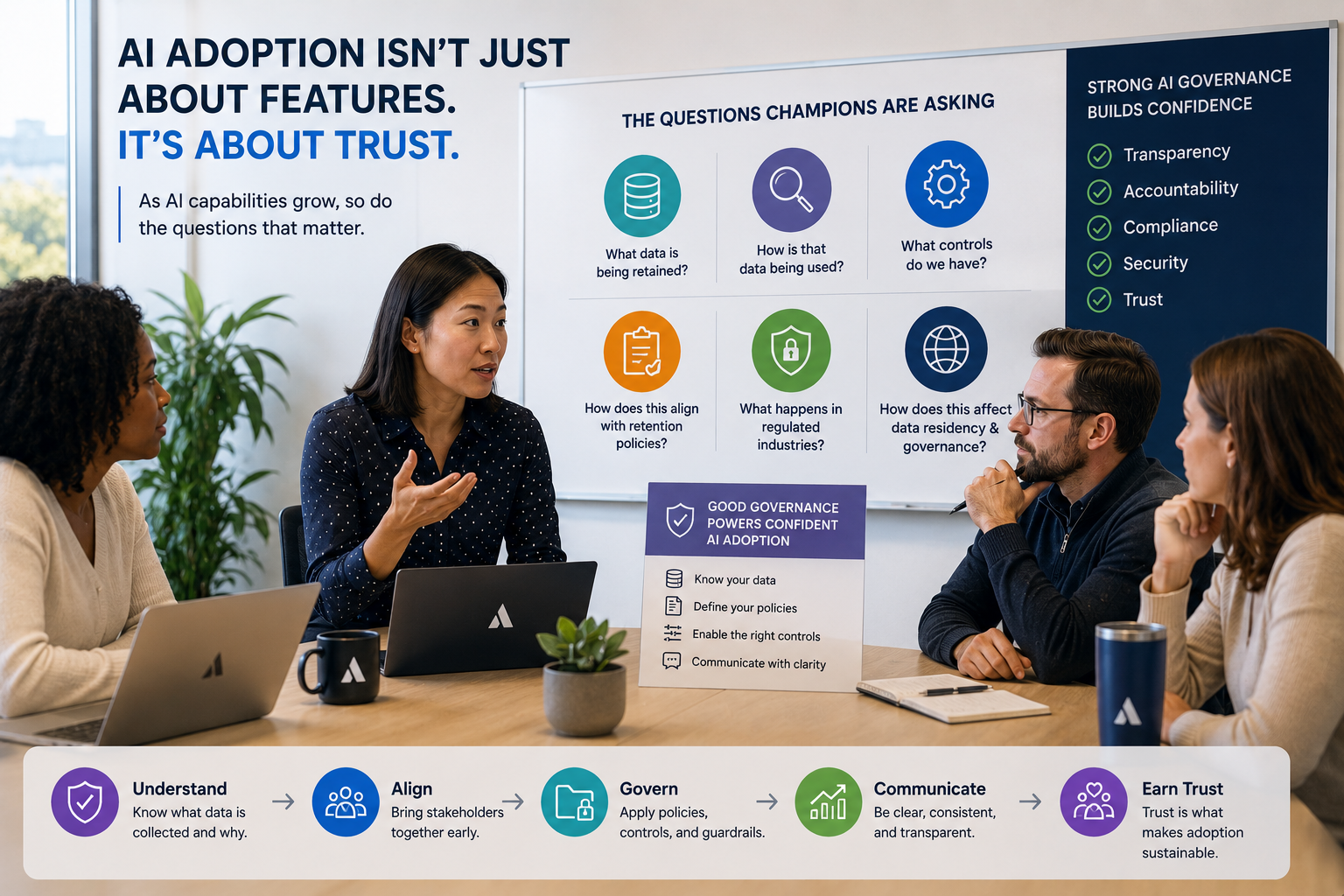
What Champions Were Really Debating
As the discussion evolved, several themes emerged:
- What data is actually being retained?
- How is that data being used?
- What controls do customers have?
- How does this align with existing retention policies?
- What happens in regulated industries?
- How does this affect data residency and governance obligations?
These are not purely technical questions. They're organizational questions.
The Trust Factor
A recurring theme was trust. Organizations approve AI tools based on a combination of:
- functionality
- security
- compliance
- vendor commitments
When data collection or retention policies change, customers naturally revisit those assumptions. That doesn't automatically make the change good or bad. It does mean customers want clarity. Particularly when legal, compliance, security, and records-management teams may all need to weigh in.
The Governance Reality
One thing this discussion reinforced is that AI governance is rapidly becoming as important as AI capabilities. A feature can be impressive. An AI assistant can be useful. But if an organization cannot clearly explain:
- what data is collected
- how long it is retained
- who can access it
- how it is used
adoption conversations become much harder.
Another Interesting Shift
The discussion also surfaced changes to Atlassian Community guidance around AI-assisted content. The updated guidance now allows AI to assist with formatting, spelling, grammar, and similar tasks, provided contributors remain responsible for the accuracy of what they post.
That reflects a broader shift we're seeing across the industry: Less focus on avoiding AI entirely. More focus on transparency and accountability.
Champion Takeaway
The most interesting part of this discussion wasn't whether Atlassian's policy is right or wrong. It was how quickly the conversation moved from AI features to governance.
Organizations evaluating AI are increasingly asking:
"What happens to our data?"
instead of simply:
"What can the AI do?"
And that's probably a sign of a maturing market. The technology is no longer the only thing being evaluated. The policies behind it are now under the microscope as well.

