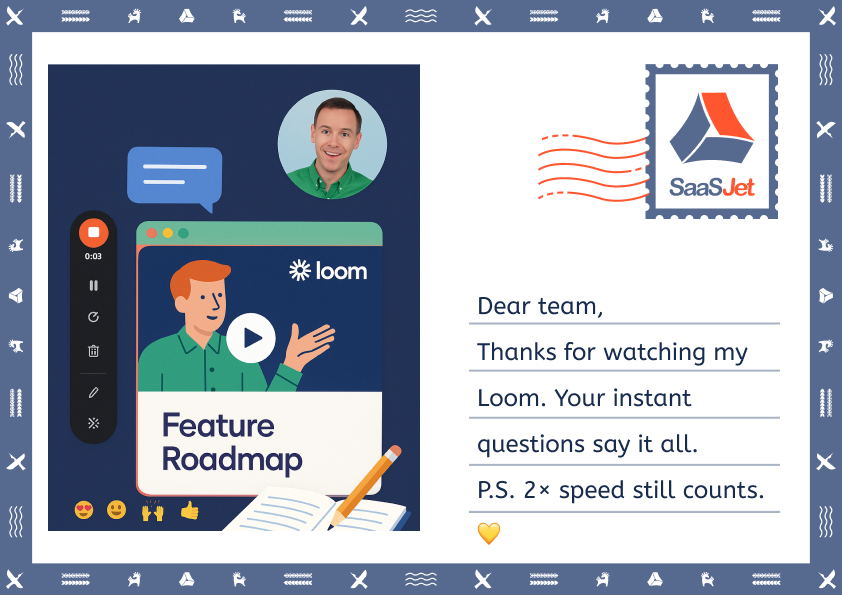
SaaSJet Advent Calendar — The Postcards We Never Sent
Async video is one of the nicest gifts we can give each other in December: fewer meetings, clearer context, and less “can you repeat that?” energy.
Today’s postcard is a gentle reminder that Loom only works when we make it easy to watch — and even easier to act on.
Why Loom videos feel ignored (and why it’s not personal)
People don’t skip your Loom because they dislike you.
They skip it because they’re busy, the video is too long, or they can’t tell what they’ll get out of it.
A Loom video competes with:
- urgent Slack messages
- Jira tickets that are already late
- “quick questions” that are never quick
- and the quiet panic of end-of-year deadlines
So if your video is 7 minutes and the first 90 seconds are “Hey everyone, just jumping in here to…” — you didn’t lose attention. You donated it to the void.
The real job of an async video
A good Loom isn’t “a meeting, but recorded.”
A good Loom is a decision-making tool.
It should do at least one of these:
- Create shared understanding (what’s happening, why it matters)
- Help someone choose (option A vs option

- Unblock action (what to do next, who owns it)
If your Loom doesn’t clearly land in one of those buckets, viewers will sense it — and postpone it forever.
How to make people actually watch your Loom video (and respond)
1) Put the outcome in the first 10 seconds
Start with:
- “This video is to decide between A and B.”
- “This is a quick walkthrough so you can review the changes.”
- “At the end, I need you to approve / comment / pick an option.”
People don’t need suspense. They need a reason.
2) Keep it under 2 minutes (unless it truly can’t be)
Most Looms should be 60 – 120 seconds.
If it’s longer, add structure:
- “0:00 goal”
- “0:20 context”
- “1:10 options”
- “2:30 recommendation”
- “3:00 next steps”
Even better: add those as quick timestamps in the message where you share the Loom.
3) Narrate decisions, not your cursor
“Now I’m clicking here… and then here…”
is a screen recording.
Instead, say:
- “Here’s the issue: the report is misleading because…”
- “Here are two approaches, trade-offs included…”
- “My recommendation is… because…”
4) End with one clear ask
Not five. One.
Examples:
- “React with ✅ if you approve Option A.”
- “Comment on the Jira ticket if you disagree.”
- “Pick one: A / B by tomorrow.”
- “I’ll move forward unless I hear objections.”
Clarity is kindness. Also: it gets responses.
Where async video delivers the most value
Here are one of the best use cases:
✅ Jira ticket walkthroughs
Perfect for: “Here’s what’s broken, here’s how to reproduce it, here’s what ‘done’ means.”
✅ Product changes + UX feedback
A 90-second Loom beats a 20-message thread trying to describe a UI issue.
✅ Release notes / “what changed” updates
Especially when teams span time zones and the same questions repeat.
✅ Stakeholder alignment
When you know a meeting would happen anyway — but you’d rather let people consume context first and show up prepared.
If you want your Loom to be watched, do this:
- make it short
- make it structured
- make the ask obvious
- and don’t hide the decision in minute 6 like it’s a plot twist
Because yes — we love async work. 💙
We just love it more when it respects our attention.
🎁 Happy Advent, and may your Loom views be real and your comments be thoughtful.


