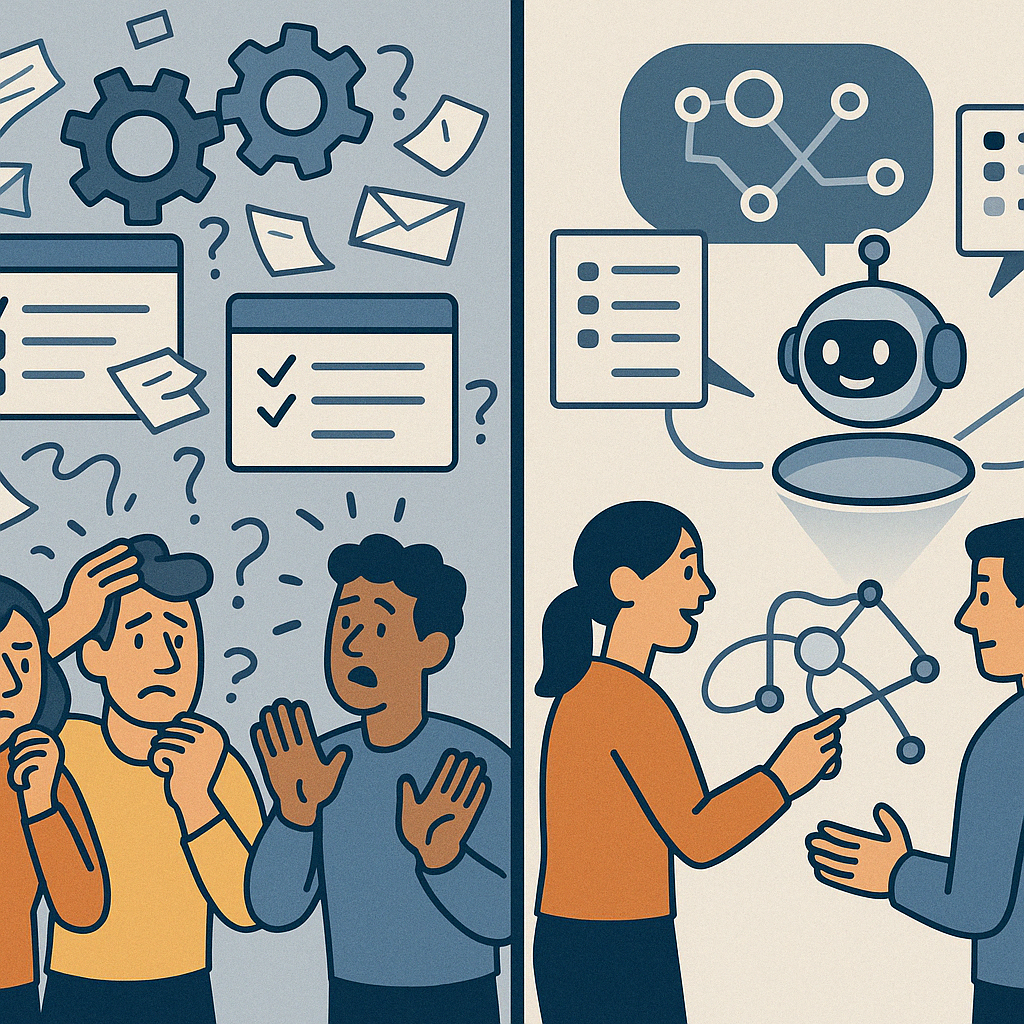
If you work in a product organization, you already know the truth: Collaboration is hard. And essential.
Earlier in my career at Google, Roblox, and several startups, I led teams that experienced this firsthand. In one case, two teams independently designed nearly identical configuration interfaces—for the same product. We caught it just in time, but only after weeks of duplicated effort and a delayed launch.
This wasn’t a planning issue. It was a collaboration failure.
Why Does Collaboration Break in Agile Teams?
In Distributed Teams
-
Distance, time zones, and cultural gaps slow decisions
-
PMs over-document to compensate (think: excessive user stories, acceptance criteria)
-
Misalignment is leading to micro-management
In Engineering-Led Orgs
-
PMs lack visibility into the real complexity of implementation
-
Engineers don’t always get the business context needed to make smart trade-offs
-
The result? Features either over-engineered or broken
In Large Enterprises
-
Multiple teams solve the same problem in isolation
-
Documentation is siloed, outdated, or both
-
Launches get delayed due to rework and confusion
Sound familiar?
If we can’t collaborate with humans today, we won’t be able to collaborate with AI agents tomorrow
AI is about to become a real co‑worker. Gartner forecasts that by 2028, autonomous “agentic AI” will make at least 15 % of everyday work decisions.
-
Developers spend just 16% of their time coding—the rest is consumed by meetings, reviews, and coordination
-
Teams waste 25% of their time just searching for context
-
Atlassian, Microsoft, and others now embed AI into Confluence, Jira, and Slack
The tech is ready. Your edge is how quickly you leverage it to identify context gaps and reduce duplicate work.
Can AI Actually Help?
Yes—but only if it’s used thoughtfully.
Here are a few collaboration-related tasks AI handles well:
-
✅ Summarizing meetings and research into key decisions
-
✅ Surfacing relevant context from past docs or tickets, just-in-time
-
✅ Flagging duplicates or gaps across projects
-
✅ Prompting better thinking before development begins
But most teams aren’t using AI this way yet. Instead, they struggle with:
-
❌ Data scattered across Confluence, Jira, Slack, GDocs, and human memory
-
❌ Resistance to AI due to fears about job replacement or loss of control
-
❌ Poor tool fit: friction, unclear value, and prompt fatigue
What Agile Teams Actually Need
If we want AI to improve collaboration (not just automate busywork), we need tools that:
📁 Keep Humans in Control — Help us think, don’t think for us
🔒 Reinforce Human Decision-Making — Clearly support, not override, judgment
↔️ Plug Into Our Workflow — Especially inside Confluence and Jira
Final Thought: Better Collaboration Starts with Better Context
We’re not just trying to help an individual get their job done faster.
We’re helping the entire team move together with more clarity and confidence.
And that starts by making sure the right people have the right context at the right time.
I'd love to hear from you:
Let’s build better loops, not bigger backlogs!

