Implementing new technologies has become an integral part of the digital transformation of enterprises that has gained momentum in the wake of the pandemic. Many companies, not only from the IT industry, then decided to switch to remote or hybrid operation. It wouldn’t be possible without appropriate tools that facilitate communication and remote cooperation of distributed teams. But that’s not all. Tools that are well matched to the needs and individual workflow of our team can noticeably increase the efficiency of work and make it more comfortable.
New technologies implementation is a strategic decision always, therefore, even made on team level need committent from organizations’ management. And that means focus on direct and indirect costs of tooling. The winners are open platforms, no-code or less-code solutions which allow rapid adoption within organization, flexibility in shaping processes, and finally – user friendliness.
In this case, when we talk about collaboration tools, we don’t mean only digital tools. Tools are not only products, but also frameworks and methodologies that improve and organize work. There are many different methodologies, but it’s impossible to say if any is better or worse. The secret is to adjust the methodology to the needs of a given project, team, and company. If we choose a methodology that supports individual workflow, we can be sure that the efficiency of our team will increase. If we decide to use an inappropriate methodology that doesn’t reflect our actual needs, it may turn out that instead of making everyday tasks easier, we have introduced an additional difficulty.
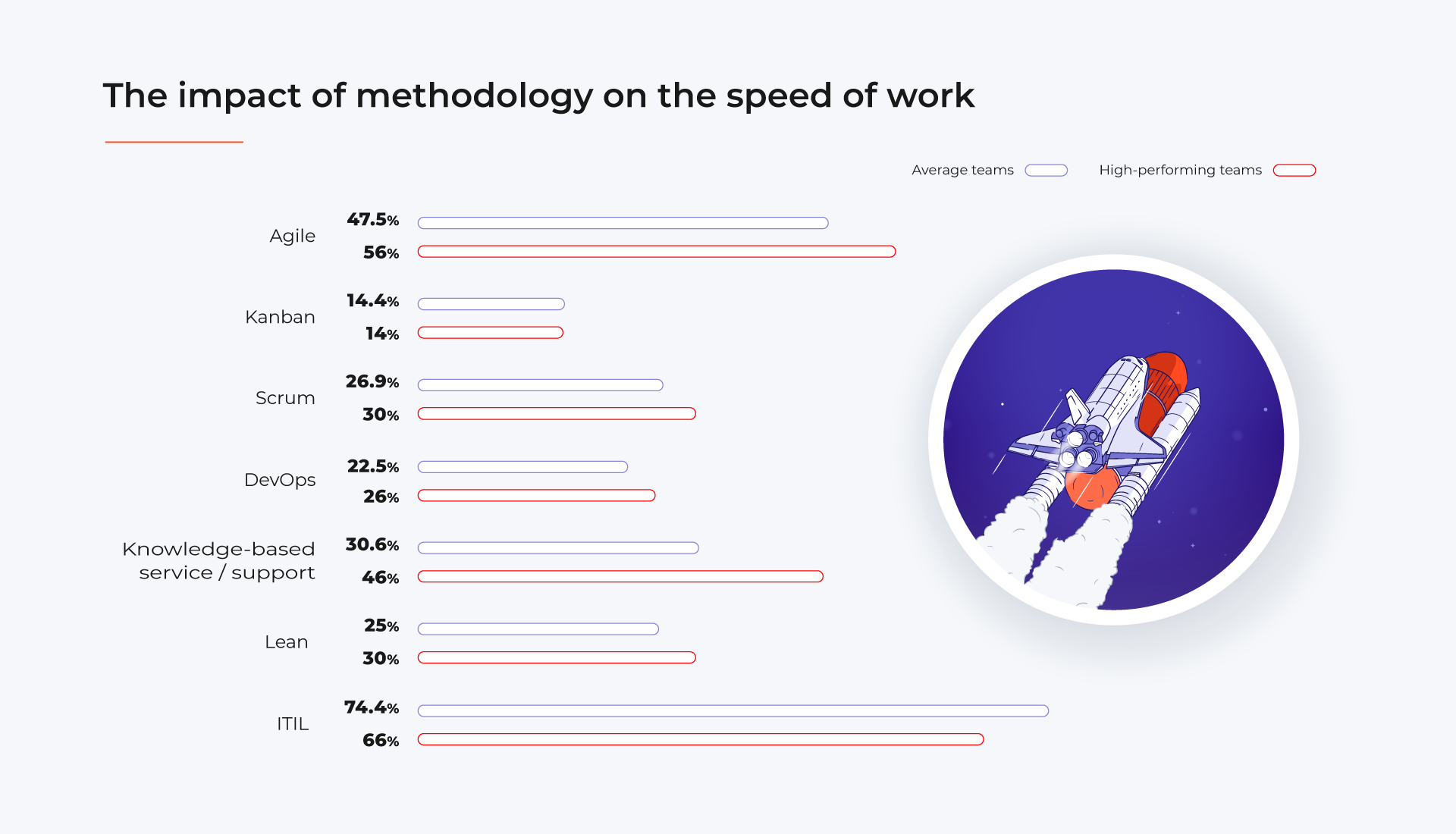
The methodology has a big impact on the speed of work. 18% of teams are more likely to use Agile methodologies, 15% of them are more likely to use DevOps methodologies. It’s hard to believe, but high-performing teams only invest too little in the ITIL technology. It’s easy to notice that ITIL is the most popular methodology from those listed above. It suggests that ITIL is truly must-have, not only for tech teams. This is mainly due to three factors:
- governance requirements – ITIL still translates the best enterprise governance needs into operational goals, while still being cooperative with agile models;
- ITIL processes, especially with modern ITIL version – v.4 are lean in their nature, and it seems that finally market understands that guidance coming from ITIL is not a conformity to the book, but adaptivity to the spirit;
- ITIL scope cover full lifecycle of business processes and supporting IT services and products, making it the most complete definition of IT world still available.
The question here is whether non-technical teams also need a work-management methodology? There is one answer, of course, they do. The best example is Agile, which can be successfully adapted to the needs of various types of teams, not only IT, but also marketing, HR, sales.
Step 4: Focus on the customer needs
Focus on the customer needs is a must. As we mentioned before, positive customer experience results in long-term business relations and truly valuable partnerships. It’s absolutely worth remembering that 100% of high-performing teams measure customer satisfaction (CSAT). They’re also more likely than other teams to use ITSM tools that support community collaboration and remote work.
We can increase customer satisfaction in some different ways. First of all, we need to know their needs and requirements. There are several ways in which information about customer needs can be collected, that will help us enhance product development. We should let our users speak and share their opinion. Therefore we should carefully gather their feedback, e.g. via customer portal. Thanks to that we can not only find out the defects in already existing products, but also receive the inspiration for creating new useful features. The other good idea is constant monitoring of customer satisfaction, using e.g. CSAT.
Step 5: Use active response
High-performing teams don’t waste time on fighting adversities and repeating tasks. They deal with basic problems through automation. 69% of them claims that the use of automation has increased in the last two years. That’s true – almost 76% of IT teams use service automation. And, what’s the most important, as a result of automation, only 8% of teams saw a decline in staff. High-performing teams are 2,5 times more likely to use problem management to avoid common emergencies.
Another way is prevention and protection against possible failures. A good example is The Phoenix Project by Kim Gene. This is the story of a team that mostly had to deal with such emergencies. After the digital transformation, the team began to introduce innovations in the company that streamline processes and even increase sales. Thanks to digitization and automation of repetitive processes, the team simply has time for it. That’s how they save time, cost, and energy for solving truly challenging problems.
How to become a highly efficient team
The secret of highly efficient team is to combine awesome customer experience with modern digital technologies. We can increase customer satisfaction by measuring CSAT indicators, linking CSAT revenues and measurements to projects, investing in proper tools that will raise the positive reactions, and managing service across the entire company. From the technical point of view, the most important is to create a digital transformation plan, use automation to solve basic problems, implement Lean and DevOps solutions, and invest in Agile and DevOps.
In general, to be effective, the team must have clearly defined goals and ways to measure their effectiveness. It’s always good to try technologies such as artificial intelligence, machine learning, or predictive analytics. But the most important at all is synchronizing the team’s ambitions with the company’s goalsand celebrate the success together.
![Photo of Martyna Wiśnik [Deviniti]](https://us.v-cdn.net/6038660/uploads/avatars/ed/ee/nedee5fc3c6babd9b86a06bfcc09534f8.png)


